Designed to make market research more actionable and strategically valuable, The Business Research Company’s 2026 market reports feature market attractiveness scoring, total addressable market sizing, company benchmarking matrices, interactive Excel dashboards, deeper supply chain intelligence, emerging startup tracking, and granular product-level insights.
How Big Is The Food Cans Market In 2026, And How Fast Will It Grow?
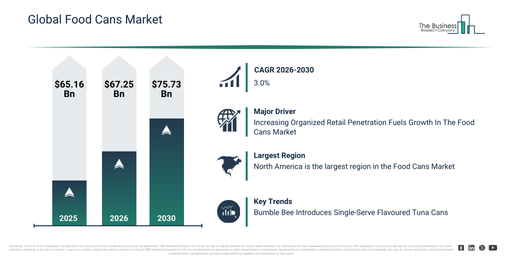
The food cans market has experienced consistent growth in recent years. It will grow from $65.16 billion in 2025 to $67.25 billion in 2026 at a compound annual growth rate (CAGR) of 3.2%. This historical expansion can be linked to factors such as increased consumption of canned foods, a growing demand for packaged meat and seafood products, greater use of aluminum and tin cans, the expansion of food processing and preservation sectors, and innovations in can manufacturing technology.
The food cans market is projected for consistent expansion over the upcoming years, reaching $75.73 billion by 2030, exhibiting a compound annual growth rate (CAGR) of 3.0%. This projected expansion is driven by a heightened demand for convenience and ready-to-eat products, a greater emphasis on sustainable and recyclable can options, the expansion of the bakery, confectionery, and beverage sectors, advancements in easy-open and embossed can technologies, and growth within the fruit, vegetable, and sauce packaging industries. Key developments anticipated during this period involve the increasing use of aluminum, steel, or tin cans for food packaging, the widespread application of 2-piece and 3-piece can constructions, the incorporation of both easy-open and standard can features, growth in packaging solutions for meat, poultry, seafood, and pet food, and improved packaging for sauces, jams, pickles, fruits, and vegetables.
Download A Free Food Cans Market Sample Report With Size And Forecast Data:
Food Cans Market Growth Driver: The Key Factor Behind Rising Demand
The food cans market is significantly propelled by the expanding presence of organized retail. This growth in organized retail is fueled by rising disposable incomes, evolving consumer tastes and preferences, shifting demographic profiles, and increased investments. Furthermore, greater Internet access and the expansion of international retailers into new countries and regions further support the organized retail sector, thereby extending the availability of diverse canned food products to consumers globally. Ultimately, the expanding presence of organized retail continues to stimulate the food cans market.
Food Cans Market Segmentation: Key Segments And Subsegments Covered
The food cans market covered in this report is segmented –
1) By Material: Aluminum Cans, Steel Or Tin Cans
2) By Product: 2-Piece Cans, 3-Piece Cans
3) By End Use: Meat, Poultry And Seafood, Sauces, Jams And Pickles, Fruits And Vegetables, Other End-Uses
Subsegments:
1) By Aluminum Cans: Standard Aluminum Food Cans, Easy-Open Aluminum Cans
2) By Steel Or Tin Cans: Tin-Plated Steel Cans, Enameled Steel Cans
Food Cans Market Trends: Key Developments Shaping 2026 And Beyond
Leading companies in the food cans market are concentrating on developing novel packaging solutions to boost convenience and attract mobile consumers. Single-serve flavored tuna cans are compact, ready-to-eat items designed to offer portion-controlled nutrition with diverse taste options. For example, in December 2025, Bumble Bee Foods, LLC, a US-based seafood company, introduced its new single-serve flavored tuna cans, which come in four distinct varieties: Lemon Pepper, Sweet Teriyaki, Smoky Bacon, and Wasabi Ginger. This product offers a convenient grab-and-go format suitable for lunches and snacks. Each can is formulated to provide a complete protein source while maintaining freshness and flavor without requiring additional preparation. The packaging also prioritizes portability and ease of use, making it ideal for busy consumers looking for quick and nutritious meal alternatives. This new range enhances Bumble Bee’s product portfolio by combining flavor innovation with consumer-centric convenience.
Leading Companies Operating In The Food Cans Market
Major companies operating in the food cans market report are Crown Holdings Inc., Ball Corporation, Ardagh Group S.A, Silgan Holdings Inc., Toyo Seikan Group Holdings Ltd, Can-Pack S.A, CPMC Holdings Limited, Visy Industries, Nampak Products Ltd, Metal Container Corporation, Kian Joo Can Factory Berhad, Independent Can Company, Jamestrong Packaging, Avon Crowncaps & Containers Nig. Plc, TinPak Pvt Ltd, Ton Yi Industrial, Sonoco Products Company, Colep Portugal S.A., Allstate Can Corporation, Universal Can Corporation, Thai Can Manufacturing Co. Ltd
Access The Full Food Cans Market Research Report:
Food Cans Market Regional Analysis: Largest Region And Key Geographies Covered
North America was the largest region in the food cans market in 2025. Asia-Pacific is expected to be the fastest-growing region in the forecast period. The regions covered in the food cans market are Asia-Pacific, South East Asia, Western Europe, Eastern Europe, North America, South America, Middle East, Africa.
Reach Out To Our Team:
The Business Research Company: https://www.thebusinessresearchcompany.com/
Americas: +1 310-496-7795
Asia: +44 7882 955267 & +91 8897263534
Europe: +44 7882 955267
Email us at: marketing@tbrc.info
Follow us on:
LinkedIn: https://in.linkedin.com/company/the-business-research-company
YouTube: https://www.youtube.com/channel/UC24_fI0rV8cR5DxlCpgmyFQ
Global Market Model: https://www.thebusinessresearchcompany.com/global-market-model

Wasay has over a decade of experience in market research, data modelling, and analytics, with prior experience at GlobalData and Decision Tree Consulting Services. At The Business Research Company , he leads research operations across syndicated studies, customized consulting engagements, and the Global Market Model platform. His professional experience includes supporting organizations such as Boston Consulting Group, KPMG, and Ernst & Young. Wasay holds a degree in Electronics and Communications Engineering, postgraduate management qualifications from International Management Institute Belgium and Indian School of Business and Entrepreneurship, and completed the Integrated Program in Business Analytics from Indian Institute of Management Indore.