With a focus on actionable insights and strategic value, The Business Research Company’s 2026 market reports include market attractiveness scoring, total addressable market sizing, company benchmarking matrices, interactive Excel dashboards, deeper supply chain intelligence, emerging startup tracking, and granular product-level insights.
Front End Reinforcement Bars Market Size Analysis: Historical Growth And Future Revenue Projections
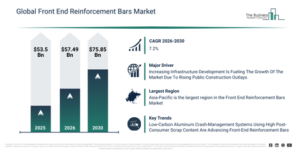
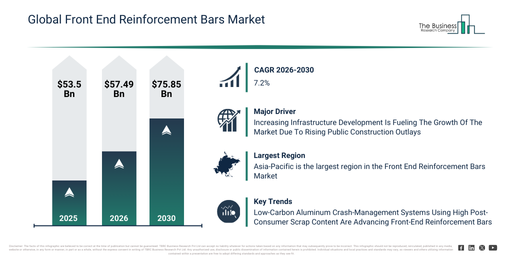
The market size for front end reinforcement bars has shown robust expansion in recent years. This market is projected to expand from $53.5 billion in 2025 to $57.49 billion in 2026, exhibiting a compound annual growth rate (CAGR) of 7.5%. Historically, this growth has been driven by factors such as an increase in automotive production, stricter safety regulations and crash-test standards, a greater need for durable and high-strength materials, the expansion of commercial and residential vehicle fleets, and advancements in steel and aluminum processing technologies.
The market for front end reinforcement bars is anticipated to experience substantial expansion in the coming years. It will grow to $75.85 billion in 2030 at a compound annual growth rate (CAGR) of 7.2%. This projected growth throughout the forecast period stems from factors such as increased adoption of electric and hybrid vehicles, a heightened focus on vehicle safety, an escalating demand for lightweight composite materials, the proliferation of automotive infrastructure developments, and an emphasis on advanced corrosion-resistant and high-performance reinforcement bars. Key trends anticipated during this period encompass the increasing integration of high-strength steel and aluminum front end reinforcement bars, a greater utilization of composite materials within crash boxes, the broadening application of front end reinforcement bars in automotive safety systems, an intensified focus on vehicle designs that are both lightweight and fuel-efficient, and a growing preference for reinforcement bars offering enhanced corrosion resistance and extended lifespan.
Preview The Front End Reinforcement Bars Market Report With A Free Sample:
Front End Reinforcement Bars Market Drivers: What Is Fueling Demand Through 2030?
Growing infrastructure construction is projected to boost the expansion of the front end reinforcement bars market in the future. This development encompasses the construction and improvement of communal assets like highways, bridges, public transport systems, water and sewage infrastructure, airports, and energy transmission routes. The surge in infrastructure development stems from increased government spending aimed at replacing outdated assets and enhancing capacity for transportation, logistics, and city services. Front-end reinforcement bars are advantageous for infrastructure initiatives as they improve the tensile strength of concrete constructions, enabling them to resist substantial loads and environmental pressures without fracturing or distorting. Consequently, the expanding infrastructure development is fueling the growth of the front end reinforcement bars market.
Front End Reinforcement Bars Market Segmentation Analysis: Core Categories And Subcategories
The front end reinforcement bars market covered in this report is segmented –
1) By Product Type: Steel Bars, Aluminum Bars, Composite Bars, Other Product Types
2) By Distribution Channel: Direct Sales, Distributors Or Wholesalers, Online Retail, Other Distribution Channels
3) By Application (Vehicle Type): Passenger Cars, Sport Utility Vehicle (SUVs) And Crossovers, Light Commercial Vehicles (LCVs), Heavy Commercial Vehicles (HCVs), Electric Vehicles (EVs)
4) By End-User: Automobile Manufacturers (OEMs), Automotive Component Suppliers, Aftermarket Or Replacement Parts Providers, Other End-Users
Subsegments:
1) By Steel Bars: High-Strength Low-Alloy (HSLA) Steel Bars, Stainless Steel Bars, Galvanized Steel Bars
2) By Aluminum Bars: Extruded Aluminum Bars, High-Strength Aluminum Alloy Bars
3) By Composite Bars: Fiber Reinforced Polymer (FRP) Bars, Basalt Fiber Reinforced Bars, Carbon Fiber Reinforced Bars
4) By Other Product Types: Epoxy Coated Bars, Micro-Alloyed Bars
Which Trends Will Define The Front End Reinforcement Bars Market Through 2030?
Key players in the front end reinforcement bars market are concentrating on creating low-carbon aluminum crash-management systems (CMS) to decrease embodied carbon without compromising crash performance. A crash-management system involves an integrated front-end structure, comprising the front bumper beam (which is the reinforcement bar), crush cans, and energy absorbers, all designed to absorb and redistribute impact energy to safeguard occupants. When these systems are constructed from high-recycled 6xxx aluminum alloys, they contribute to weight reduction and lower lifecycle emissions while preserving strength. For example, in September 2025, Constellium, an aluminum product provider based in France, introduced prototypes of crash-management systems (CMS) at Cenex 2025. These prototypes were manufactured using over 90% post-consumer aluminum scrap, based on their high-strength alloy platform, with the objective of maintaining embodied CO₂ below approximately 2 tCO₂ per ton of aluminum. These lightweight front bumper beams deliver high energy absorption with significantly reduced embedded CO₂, aligning with automotive manufacturers’ objectives for sustainability and enhanced range efficiency via decreased vehicle mass. They serve as the main crash-load path at the vehicle’s front, boosting occupant safety and enabling the creation of repairable and modular front-end structures.
Front End Reinforcement Bars Market Major Companies And Industry Participants
Major companies operating in the front end reinforcement bars market report are ArcelorMittal SA, POSCO Holdings, Nippon Steel Corp., Hebei Iron and Steel Group Co. Ltd., Thyssenkrupp AG, Nucor Corporation, Tata Steel Limited, JSW Steel Limited, Hyundai Steel Company, Kobe Steel Limited, Ternium SA, Voestalpine Group, Novolipetsk Steel Group, Gerdau Sociedade Anônima, Reliance Steel & Aluminum Co., Steel Authority of India Limited, SSAB AB, Shagang Group Company Limited, Commercial Metals Company, Jindal Steel & Power Limited.
Buy The Full Front End Reinforcement Bars Global Market Report 2026:
Front End Reinforcement Bars Market Geographic Analysis: Which Region Accounts For The Biggest Share?
Asia-Pacific was the largest region in the front end reinforcement bars market in 2025. North America is expected to be the fastest-growing region in the forecast period. The regions covered in the front end reinforcement bars market are Asia-Pacific, South East Asia, Western Europe, Eastern Europe, North America, South America, Middle East, Africa.
Reach Out To Our Team:
The Business Research Company: https://www.thebusinessresearchcompany.com/
Americas: +1 310-496-7795
Asia: +44 7882 955267 & +91 8897263534
Europe: +44 7882 955267
Email us at: marketing@tbrc.info
Follow us on:
LinkedIn: https://in.linkedin.com/company/the-business-research-company
YouTube: https://www.youtube.com/channel/UC24_fI0rV8cR5DxlCpgmyFQ
Global Market Model: https://www.thebusinessresearchcompany.com/global-market-model

Wasay has over a decade of experience in market research, data modelling, and analytics, with prior experience at GlobalData and Decision Tree Consulting Services. At The Business Research Company , he leads research operations across syndicated studies, customized consulting engagements, and the Global Market Model platform. His professional experience includes supporting organizations such as Boston Consulting Group, KPMG, and Ernst & Young. Wasay holds a degree in Electronics and Communications Engineering, postgraduate management qualifications from International Management Institute Belgium and Indian School of Business and Entrepreneurship, and completed the Integrated Program in Business Analytics from Indian Institute of Management Indore.