Designed to make market research more actionable and strategically valuable, The Business Research Company’s 2026 market reports feature market attractiveness scoring, total addressable market sizing, company benchmarking matrices, interactive Excel dashboards, deeper supply chain intelligence, emerging startup tracking, and granular product-level insights.
How Big Is The Magnetic Beads Market In 2026, And How Fast Will It Grow?
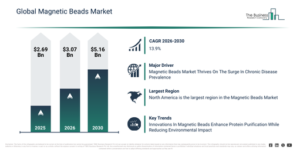
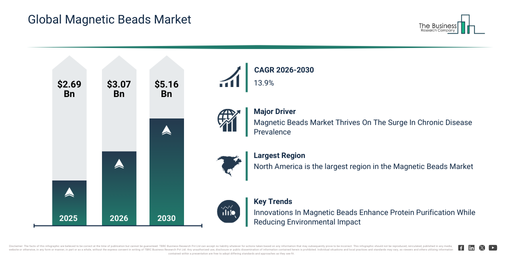
The magnetic beads market size has seen rapid expansion in recent years. It is anticipated to expand from $2.69 billion in 2025 to $3.07 billion in 2026, exhibiting a compound annual growth rate (CAGR) of 14.0%. This historical growth can be attributed to advancements in molecular biology research, the expansion of biotechnology and pharmaceutical industries, a rise in applications within genomics and proteomics, the widespread adoption of magnetic bead-based sample preparation techniques, and increasing investments in research laboratories.
The magnetic beads market is projected for significant expansion over the coming years, anticipated to reach $5.16 billion by 2030, demonstrating a compound annual growth rate (CAGR) of 13.9%. This projected growth stems from factors such as increasing demand for personalized medicine, advancements in IVD assay development, expanded research in cell therapy, wider adoption in clinical diagnostics, and technological enhancements in bead functionalization. Key trends during this period are expected to encompass the broader application of nucleic acid isolation, developments in protein purification and sample preparation, greater integration into cell separation and expansion processes, increased utilization in IVD assay development, and improved functionalization of magnetic beads for specific applications.
Download A Free Magnetic Beads Market Sample Report With Size And Forecast Data:
Magnetic Beads Market Growth Driver: The Key Factor Behind Rising Demand
The growing prevalence of chronic diseases is anticipated to act as a significant driver for the magnetic beads market. Chronic conditions, such as cancer, diabetes, and heart diseases, are generally characterized as lasting a year or more, requiring continuous medical attention, or limiting daily activities. The increasing occurrence of these illnesses generates a heightened demand for advanced diagnostic technologies utilizing magnetic beads for efficient and cost-effective diagnosis. The application of magnetic beads eliminates the necessity for vacuum or centrifugation, thereby reducing the stress on target molecules, and also streamlines the process by requiring fewer steps and reagents. Consequently, the rising incidence of chronic diseases is poised to drive the magnetic beads market during the forecast period.
Magnetic Beads Market Segmentation: Key Segments And Subsegments Covered
The magnetic beads market covered in this report is segmented –
1) By Type: Cell Microbes, Nucleic Acids, Proteins
2) By Magnetic Core: Superparamagnetic, Composite Or Polymer-Coated Iron Oxide Beads
3) By Application: Protein Sample Preparation And Protein Purification, IVD Assay Development, Nucleic Acid Isolation, Immunoprecipitation, Antibody Purification
4) By End User: Healthcare Facilities, Individual Pathology Labs, Research Labs
Subsegments:
1) By Cell Microbes: Bacterial Cells, Yeast Cells, Mammalian Cells
2) By Nucleic Acids: DNA Magnetic Beads, RNA Magnetic Beads, Plasmid DNA Magnetic Beads
3) By Proteins: Antibody-Conjugated Magnetic Beads, Enzyme-Conjugated Magnetic Beads, Peptide-Conjugated Magnetic Beads
Magnetic Beads Market Trends: Key Developments Shaping 2026 And Beyond
Leading companies operating in the magnetic beads market are focusing on developing advanced solutions, such as microplastic-free magnetic beads, to enhance protein purification efficiency, reduce environmental impact, and support sustainable laboratory practices. These microplastic-free magnetic beads are bead products engineered without traditional plastic components, maintaining high magnetic responsiveness and target capture performance while lowering their environmental footprint.
Leading Companies Operating In The Magnetic Beads Market
Major companies operating in the magnetic beads market report are Thermo Fisher Scientific Inc., Merck KGaA, Bio-Rad Laboratories Inc., Qiagen N.V., Miltenyi Biotec, Promega Corporation, Takara Bio Inc., GenScript Biotech Corporation, Bangs Laboratories Inc., Spherotech Inc., New England Biolabs Inc., Roche Holding AG, Cytiva, Luminex Corporation, Micromod Partikeltechnologie GmbH, Ademtech, Chemicell GmbH, Ocean NanoTech LLC, MagQu Co. Ltd., BioClone Inc., Creative Diagnostics, Cube Biotech GmbH
Access The Full Magnetic Beads Market Research Report:
Magnetic Beads Market Regional Analysis: Largest Region And Key Geographies Covered
North America was the largest region in the magnetic beads market in 2025. Eastern Europe is expected to be the fastest-growing region in the forecast period. The regions covered in the magnetic beads market are Asia-Pacific, South East Asia, Western Europe, Eastern Europe, North America, South America, Middle East, Africa.
Reach Out To Our Team:
The Business Research Company: https://www.thebusinessresearchcompany.com/
Americas: +1 310-496-7795
Asia: +44 7882 955267 & +91 8897263534
Europe: +44 7882 955267
Email us at: marketing@tbrc.info
Follow us on:
LinkedIn: https://in.linkedin.com/company/the-business-research-company
YouTube: https://www.youtube.com/channel/UC24_fI0rV8cR5DxlCpgmyFQ
Global Market Model: https://www.thebusinessresearchcompany.com/global-market-model

Wasay has over a decade of experience in market research, data modelling, and analytics, with prior experience at GlobalData and Decision Tree Consulting Services. At The Business Research Company , he leads research operations across syndicated studies, customized consulting engagements, and the Global Market Model platform. His professional experience includes supporting organizations such as Boston Consulting Group, KPMG, and Ernst & Young. Wasay holds a degree in Electronics and Communications Engineering, postgraduate management qualifications from International Management Institute Belgium and Indian School of Business and Entrepreneurship, and completed the Integrated Program in Business Analytics from Indian Institute of Management Indore.