Designed to make market research more actionable and strategically valuable, The Business Research Company’s 2026 market reports feature market attractiveness scoring, total addressable market sizing, company benchmarking matrices, interactive Excel dashboards, deeper supply chain intelligence, emerging startup tracking, and granular product-level insights.
How Fast Is The Ceramic Matrix Composites Market Growing? Market Size, CAGR And Forecast Insights
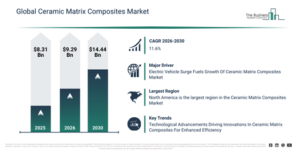
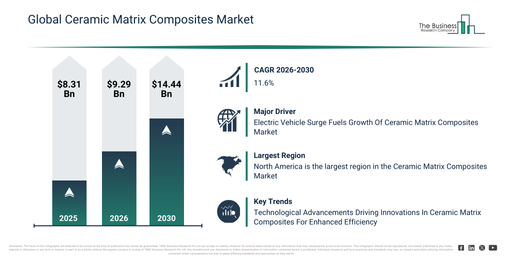
The ceramic matrix composites market has experienced rapid expansion in recent years. This market is projected to grow from $8.31 billion in 2025 to $9.29 billion in 2026, demonstrating a compound annual growth rate (CAGR) of 11.8%. Historically, this growth can be attributed to advancements in ceramic processing technologies, increased defense and aerospace spending, the demand for materials with superior thermal stability, the expansion of high-performance industrial applications, and early adoption in aerospace propulsion systems.
The ceramic matrix composites market is projected to experience substantial expansion in the coming years. It is anticipated to reach $14.44 billion by 2030, exhibiting a compound annual growth rate (CAGR) of 11.6%. The primary drivers for this growth during the forecast period include the increasing adoption of electric and hybrid propulsion systems, a rising demand for fuel-efficient aircraft components, the expansion of renewable energy and power generation systems, growing investments in advanced materials research, and the increasing application of cmcs in high-performance automotive parts. Key trends anticipated during this period encompass the growing adoption of high-temperature resistant materials, the expanding utilization of ceramic matrix composites in aerospace components, a heightened demand for lightweight and high-strength materials, the proliferation of advanced manufacturing techniques for cmcs, and their increasing application in energy and power systems.
Unlock Ceramic Matrix Composites Market Insights With A Free Sample Report:
Ceramic Matrix Composites Market Momentum: Key Driver Expected To Boost Growth Through 2030
The escalating demand for electric vehicles is poised to positively affect the ceramic matrix composites market. Ceramic matrix composites are increasingly being utilized in hybrid vehicles, and given their characteristics and behavior, they demonstrate significant potential for application in both electric and hybrid vehicles. For the automotive industry, the primary benefits of ceramic matrix composites in reducing car weight are fuel savings, and for electric vehicles, increased driving times before needing to recharge. Therefore, the growing demand for electric vehicles will stimulate the ceramic matrix composites market’s growth.
Ceramic Matrix Composites Market Segments: A Category-By-Category Overview
The ceramic matrix composites market covered in this report is segmented –
1) By Type: Oxide, Carbon/Silicon Carbide, Silicon Carbide
2) By Category: Short Fiber, Long Continuous Fiber
3) By Production Method: Powder Dispersion, Reactive Melt Infiltration, Polymer Impregnation And Pyrolysis, Gaseous Infiltration, Chemical Vapor Infiltration
4) By End-Use Industry: Aerospace And Defense, Automotive, Energy And Power
Subsegments:
1) By Oxide: Alumina/Alumina Composites, Zirconia/Zirconia Composites
2) By Carbon/Silicon Carbide: Carbon Fiber-Reinforced Silicon Carbide (C/SiC), Silicon Carbide Matrix Composites
3) By Silicon Carbide: SiC Fiber-Reinforced SiC Composites, SiC Matrix Composites
Which Emerging Trends Are Gaining Traction In The Ceramic Matrix Composites Market?
Major companies operating in the ceramic matrix composites market are increasingly focusing on adopting advanced technologies like carbon fiber-reinforced ceramic matrix composites to secure a competitive advantage by offering lightweight, durable materials for high-performance applications. Carbon fiber-reinforced ceramic matrix composites (C/C CMCs) integrate the lightweight and high-strength attributes of carbon fibers with the high-temperature resistance and longevity of ceramic matrices, making them perfectly suited for demanding uses in the aerospace, defense, and industrial sectors.
Ceramic Matrix Composites Market Key Participants: Prominent Companies At A Glance
Major companies operating in the ceramic matrix composites market report are General Electric Company, Safran, Rolls Royce plc, RTX Corporation, MTU Aero Engines, Aerojet Rocketdyne, Spirit AeroSystems, Boeing, Airbus, SGL Carbon, CoorsTek Inc, CeramTec GmbH, Morgan Advanced Materials, Kyocera Corporation, Ultramet, COI Ceramics, Lancer Systems, CFC Carbon Co Ltd, ZhongAo Carbon, DJT Carbon Co Ltd
Get Detailed Ceramic Matrix Composites Market Forecasts In The Complete Report:
Top Region In The Ceramic Matrix Composites Market: A Global Perspective
North America will be the largest region in the ceramic matrix composites market in 2025. North America is expected to be the fastest-growing region in the forecast period. The regions covered in the ceramic matrix composites market are Asia-Pacific, South East Asia, Western Europe, Eastern Europe, North America, South America, Middle East, Africa.
Reach Out To Our Team:
The Business Research Company: https://www.thebusinessresearchcompany.com/
Americas: +1 310-496-7795
Asia: +44 7882 955267 & +91 8897263534
Europe: +44 7882 955267
Email us at: marketing@tbrc.info
Follow us on:
LinkedIn: https://in.linkedin.com/company/the-business-research-company
YouTube: https://www.youtube.com/channel/UC24_fI0rV8cR5DxlCpgmyFQ
Global Market Model: https://www.thebusinessresearchcompany.com/global-market-model

Wasay has over a decade of experience in market research, data modelling, and analytics, with prior experience at GlobalData and Decision Tree Consulting Services. At The Business Research Company , he leads research operations across syndicated studies, customized consulting engagements, and the Global Market Model platform. His professional experience includes supporting organizations such as Boston Consulting Group, KPMG, and Ernst & Young. Wasay holds a degree in Electronics and Communications Engineering, postgraduate management qualifications from International Management Institute Belgium and Indian School of Business and Entrepreneurship, and completed the Integrated Program in Business Analytics from Indian Institute of Management Indore.