Designed to make market research more actionable and strategically valuable, The Business Research Company’s 2026 market reports feature market attractiveness scoring, total addressable market sizing, company benchmarking matrices, interactive Excel dashboards, deeper supply chain intelligence, emerging startup tracking, and granular product-level insights.
How Big Is The Microfluidics Market In 2026, And How Fast Will It Grow?
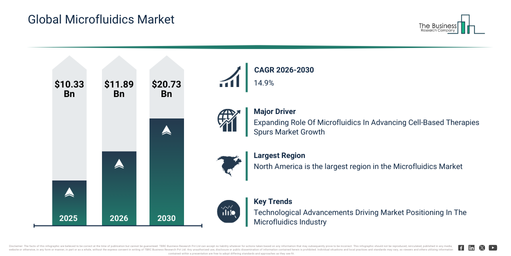
The microfluidics market size has experienced rapid expansion in recent years. This market is projected to expand from $10.33 billion in 2025 to $11.89 billion in 2026, exhibiting a compound annual growth rate (CAGR) of 15.0%. Historically, this growth has been fueled by factors such as the rise in laboratory-on-a-chip research, increasing demand for compact diagnostic devices, integration into pharmaceutical R&D, broader analytical and clinical testing, and advancements in silicon and glass-based microfluidic device development.
The microfluidics market is anticipated to undergo significant expansion in the upcoming years. It is forecast to attain a value of $20.73 billion by 2030, growing at a compound annual growth rate (CAGR) of 14.9%. This projected increase during the forecast period is driven by factors such as the growing adoption in point-of-care diagnostics, the expansion of personalized medicine applications, the proliferation of polymer-based microfluidics, increased integration with IoT and smart lab systems, and improvements in high-throughput screening technologies. Noteworthy trends for this period encompass the incorporation of microfluidics into drug delivery systems, its increased use in clinical diagnostics, the broadening of its applications in pharmaceutical and life science research, the development of industrial and environmental microfluidics solutions, and advancements in technologies for high-precision fluid manipulation.
Download A Free Microfluidics Market Sample Report With Size And Forecast Data:
Microfluidics Market Growth Driver: The Key Factor Behind Rising Demand
A rise in clinical studies for cell-based therapies contributed to the expansion of the microfluidics market historically. Microfluidics presents a promising platform to advance biomanufacturing in drug, gene, or cell therapies by improving the synthesis of nanoscale drug/gene delivery systems, enabling microencapsulation of drugs or cells, facilitating intracellular delivery of macromolecules, and fabricating macroscale constructs from micro-nano-fibers.
Microfluidics Market Segmentation: Key Segments And Subsegments Covered
The microfluidics market covered in this report is segmented –
1) By Material: Silicon-Based Microfluidics, Glass-Based Microfluidics, Polymer-Based Microfluidics
2) By Technology: Droplet-Based Microfluidics, Continuous-Flow Microfluidics, Digital Microfluidics, Paper-Based Microfluidics, Centrifugal Microfluidics, Organ-on-a-Chip Platforms
3) By Application: Industrial And Environmental, Drug Delivery, Pharmaceutical And Life Science Research, Analysis, Clinical And Veterinary Diagnostics
Subsegments:
1) By Silicon-Based Microfluidics: Bulk Micromachined Silicon, Silicon-on-Insulator (SOI), Nano-Structured Silicon
2) By Glass-Based Microfluidics: Borosilicate Glass, Fused Silica Glass, Soda-Lime Glass
3) By Polymer-Based Microfluidics: Polydimethylsiloxane (PDMS), Poly(methyl methacrylate) (PMMA), Polycarbonate (PC)
Microfluidics Market Trends: Key Developments Shaping 2026 And Beyond
Major companies operating in the microfluidics market are focusing on creating advanced solutions, including lab-on-a-chip devices and integrated microfluidic platforms, to boost diagnostic accuracy, decrease sample processing duration, and elevate point-of-care testing functionalities. Lab-on-a-chip devices are miniaturized systems designed to integrate multiple laboratory functions on a single chip, facilitating quicker and more precise analyses with minimal sample volumes.
Leading Companies Operating In The Microfluidics Market
Major companies operating in the microfluidics market report are Thermo Fisher Scientific, Agilent Technologies, Bio-Rad Laboratories, Fluidigm Corporation, Dolomite Microfluidics, PerkinElmer, Inc., Sphere Fluidics Limited, Micronit Micro Technologies B.V., Fluigent, Elveflow, Cellix Ltd., Microliquid S.L., Biosurfit S.A., FlowJEM, uFluidix, QuantWave Technologies Inc., Harvard Bioscience, Inc., Abaxis, Inc., OPKO Health, Inc., Abbott, Stämm
Access The Full Microfluidics Market Research Report:
Microfluidics Market Regional Analysis: Largest Region And Key Geographies Covered
North America was the largest region in the microfluidics market in 2025. North America is expected to be the fastest-growing region in the forecast period. The regions covered in the microfluidics market are Asia-Pacific, South East Asia, Western Europe, Eastern Europe, North America, South America, Middle East, Africa.
Reach Out To Our Team:
The Business Research Company: https://www.thebusinessresearchcompany.com/
Americas: +1 310-496-7795
Asia: +44 7882 955267 & +91 8897263534
Europe: +44 7882 955267
Email us at: marketing@tbrc.info
Follow us on:
LinkedIn: https://in.linkedin.com/company/the-business-research-company
YouTube: https://www.youtube.com/channel/UC24_fI0rV8cR5DxlCpgmyFQ
Global Market Model: https://www.thebusinessresearchcompany.com/global-market-model

Wasay has over a decade of experience in market research, data modelling, and analytics, with prior experience at GlobalData and Decision Tree Consulting Services. At The Business Research Company , he leads research operations across syndicated studies, customized consulting engagements, and the Global Market Model platform. His professional experience includes supporting organizations such as Boston Consulting Group, KPMG, and Ernst & Young. Wasay holds a degree in Electronics and Communications Engineering, postgraduate management qualifications from International Management Institute Belgium and Indian School of Business and Entrepreneurship, and completed the Integrated Program in Business Analytics from Indian Institute of Management Indore.