With a focus on actionable insights and strategic value, The Business Research Company’s 2026 market reports include market attractiveness scoring, total addressable market sizing, company benchmarking matrices, interactive Excel dashboards, deeper supply chain intelligence, emerging startup tracking, and granular product-level insights.
Prismatic Cell Assembly Automation Market Size Outlook: A $4.25 Billion Market By 2030, Growing At 12.8% Annually
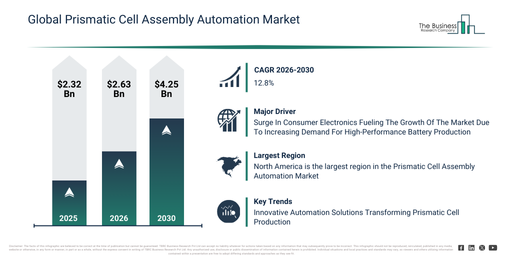
The prismatic cell assembly automation market size has experienced rapid expansion in recent years. It is forecast to increase from $2.32 billion in 2025 to $2.63 billion in 2026, achieving a compound annual growth rate (CAGR) of 13.0%. This historical growth can be attributed to the expansion of lithium-ion battery manufacturing capacity, a rise in prismatic cell adoption, increasing automation in battery production, the availability of advanced robotic systems, and a growing demand for consistent cell quality.
The prismatic cell assembly automation market is projected to undergo substantial expansion over the next few years. It is forecast to attain a valuation of $4.25 billion by 2030, exhibiting a compound annual growth rate (CAGR) of 12.8%. This anticipated growth during the forecast period is primarily driven by factors such as the scaling up of electric vehicle production, increasing investments in battery gigafactories, the rising demand for standardized battery formats, the growing adoption of digital twins in manufacturing, and the integration of AI-driven quality monitoring. Significant trends expected in this period include the increasing adoption of fully automated prismatic cell lines, the rising integration of vision-guided assembly systems, the growing use of robotics for precision stacking and welding, the expansion of high-throughput battery assembly plants, and enhanced quality control through software analytics.
Make Data-Driven Decisions With A Free Prismatic Cell Assembly Automation Market Sample Report:
Key Demand Driver Expected To Lift Prismatic Cell Assembly Automation Market Revenue
The escalating demand for consumer electronics is projected to fuel the advancement of the prismatic cell assembly automation market moving ahead. Consumer electronics encompass electronic gadgets utilized daily by individuals, including smartphones, laptops, tablets, and wearable devices. The need for consumer electronics is increasing due to the development of faster and more powerful processors, which enhance device performance and enable new features that encourage consumers to upgrade more frequently. This growing demand for consumer electronics consequently necessitates prismatic cell assembly automation, as these devices require high-capacity, efficient batteries that can only be produced at scale through automated manufacturing processes. Therefore, the escalating demand for consumer electronics is driving the growth of the prismatic cell assembly automation market.
Exploring The Prismatic Cell Assembly Automation Market Through Its Key Segments
The prismatic cell assembly automation market covered in this report is segmented –
1) By Component: Robots, Conveyors, Vision Systems, Control Systems, Software, Other Components
2) By Automation Level: Fully Automated, Semi-Automated
3) By Application: Electric Vehicles, Consumer Electronics, Energy Storage Systems, Industrial Equipment, Other Applications
4) By End-User: Automotive, Electronics, Energy And Power, Industrial, Other End-Users
Subsegments:
1) By Robots: Articulated Robots, Selective Compliance Assembly Robot Arm (SCARA) Robots, Delta Robots, Collaborative Robots (Cobots)
2) By Conveyors: Belt Conveyors, Roller Conveyors, Chain Conveyors, Modular Conveyors
3) By Vision Systems: Two-Dimensional (2D) Vision Systems, Three-Dimensional (3D) Vision Systems, Laser Vision Systems, Multi-Camera Vision Systems
4) By Control Systems: Programmable Logic Controllers (PLC), Human-Machine Interfaces (HMI), Distributed Control Systems (DCS), Motion Controllers
5) By Software: Assembly Automation Software, Process Monitoring Software, Quality Control Software, Analytics And Reporting Software
6) By Other Components: End Effectors, Grippers, Sensors, Safety Systems
New Trends Redefining Competition In The Prismatic Cell Assembly Automation Market
Leading companies within the prismatic cell assembly automation market are concentrating on creating inventive solutions, such as fully automated assembly lines, to boost production efficiency, guarantee quality, and address the increasing need for advanced energy storage. These fully automated assembly lines represent production systems where machines and robotics execute all manufacturing operations with very little human involvement, thereby contributing to enhanced efficiency, fewer errors, decreased labor expenses, and the consistent production of high-quality batteries. As an example, in January 2025, The Lithium Battery Company, a manufacturing firm based in the US, inaugurated a cutting-edge 60,000 sq ft automated manufacturing facility in Tampa, Florida. This facility incorporates fully automated large prismatic and cylindrical battery assembly lines, along with semi-automated pack assembly lines, built to cater to defense contracts, AI data center energy storage, and OEM partnerships. This plant allows the company to scale up production, improve quality control, and hasten the deployment of sophisticated energy storage solutions. Featuring clean room environments, advanced testing and validation laboratories, climate-controlled storage, and extensive quality control systems, the plant guarantees robust reliability and safety standards across all its battery products.
Prismatic Cell Assembly Automation Market Competition: Key Players And Industry Participants
Major companies operating in the prismatic cell assembly automation market are Siemens AG, Mitsubishi Electric Corporation, Schneider Electric SE, Rockwell Automation Inc., FANUC Corporation, Yaskawa Electric Corporation, Comau S.p.A., Manz AG, Dürr AG, Wuxi Lead Intelligent Equipment Co. Ltd., Shenzhen Yinghe Technology Co. Ltd., Guangdong Lyric Robot Automation Co. Ltd., CKD Corporation, Schuler Group GmbH, Hitachi Ltd., Thyssenkrupp AG, Honeywell International Inc., KUKA AG, ABB Ltd., Bosch Rexroth AG, SFA Engineering S.p.A., Koerber AG
Get The Detailed Prismatic Cell Assembly Automation Market Research Report Here:
Prismatic Cell Assembly Automation Market Regional Overview: Largest Market And Global Coverage
North America was the largest region in the prismatic cell assembly automation market in 2025. The regions covered in the prismatic cell assembly automation market report are Asia-Pacific, South East Asia, Western Europe, Eastern Europe, North America, South America, Middle East, Africa
Reach Out To Our Team:
The Business Research Company: https://www.thebusinessresearchcompany.com/
Americas: +1 310-496-7795
Asia: +44 7882 955267 & +91 8897263534
Europe: +44 7882 955267
Email us at: marketing@tbrc.info
Follow us on:
LinkedIn: https://in.linkedin.com/company/the-business-research-company
YouTube: https://www.youtube.com/channel/UC24_fI0rV8cR5DxlCpgmyFQ
Global Market Model: https://www.thebusinessresearchcompany.com/global-market-model

Wasay has over a decade of experience in market research, data modelling, and analytics, with prior experience at GlobalData and Decision Tree Consulting Services. At The Business Research Company , he leads research operations across syndicated studies, customized consulting engagements, and the Global Market Model platform. His professional experience includes supporting organizations such as Boston Consulting Group, KPMG, and Ernst & Young. Wasay holds a degree in Electronics and Communications Engineering, postgraduate management qualifications from International Management Institute Belgium and Indian School of Business and Entrepreneurship, and completed the Integrated Program in Business Analytics from Indian Institute of Management Indore.