With a focus on actionable insights and strategic value, The Business Research Company’s 2026 market reports include market attractiveness scoring, total addressable market sizing, company benchmarking matrices, interactive Excel dashboards, deeper supply chain intelligence, emerging startup tracking, and granular product-level insights.
Railway Noise Control Barrier Market Size Forecast Points To $2 Billion In Revenue By 2030
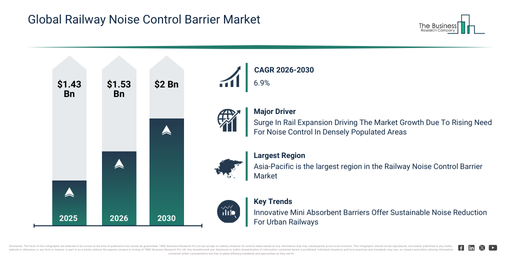
The railway noise control barrier market has seen significant expansion in recent years. Its valuation is anticipated to increase from $1.43 billion in 2025 to $1.53 billion in 2026, achieving a compound annual growth rate (CAGR) of 7.2%. This historical growth can be attributed to factors such as the expansion of railway networks, urbanization occurring close to rail lines, the implementation of environmental noise regulations, investments in public infrastructure, and an increase in passenger rail traffic.
The railway noise control barrier market is projected to experience substantial expansion in the coming years, reaching a valuation of $2 billion by 2030, driven by a compound annual growth rate (CAGR) of 6.9%. This anticipated growth is primarily driven by factors such as the advancement of high-speed rail, more stringent noise pollution regulations, various smart city programs, the increasing need for sustainable infrastructure, and government investments in transportation. Key trends expected during this period involve an increasing need for urban noise reduction, a rise in installations along high-speed rail routes, greater adoption of composite barrier materials, an increase in rail infrastructure development, and an emphasis on environmentally conscious barrier designs.
Get A Free Railway Noise Control Barrier Market Sample Covering Drivers, Trends And Key Players:
Railway Noise Control Barrier Market Driver Analysis: Key Factor Supporting Revenue Growth
The increasing need for rail infrastructure is expected to drive the expansion of the railway noise control barrier market. A rail network comprises integrated railway lines, tracks, stations, and supporting facilities designed to move trains carrying both passengers and goods across diverse regions. This expansion stems from their capacity to offer quicker, more effective, and ecologically sound transport solutions over extensive distances. Within these networks, noise control barriers are vital for mitigating sound generated by fast-moving trains, thereby lessening environmental impact. They also enhance the well-being of local residents and aid in compliance with noise regulations, fostering sustainable rail development. Consequently, the heightened demand for rail networks significantly propels the growth of the railway noise control barrier market.
Railway Noise Control Barrier Market Segmentation Framework: Major Segments At A Glance
The railway noise control barrier market covered in this report is segmented –
1) By Type: Acoustic Barriers, Noise Absorbing Barriers, Noise Reflecting Barriers, Hybrid Barriers
2) By Material: Concrete, Metal, Wood, Plastic, Glass, Composite Materials
3) By Mounting: Ground Mounted, Rail Mounted, Bridge Mounted
4) By Installation: Permanent Installations, Temporary Installations
5) By End-User: Railway Operators, Construction Companies, Government Authorities
Subsegments:
1) By Acoustic Barriers: Vertical Panels, Horizontal Panels, Integrated Panels
2) By Noise Absorbing Barriers: Porous Concrete Barriers, Timber Barriers, Recycled Plastic Barriers
3) By Noise Reflecting Barriers: Steel Barriers, Aluminum Barriers, Glass Barriers, Polycarbonate Barriers
4) By Hybrid Barriers: Absorptive-Reflective Composite Barriers, Transparent Sound-Absorbing Barriers, Vegetation-Metal Hybrid Barriers
Latest Railway Noise Control Barrier Market Developments And Emerging Trends
Leading companies within the railway noise control barrier market are concentrating on developing innovative products, such as mini absorbent noise barriers, to enhance noise reduction in compact urban environments. These mini absorbent noise barriers are compact sound-reducing structures specifically designed to mitigate railway noise in confined city areas. Constructed with sound-absorbing materials, they effectively control noise while maintaining minimal spatial impact and preserving visibility.
Which Companies Are Shaping The Railway Noise Control Barrier Market?
Major companies operating in the railway noise control barrier market are AIL Sound Walls, Echo Barrier Ltd., PHONOBLOC Noise Barriers (Deltabloc), IAC Acoustics Ltd., Soundim Oy, Pliteq Inc., Metalesa S.A., Quietstone Acoustic Solutions, Envirotech Systems Limited, Greenvent Private Limited, Zak Noise Barrier, Antimo Noise Barrier, ESPL Noise Barrier, Himalayan Acoustics Noise Barrier, MMT Acoustix Noise Barrier, Technicon Acoustics, Active Acoustic Engineers, Trelleborg Applied Technologies, Kantaflex, DDSTHA Mechanicals, Acoustiblok Inc., Noise Barriers International
Dive Deeper Into The Railway Noise Control Barrier Market With The Full Report:
Railway Noise Control Barrier Market Regional Distribution: Where Is Revenue Concentrated?
Asia-Pacific was the largest region in the railway noise control barrier market in 2025. North America is expected to be the fastest-growing region in the forecast period. The regions covered in the railway noise control barrier market report are Asia-Pacific, South East Asia, Western Europe, Eastern Europe, North America, South America, Middle East, Africa
Reach Out To Our Team:
The Business Research Company: https://www.thebusinessresearchcompany.com/
Americas: +1 310-496-7795
Asia: +44 7882 955267 & +91 8897263534
Europe: +44 7882 955267
Email us at: marketing@tbrc.info
Follow us on:
LinkedIn: https://in.linkedin.com/company/the-business-research-company
YouTube: https://www.youtube.com/channel/UC24_fI0rV8cR5DxlCpgmyFQ
Global Market Model: https://www.thebusinessresearchcompany.com/global-market-model

Wasay has over a decade of experience in market research, data modelling, and analytics, with prior experience at GlobalData and Decision Tree Consulting Services. At The Business Research Company , he leads research operations across syndicated studies, customized consulting engagements, and the Global Market Model platform. His professional experience includes supporting organizations such as Boston Consulting Group, KPMG, and Ernst & Young. Wasay holds a degree in Electronics and Communications Engineering, postgraduate management qualifications from International Management Institute Belgium and Indian School of Business and Entrepreneurship, and completed the Integrated Program in Business Analytics from Indian Institute of Management Indore.