With a focus on actionable insights and strategic value, The Business Research Company’s 2026 market reports include market attractiveness scoring, total addressable market sizing, company benchmarking matrices, interactive Excel dashboards, deeper supply chain intelligence, emerging startup tracking, and granular product-level insights.
How Large Could The Resistance Welding Equipment For Electric Vehicle (EV) Battery Market Become By 2030 At A 10.9% CAGR?
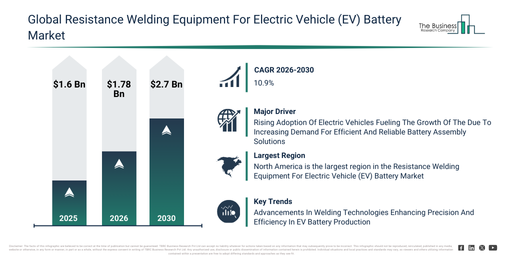
The resistance welding equipment for electric vehicle (ev) battery market size has undergone rapid growth in recent years. It is anticipated to increase from $1.6 billion in 2025 to $1.78 billion in 2026, achieving a compound annual growth rate (CAGR) of 11.2%. The expansion observed in previous periods is attributable to factors including the growth of electric vehicle manufacturing, an increase in lithium-ion battery production, rising investments in battery gigafactories, the availability of automated welding technologies, and the implementation of higher quality standards in battery assembly.
The market for resistance welding equipment for electric vehicle (EV) batteries is projected to experience swift expansion over the coming years. This market is anticipated to reach $2.7 billion in 2030, demonstrating a compound annual growth rate (CAGR) of 10.9%. The drivers behind this growth period include the escalating global adoption of EVs, advancements in next-generation battery technologies, an increasing demand for lightweight battery designs, rising automation in automotive manufacturing, and a focus on high-throughput production systems. Prominent trends for the forecast period include enhanced automation of battery welding lines, a growing need for high-precision joining technologies, the expansion of servo-controlled welding systems, an intensified focus on weld quality and consistency, and the integration of smart monitoring solutions.
Get A Free Resistance Welding Equipment For Electric Vehicle (EV) Battery Market Sample With 2030 Forecast Insights:
Resistance Welding Equipment For Electric Vehicle (EV) Battery Market Outlook: Key Driver Supporting Long-Term Growth
The expanding uptake of electric vehicles (EVs) is anticipated to propel the resistance welding equipment for electric vehicle (EV) battery market going forward. An electric vehicle (EV) is defined as a mode of transportation powered entirely or primarily by electricity, utilizing electric motors instead of internal combustion engines. The rising adoption of EVs stems from increasing environmental awareness and government incentives promoting clean and sustainable transportation. Resistance welding equipment for electric vehicle (EV) batteries is employed to join battery cells, tabs, and busbars with high precision and strength, ensuring reliable electrical connections and efficient energy transfer within the EV battery pack. Consequently, the growing acceptance of electric vehicles is driving the expansion of the resistance welding equipment for electric vehicle (EV) battery market.
Segmentation Of The Resistance Welding Equipment For Electric Vehicle (EV) Battery Market: Key Categories Explained
The resistance welding equipment for electric vehicle (ev) battery market covered in this report is segmented –
1) By Type: Spot Welding Equipment, Projection Welding Equipment, Other Types
2) By Technology: Semi-Automatic, Fully Automatic
3) By Application: Battery Module Assembly, Cell-to-Cell Welding, Busbar Welding, Other Applications
4) By End-User: Automotive Original Equipment Manufacturers (OEMs), Battery Manufacturers, Other End-Users
Subsegments:
1) By Spot Welding Equipment: Manual Spot Welding Machines, Robotic Spot Welding Systems, Portable Spot Welders, Multi-Spot Welding Systems, Servo-Controlled Spot Welders
2) By Projection Welding Equipment: Nut And Bolt Projection Welders, Multi-Projection Welding Systems, Capacitor Discharge Projection Welders, Hydraulic Projection Welders, Automated Projection Welding Cells
3) By Other Types: Micro Resistance Welding Equipment, Customized Hybrid Resistance Welding Systems
Resistance Welding Equipment For Electric Vehicle (EV) Battery Market Evolving Trends: What Businesses Should Know
Leading firms in the resistance welding equipment for electric vehicle (EV) battery market are prioritizing the creation of sophisticated welding technologies. Their aim is to boost precision, efficiency, and traceability within battery manufacturing and electric mobility uses. This technology involves connecting two or more materials, typically metals or thermoplastics, through the application of heat, pressure, or a combination of both, creating a robust and lasting connection. As an illustration, in September 2025, AMADA WELD TECH INC., a US-based producer of welding and bonding machinery, presented its cutting-edge battery and EV welding solutions during The Battery Show 2025 in Detroit. Its exhibition included innovations like the TL-188B-EZ weld head, the UB-4000 Linear DC Resistance Welding Power Supply, and the WL-300A laser workstation paired with an MM-L400A weld monitor. These were engineered to improve efficiency, traceability, and weld quality in EV battery production. The demonstrations also covered wire compacting, crimping, and electric motor welding solutions suitable for high-current and traction motor applications, underscoring AMADA’s dedication to pioneering advancements and precision in e-mobility and battery production technologies.
Who Competes In The Resistance Welding Equipment For Electric Vehicle (EV) Battery Market? Major Companies Listed
Major companies operating in the resistance welding equipment for electric vehicle (ev) battery market are Panasonic Holdings Corporation, Illinois Tool Works Inc., KUKA AG, DAIHEN Corporation, AMADA WELD TECH INC., CenterLine (Windsor) Limited, ARO Welding Technologies SAS, NIMAK GmbH, Obara Corporation, Dengensha Manufacturing Company, TECNA S.p.A., Heron Intelligent Equipment Co. Ltd., T. J. Snow Company Inc., Milco Manufacturing Company Inc., Dai-ichi High Frequency Co., Ltd., Senfeng Laser Technology Co., Ltd., Suzhou Keda Technology Co., Ltd., Guangdong Hwashi Technology Inc., Taylor-Winfield Technologies, Inc., Guangdong Ur Welder Co., Ltd., SKS Welding Systems GmbH, Mechelonic Welding Systems Pvt. Ltd.
Read The Complete Resistance Welding Equipment For Electric Vehicle (EV) Battery Market Forecast Report Through 2030:
Resistance Welding Equipment For Electric Vehicle (EV) Battery Market Regional Ranking: Which Geography Comes First?
North America was the largest region in the resistance welding equipment for electric vehicle (EV) battery market in 2025. Asia-Pacific is expected to be the fastest-growing region in the forecast period. The regions covered in the resistance welding equipment for electric vehicle (ev) battery market report are Asia-Pacific, South East Asia, Western Europe, Eastern Europe, North America, South America, Middle East, Africa
Reach Out To Our Team:
The Business Research Company: https://www.thebusinessresearchcompany.com/
Americas: +1 310-496-7795
Asia: +44 7882 955267 & +91 8897263534
Europe: +44 7882 955267
Email us at: marketing@tbrc.info
Follow us on:
LinkedIn: https://in.linkedin.com/company/the-business-research-company
YouTube: https://www.youtube.com/channel/UC24_fI0rV8cR5DxlCpgmyFQ
Global Market Model: https://www.thebusinessresearchcompany.com/global-market-model

Wasay has over a decade of experience in market research, data modelling, and analytics, with prior experience at GlobalData and Decision Tree Consulting Services. At The Business Research Company , he leads research operations across syndicated studies, customized consulting engagements, and the Global Market Model platform. His professional experience includes supporting organizations such as Boston Consulting Group, KPMG, and Ernst & Young. Wasay holds a degree in Electronics and Communications Engineering, postgraduate management qualifications from International Management Institute Belgium and Indian School of Business and Entrepreneurship, and completed the Integrated Program in Business Analytics from Indian Institute of Management Indore.