With a focus on actionable insights and strategic value, The Business Research Company’s 2026 market reports include market attractiveness scoring, total addressable market sizing, company benchmarking matrices, interactive Excel dashboards, deeper supply chain intelligence, emerging startup tracking, and granular product-level insights.
Robot Self-Piercing Rivet Cells Market Size Analysis: Historical Growth And Future Revenue Projections
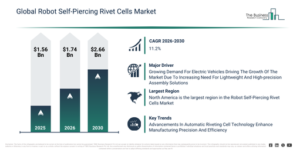
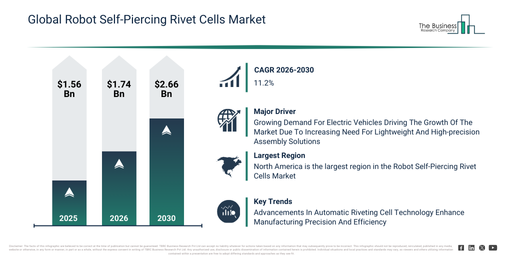
The market size for robot self-piercing rivet cells has experienced rapid expansion in recent years. It is anticipated to grow from $1.56 billion in 2025 to $1.74 billion in 2026, demonstrating a compound annual growth rate (CAGR) of 11.5%. This historical growth can be linked to the expansion of automotive lightweighting initiatives, the proliferation of robotic assembly lines, an increasing reliance on aluminum and mixed materials, the availability of high-precision robotic systems, and a rising demand for repeatable fastening processes.
The robot self-piercing rivet cells market size is anticipated to expand rapidly over the coming years. It is projected to reach $2.66 billion in 2030, exhibiting a compound annual growth rate (CAGR) of 11.2%. This growth throughout the forecast period is primarily driven by the increasing adoption in EV body manufacturing, the expansion of aerospace structural assembly, rising automation across tier suppliers, a growing focus on defect-free joining, and the integration of smart factory technologies. Noteworthy trends during this period encompass the increasing adoption of automated riveting cells, their rising use in lightweight vehicle structures, the growing integration of vision and sensor systems, the expansion of high-speed riveting applications, and an enhanced focus on joint strength consistency.
Preview The Robot Self-Piercing Rivet Cells Market Report With A Free Sample:
Robot Self-Piercing Rivet Cells Market Drivers: What Is Fueling Demand Through 2030?
An anticipated increase in electric vehicle (EV) demand is set to drive the expansion of the robot self-piercing rivet cells market in the future. This surge in EV demand stems from governmental actions, specifically the imposition of more stringent fleet emission regulations and the provision of purchase incentives, which collectively boost EV adoption and market penetration. Robot self-piercing rivet cells offer automakers a solution for high-speed, precise, and repeatable joining across multi-layer and mixed-material assemblies. This capability assists manufacturers in scaling electric vehicle (EV) body production and achieving lightweighting objectives. Consequently, the escalating demand for electric vehicles (EVs) is a primary catalyst for the expansion of the robot self-piercing rivet cells market.
Robot Self-Piercing Rivet Cells Market Segmentation Analysis: Core Categories And Subcategories
The robot self-piercing rivet cells market covered in this report is segmented –
1) By Component: Robots, Riveting Tools, Control Systems, Safety Systems, Other Components
2) By Cell Type: Standalone Cells, Integrated Cells
3) By Application: Automotive, Aerospace, Other Applications
4) By End-User: Original Equipment Manufacturer (OEMs), Tier 1 Suppliers, Contract Manufacturers, Other End-Users
Subsegments:
1) By Robots: Articulated Robots, Gantry Robots
2) By Riveting Tools: Hydraulic Riveting Tools, Pneumatic Riveting Tools, Electric Riveting Tools, Servo-Driven Riveting Tools
3) By Control Systems: Programmable Logic Controllers (PLC), Human Machine Interface (HMI), Motion Control Systems, Vision Systems, Feedback and Sensor Modules
4) By Safety Systems: Safety Light Curtains, Emergency Stop Systems, Safety Mats And Barriers, Interlock Switches, Safety Controllers
5) By Other Components: Tool Changers, End Effectors, Fixtures And Positioners, Conveyors And Material Handling Units, Power Supply And Cabling Assemblies
Which Trends Will Define The Robot Self-Piercing Rivet Cells Market Through 2030?
Major companies in the robot self-piercing rivet cells market are focusing on technological advancements, including automatic riveting cells equipped with integrated robotic systems and intelligent control platforms, to improve fastening precision, production flexibility, and operational efficiency. Automatic riveting cells are defined as fully automated robotic systems designed to apply self-piercing rivets or inserts to composite or metallic components without manual intervention. These systems combine advanced motion control, adaptive force monitoring, and automated feeding mechanisms to ensure consistent and high-speed joining performance across complex geometries. For instance, in January 2025, Belotti SpA, an Italy-based industrial automation company, unveiled the Automatic Riveting Cell (ARC) at JEC World 2025, a leading international composites event. The Belotti ARC features a robotic riveting platform capable of machining and joining composite frames and components for automotive and aerospace applications, offering enhanced precision, reduced cycle times, and live operational demonstrations of its state-of-the-art robotic performance.
Robot Self-Piercing Rivet Cells Market Major Companies And Industry Participants
Major companies operating in the robot self-piercing rivet cells market are ABB Ltd., Atlas Copco AB, Autoriv GmbH, FANUC Corporation, Yaskawa Electric Corporation, Böllhoff GmbH & Co. KG, ECKOLD GmbH & Co. KG, Rivetmach Machinery Industries Co. Ltd., ERSM Machinery Co. Ltd., Wuhan Herorivet Machinery Manufacturing Co. Ltd., EXO Automation Technology Co. Ltd., Tokai-MMC Co. Ltd., Oro Robotics & Automation Pvt. Ltd., Vario Engineering Solutions Pvt. Ltd., Flexible Automation Inc., KUKA AG, Dürr AG, Lincoln Electric Company, Stanley Black & Decker, Inc., RSM Machinery, Gesipa (Gesipa Blindniettechnik GmbH), RENMAKCH
Buy The Full Robot Self-Piercing Rivet Cells Global Market Report 2026:
Robot Self-Piercing Rivet Cells Market Geographic Analysis: Which Region Accounts For The Biggest Share?
North America was the largest region in the robot self-piercing rivet cells market in 2025. Asia-Pacific is expected to be the fastest-growing region in the forecast period. The regions covered in the robot self-piercing rivet cells market report are Asia-Pacific, South East Asia, Western Europe, Eastern Europe, North America, South America, Middle East, Africa
Reach Out To Our Team:
The Business Research Company: https://www.thebusinessresearchcompany.com/
Americas: +1 310-496-7795
Asia: +44 7882 955267 & +91 8897263534
Europe: +44 7882 955267
Email us at: marketing@tbrc.info
Follow us on:
LinkedIn: https://in.linkedin.com/company/the-business-research-company
YouTube: https://www.youtube.com/channel/UC24_fI0rV8cR5DxlCpgmyFQ
Global Market Model: https://www.thebusinessresearchcompany.com/global-market-model

Wasay has over a decade of experience in market research, data modelling, and analytics, with prior experience at GlobalData and Decision Tree Consulting Services. At The Business Research Company , he leads research operations across syndicated studies, customized consulting engagements, and the Global Market Model platform. His professional experience includes supporting organizations such as Boston Consulting Group, KPMG, and Ernst & Young. Wasay holds a degree in Electronics and Communications Engineering, postgraduate management qualifications from International Management Institute Belgium and Indian School of Business and Entrepreneurship, and completed the Integrated Program in Business Analytics from Indian Institute of Management Indore.