The Business Research Company’s 2026 market reports are designed to deliver research that is more actionable and strategically valuable. Key offerings include market attractiveness scoring, total addressable market sizing, company benchmarking matrices, interactive Excel dashboards, deeper supply chain intelligence, emerging startup tracking, and granular product-level insights.
Robot Ultrasonic Staking Cells Market Revenue Projected To Rise To $2.23 Billion By 2030
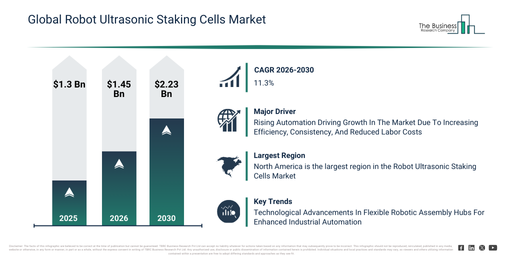
The robot ultrasonic staking cells market has seen rapid expansion in recent years. Its valuation is set to climb from $1.3 billion in 2025 to $1.45 billion in 2026, achieving a compound annual growth rate (CAGR) of 11.6%. In the past, this growth was fueled by the wider adoption of plastic components in automotive interiors, advancements in electronics assembly automation, a growing need for dependable joining methods, the accessibility of ultrasonic welding technology, and an elevated focus on consistent production outcomes.
The market for robot ultrasonic staking cells is projected to experience swift expansion in the coming years. This market is anticipated to reach $2.23 billion by 2030, exhibiting a compound annual growth rate (CAGR) of 11.3%. Factors contributing to this growth over the forecast period include the broader acceptance of lightweight materials, increased automation in the production of medical devices, a heightened need for flawless plastic assemblies, the incorporation of smart factory systems, and the expanding utilization of collaborative robots. Key trends identified for the forecast period encompass a greater uptake of integrated ultrasonic staking cells, an increasing requirement for high-precision plastic joining, their wider application in multi-component assemblies, the extended integration of robotic handling, and improvements in process repeatability and control.
Want Deeper Robot Ultrasonic Staking Cells Market Insights? Get A Free Sample Report:
Primary Growth Driver Shaping The Robot Ultrasonic Staking Cells Market Outlook
The robot ultrasonic staking cells market is anticipated to expand due to the growing integration of automation. Automation involves employing technology and systems to execute tasks with limited human involvement, thereby enhancing both efficiency and precision. Its increasing prevalence stems from its capacity to elevate productivity by completing operations more rapidly and uniformly than human labor. These cells support automation by facilitating accurate, rapid joining of parts without requiring manual effort, which guarantees uniform quality, shortens assembly durations, and reduces labor expenses in production. Consequently, the expanding use of automation is a primary factor fueling the expansion of the robot ultrasonic staking cells market.
Robot Ultrasonic Staking Cells Market Structure: A Detailed Look At Segments And Subsegments
The robot ultrasonic staking cells market covered in this report is segmented –
1) By Product Type: Standalone Ultrasonic Staking Cells, Integrated Ultrasonic Staking Cells
2) By Distribution Channel: Direct Sales, Distributors
3) By Application: Automotive, Electronics, Medical Devices, Consumer Goods, Other Applications
4) By End-User: Automotive Manufacturers, Electronics Manufacturers, Medical Device Manufacturers, Other End Users
Subsegments:
1) By Standalone Ultrasonic Staking Cells: Manual Configuration, Semi-Automated Setup
2) By Integrated Ultrasonic Staking Cells: Robotic Assembly Line Integration, Fully Automated Production System
Robot Ultrasonic Staking Cells Market Innovation And Strategy Trends Among Leading Companies
Major companies operating in the robot ultrasonic staking cells market are concentrating on developing flexible robotic assembly hubs to improve industrial production efficiency, accuracy, and scalability. Flexible robotic assembly hubs are reconfigurable manufacturing units that employ robotic arms and ultrasonic staking systems to achieve precise, high-speed component assembly with minimal human involvement.
Top Companies Competing In The Robot Ultrasonic Staking Cells Market
Major companies operating in the robot ultrasonic staking cells market are Emerson Electric Co., KUKA AG, Unisonic Engineers, MS Ultrasonic Technology Group, Dukane Corporation, Herrmann Ultrasonics GmbH & Co. KG, Telsonic AG, Sonotronic Nagel GmbH, Schunk Sonosystems GmbH, Rychiger, Sonics & Materials Inc., Sonitek Corporation, Crest Group, JSK Ultrasonics Ltd., Mecasonic, Rinco Ultrasonics AG, Sonic Italia Srl, TESPA Robotics, Weber Ultrasonics AG, Shanghai Chenfeng Ultrasonic Equipment Co. Ltd.
View The Complete Robot Ultrasonic Staking Cells Market Study With Segment And Regional Data:
Robot Ultrasonic Staking Cells Market Regional Outlook Across Major Geographies
North America was the largest region in the robot ultrasonic staking cells market in 2025. Asia-Pacific is expected to be the fastest-growing region in the forecast period. The regions covered in the robot ultrasonic staking cells market report are Asia-Pacific, South East Asia, Western Europe, Eastern Europe, North America, South America, Middle East, Africa
Reach Out To Our Team:
The Business Research Company: https://www.thebusinessresearchcompany.com/
Americas: +1 310-496-7795
Asia: +44 7882 955267 & +91 8897263534
Europe: +44 7882 955267
Email us at: marketing@tbrc.info
Follow us on:
LinkedIn: https://in.linkedin.com/company/the-business-research-company
YouTube: https://www.youtube.com/channel/UC24_fI0rV8cR5DxlCpgmyFQ
Global Market Model: https://www.thebusinessresearchcompany.com/global-market-model

Wasay has over a decade of experience in market research, data modelling, and analytics, with prior experience at GlobalData and Decision Tree Consulting Services. At The Business Research Company , he leads research operations across syndicated studies, customized consulting engagements, and the Global Market Model platform. His professional experience includes supporting organizations such as Boston Consulting Group, KPMG, and Ernst & Young. Wasay holds a degree in Electronics and Communications Engineering, postgraduate management qualifications from International Management Institute Belgium and Indian School of Business and Entrepreneurship, and completed the Integrated Program in Business Analytics from Indian Institute of Management Indore.