The Business Research Company’s 2026 market reports combine market attractiveness scoring, total addressable market sizing, company benchmarking matrices, interactive Excel dashboards, deeper supply chain intelligence, emerging startup tracking, and granular product-level insights to deliver research that is more actionable and strategically valuable.
Architecture Clear Float Glass Market Value Projected To Grow At A 5.4% Compound Annual Growth Rate Through 2030
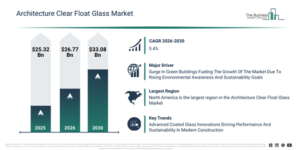
The architecture clear float glass market has shown strong expansion in recent years. It is anticipated to increase from $25.32 billion in 2025 to $26.77 billion in 2026, with a compound annual growth rate (CAGR) of 5.7%. Historically, this growth can be attributed to several factors including a heightened demand for high-clarity architectural glass, the broader adoption of float glass in modern construction, the proliferation of facade and glazing applications, a reliance on silica-based materials, and the increasing use of interior decorative glass.
The architecture clear float glass market is anticipated to experience significant growth over the next few years. It is projected to reach $33.08 billion in 2030, with a compound annual growth rate (CAGR) of 5.4%. This expansion during the forecast period is primarily attributed to the increasing adoption of energy-efficient glazing solutions, the broader application of solar glass, rising investments in automated glass manufacturing, the ongoing development of advanced coated and laminated float glass, and a growing demand for lightweight architectural materials. Prominent trends for this period include the advancement of AI-based glass quality inspection, the automation of clear float glass production lines, the proliferation of energy-efficient low-iron glass solutions, the integration of smart glass monitoring systems, and the growth of digitally managed architectural glass supply chains.
Evaluate The Architecture Clear Float Glass Market Report Before You Buy With A Free Sample:
Architecture Clear Float Glass Market Growth Driver Analysis For The 2026–2030 Forecast Period
The increasing need for environmentally friendly structures is anticipated to boost the expansion of the architecture clear float glass market in the foreseeable future. Green buildings are defined as constructions planned and erected to lessen their ecological footprint through optimal energy, water, and resource utilization, simultaneously fostering the well-being and long-term viability for occupants. This heightened demand for green buildings stems from greater ecological consciousness, prompting a larger number of people and entities to pursue sustainable options for lowering their carbon emissions and utility expenses. Architecture clear float glass aids green building development by maximizing the entry of natural illumination, thereby decreasing dependence on artificial light sources and reducing total energy use. As an illustration, in December 2024, the Green Building Council of Australia, an Australian government body, reported that the nation’s construction industry exceeded 1,000 certified buildings, fitouts, and precincts under the green star rating system, acknowledging their sustainable performance. Relative to 2023, the volume of certification applications doubled, featuring over 120 new project submissions and more than 150 inquiries lodged over a period of three months. Consequently, the expanding requirement for green buildings is fueling the expansion of the architecture clear float glass market.
Architecture Clear Float Glass Market Segmentation Breakdown: Primary And Secondary Categories
The architecture clear float glass market covered in this report is segmented –
1) By Product Type: Float Glass, Tempered Glass, Laminated Glass, Coated Glass, Insulated Glass
2) By Thickness: Thin Glass (Up To 6 Millimeter (MM)), Medium Thickness (6 Millimeter (MM) – 12 Millimeter (MM)), Thick Glass (Over 12 Millimeter (MM))
3) By Distribution Channel: Direct Sales, Wholesale Distributors, Online Retail, Specialty Glass Stores, Architectural Firms
4) By Application: Residential Buildings, Commercial Buildings, Aerospace And Automotive, Future And Interior Design, Electrical And Electronics
5) By End-Use Industry: Construction, Automotive, Solar Energy, Home Appliances, Safety And Security
Subsegments:
1) By Float Glass: Clear Float Glass, Tinted Float Glass, Patterned Float Glass, Low Iron Float Glass
2) By Tempered Glass: Heat Tempered Glass, Chemically Tempered Glass, Heat Soaked Tempered Glass
3) By Laminated Glass: Polyvinyl Butyral Laminated Glass, Ethylene Vinyl Acetate Laminated Glass, SentryGlas Plus Laminated Glass, Acoustic Laminated Glass
4) By Coated Glass: Low Emissivity Glass, Anti-Reflective Coated Glass, Mirror Coated Glass, Anti-Glare Coated Glass
5) By Insulated Glass: Single Sealed Insulated Glass Unit (IGU), Double Sealed Insulated Glass Unit (IGU), Triple Sealed Insulated Glass Unit (IGU), Gas Filled Insulated Glass Unit (IGU)
Architecture Clear Float Glass Market Industry Trends: New Developments From Leading Companies
Leading companies operating in the architecture clear float glass market are concentrating on developing advanced solutions, such as specialized coated glass variants for architecture. These developments aim to improve energy efficiency, enhance aesthetic appeal, and provide superior light transmittance with accurate color rendering for both exterior and interior applications. Coated glass variants for architecture refer to glass products with unique surface coatings that boost energy efficiency, control light, and improve visual appeal. For instance, in February 2024, Larta Glass, a Russia-based glass manufacturing company, introduced a new product line based on Larta UltraClear glass, intended for architectural and interior uses. This range includes innovative coated glass variants like LartaPro Premium T UltraClear and LartaPro HD Platinum 67 UltraClear, which offer high light transmission and improved thermal performance. Designed to replace imported equivalents, these products support large-format glazing and ensure accurate color rendering, making them ideal for facades, partitions, and luxury interiors. This new product line demonstrates Larta Glass’s commitment to combining performance, sustainability, and design flexibility to address modern construction requirements.
Who Are The Top Competitors In The Architecture Clear Float Glass Market?
Major companies operating in the architecture clear float glass market are AGC Inc., Sisecam Group, Nippon Sheet Glass Co. Ltd., Guardian Industries LLC, Xinyi Glass Holdings Limited, Schott AG, Cardinal Glass Industries Inc., CSG Holding Co. Ltd., Jinjing Group Co. Ltd., Gold Plus Glass Industry Limited, Saint-Gobain Glass, China Yaohua Glass Group Corporation, Bendheim Corporation, Eastern Glass Resources Inc., Rider Glass Company Limited, Qingdao Globalstar Glass Co. Ltd., Sterling Glass Group, Larta Glass Private Limited, Essar Sons Glass Private Limited, Skyline Design Inc.
Access The Architecture Clear Float Glass Market Report For Complete Segment-Level Analysis:
Which Region Leads The Architecture Clear Float Glass Market, And Which Regions Are Covered?
North America was the largest region in the architecture clear float glass market in 2025. Asia-Pacific is expected to be the fastest-growing region in the forecast period. The regions covered in the architecture clear float glass market report are Asia-Pacific, South East Asia, Western Europe, Eastern Europe, North America, South America, Middle East, Africa.
Reach Out To Our Team:
The Business Research Company: https://www.thebusinessresearchcompany.com/
Americas: +1 310-496-7795
Asia: +44 7882 955267 & +91 8897263534
Europe: +44 7882 955267
Email us at: marketing@tbrc.info
Follow us on:
LinkedIn: https://in.linkedin.com/company/the-business-research-company
YouTube: https://www.youtube.com/channel/UC24_fI0rV8cR5DxlCpgmyFQ
Global Market Model: https://www.thebusinessresearchcompany.com/global-market-model

Wasay has over a decade of experience in market research, data modelling, and analytics, with prior experience at GlobalData and Decision Tree Consulting Services. At The Business Research Company , he leads research operations across syndicated studies, customized consulting engagements, and the Global Market Model platform. His professional experience includes supporting organizations such as Boston Consulting Group, KPMG, and Ernst & Young. Wasay holds a degree in Electronics and Communications Engineering, postgraduate management qualifications from International Management Institute Belgium and Indian School of Business and Entrepreneurship, and completed the Integrated Program in Business Analytics from Indian Institute of Management Indore.