With a focus on actionable insights and strategic value, The Business Research Company’s 2026 market reports include market attractiveness scoring, total addressable market sizing, company benchmarking matrices, interactive Excel dashboards, deeper supply chain intelligence, emerging startup tracking, and granular product-level insights.
Aviation Infrastructure Market Size Analysis: Historical Growth And Future Revenue Projections
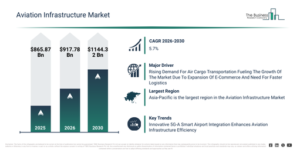
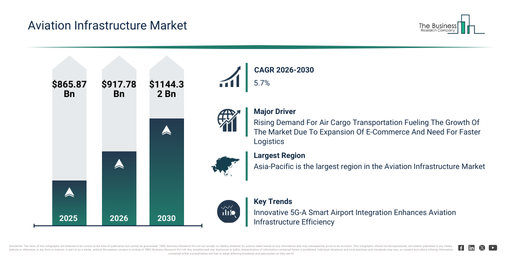
The aviation infrastructure market has experienced significant growth in recent years. It is projected to expand from $865.87 billion in 2025 to $917.78 billion in 2026, at a compound annual growth rate (CAGR) of 6.0%. This historical expansion can be attributed to the increasing expansion of commercial air travel, early modernization of airport facilities, rising construction of runways and terminals, growth of global air cargo activities, and the development of specialized aviation safety systems.
The aviation infrastructure market is projected to experience substantial expansion in the coming years. Its size is anticipated to reach $1144.32 billion by 2030, demonstrating a compound annual growth rate (CAGR) of 5.7%. This growth over the forecast period is attributable to factors such as increased investment in intelligent airport technologies, an escalating demand for environmentally friendly aviation infrastructure, the expansion of automated ground operations, a heightened emphasis on robust airport design, and significant advancements in digital air traffic management systems. Key trends during this period encompass a growing necessity for effective airport facility modernizations, developments in digital infrastructure improvements, the broadening of sophisticated airside and landside systems, an increase in the implementation of real-time operational oversight, and enhanced funding into environmentally conscious airport design.
Preview The Aviation Infrastructure Market Report With A Free Sample:
Aviation Infrastructure Market Drivers: What Is Fueling Demand Through 2030?
The increasing need for air cargo services is projected to stimulate expansion within the aviation infrastructure market in the future. This method involves moving merchandise and goods via aircraft, providing quick and effective delivery for items that are time-critical and possess significant value. The heightened demand for air cargo transport stems from a surge in worldwide trade, necessitating quicker and more dependable shipping methods to effectively link global markets. Aviation infrastructure supports air cargo operations through the provision of essential runways, cargo facilities, and logistical backing systems, ensuring the smooth handling, storage, and transit of merchandise. As an example, in December 2023, the International Air Transport Association (IATA), an airline trade association headquartered in Canada, reported that air cargo capacity rose by 13.6% from 2022, reaching 49.8 billion available cargo ton-kilometers (ACTKs) in 2023. Consequently, the growing requirement for air cargo services is fueling the expansion of the aviation infrastructure market.
Aviation Infrastructure Market Segmentation Analysis: Core Categories And Subcategories
The aviation infrastructure market covered in this report is segmented –
1) By Airport Type: Commercial Airport, Military Airport, General Aviation Airport
2) By Infrastructure Type: Terminal, Control Tower, Taxiway And Runway, Apron, Hangar, Other Infrastructure Types
3) By Size: Small Airports (Less Than 1 Million Passengers Per Year), Medium Airports (1-5 Million Passengers Per Year), Large Airports (Over 5 Million Passengers Per Year)
4) By Location: Urban, Suburban, Rural
Subsegments:
1) By Commercial Airport: Domestic Terminals, International Terminals, Cargo Terminals, Maintenance Hangars, Runways And Taxiways, Passenger Lounges
2) By Military Airport: Airbase Facilities, Aircraft Maintenance Units, Munitions Storage, Command And Control Centers, Runways And Hangars
3) By General Aviation Airport: Private Jet Terminals (FBOs), Aircraft Hangars, Flight Schools, Charter Services, Maintenance And Repair Operations (MRO) Facilities
Which Trends Will Define The Aviation Infrastructure Market Through 2030?
Leading entities within the aviation infrastructure market are prioritizing the implementation of groundbreaking solutions, specifically smart airport construction, with the aim of improving operational effectiveness and the overall passenger journey. This concept, smart airport construction, involves embedding sophisticated technologies like 5G, IoT, and AI into airport facilities to facilitate intelligent oversight, proactive maintenance, and optimized processes. As an example, during March 2024, Baoshan Yunrui Airport, a medium-sized airport situated in China, unveiled the world’s first 5G-Advanced (5G-A) smart airport integrated sensing base station. This marked the initial worldwide deployment of 5G-A technology within airport development. This innovative system integrates extremely high-speed 5G-A connectivity alongside sophisticated sensing functionalities to facilitate real-time data transfer, accurate aircraft location tracking, and extensive environmental observation. A key characteristic of this system is its consolidation of communication, sensing, and edge computing within one base station, which allows for intelligent synchronization across various airport functions such as baggage processing, runway administration, and crisis management.
Aviation Infrastructure Market Major Companies And Industry Participants
Major companies operating in the aviation infrastructure market are Siemens AG, Raytheon Technologies Corporation, Honeywell International Inc., Bechtel Corporation, Safran S.A., Thales Group, Skanska AB, Turner Construction Company, Jacobs Engineering Group, Balfour Beatty plc, Ferrovial S.A., Groupe ADP, Vinci Airports, Fraport AG, HDR Inc., Arup Group, Royal Schiphol Group, Changi Airports International, HOK Group Inc., Fluor Corporation, TAV Airports Holding, Dubai Aviation Engineering Projects (DAEP), Flughafen Zürich AG, Perkins and Will, Copenhagen Airports A/S, Foster + Partners
Buy The Full Aviation Infrastructure Global Market Report 2026:
Aviation Infrastructure Market Geographic Analysis: Which Region Accounts For The Biggest Share?
Asia-Pacific was the largest region in the aviation infrastructure market in 2025. Asia-Pacific is expected to be the fastest-growing region in the forecast period. The regions covered in the aviation infrastructure market report are Asia-Pacific, South East Asia, Western Europe, Eastern Europe, North America, South America, Middle East, Africa.
Reach Out To Our Team:
The Business Research Company: https://www.thebusinessresearchcompany.com/
Americas: +1 310-496-7795
Asia: +44 7882 955267 & +91 8897263534
Europe: +44 7882 955267
Email us at: marketing@tbrc.info
Follow us on:
LinkedIn: https://in.linkedin.com/company/the-business-research-company
YouTube: https://www.youtube.com/channel/UC24_fI0rV8cR5DxlCpgmyFQ
Global Market Model: https://www.thebusinessresearchcompany.com/global-market-model

Wasay has over a decade of experience in market research, data modelling, and analytics, with prior experience at GlobalData and Decision Tree Consulting Services. At The Business Research Company , he leads research operations across syndicated studies, customized consulting engagements, and the Global Market Model platform. His professional experience includes supporting organizations such as Boston Consulting Group, KPMG, and Ernst & Young. Wasay holds a degree in Electronics and Communications Engineering, postgraduate management qualifications from International Management Institute Belgium and Indian School of Business and Entrepreneurship, and completed the Integrated Program in Business Analytics from Indian Institute of Management Indore.