Designed to make market research more actionable and strategically valuable, The Business Research Company’s 2026 market reports feature market attractiveness scoring, total addressable market sizing, company benchmarking matrices, interactive Excel dashboards, deeper supply chain intelligence, emerging startup tracking, and granular product-level insights.
How Big Is The Building Thermal Insulation Market In 2026, And How Fast Will It Grow?
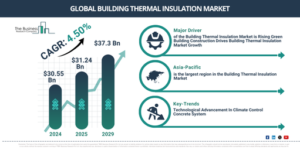
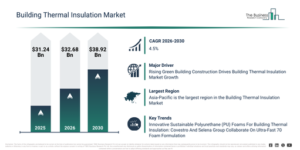
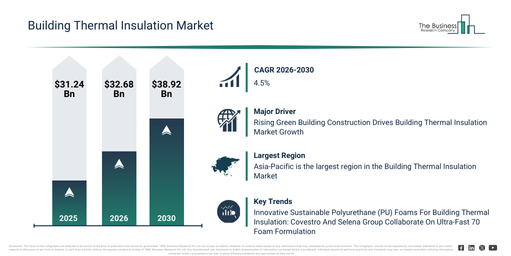
The building thermal insulation market size has shown consistent expansion over recent years. It is anticipated to increase from $31.24 billion in 2025 to $32.68 billion in 2026, achieving a compound annual growth rate (CAGR) of 4.6%. In previous periods, this market’s expansion was primarily driven by the rising need for energy-efficient constructions, the ongoing dependence on established insulation materials, the enlargement of both residential and commercial building sectors, a stable supply of polymer feedstock, and the historical cost advantage of fiberglass and foam insulation.
The building thermal insulation market size is expected to show sustained expansion over the next few years. It is forecast to grow to $38.92 billion in 2030, achieving a compound annual growth rate (CAGR) of 4.5%. This growth during the forecast period is attributable to a transition towards sustainable insulation substances, escalating regulatory requirements for energy efficiency, a rise in retrofitting endeavors, the increasing embrace of advanced insulation technologies, and the expanding utilization of low-conductivity materials. Key trends anticipated during this period include a rising demand for high-performance insulation solutions, the growing adoption of fire-resistant insulation options, an increase in retrofitting and energy-efficiency improvements, the proliferation of lightweight and adaptable insulation products, and advancements in manufacturing processes for foamed plastics.
Download A Free Building Thermal Insulation Market Sample Report With Size And Forecast Data:
Building Thermal Insulation Market Growth Driver: The Key Factor Behind Rising Demand
The anticipated expansion of green building construction is projected to stimulate the growth of the building thermal insulation market in the future. Green buildings are environmentally responsible structures, engineered and built using sustainable methods aimed at minimizing resource use, lowering environmental footprint, and enhancing the well-being and comfort of occupants. This surge in green building development largely stems from initiatives to combat climate change and more stringent governmental policies mandating improved energy efficiency benchmarks. To meet their energy efficiency objectives and sustain ideal indoor environmental conditions while reducing heating and cooling energy use, green buildings necessitate high-performance insulation systems. For example, data from the Green Building Council, a US-based non-profit organization, revealed that in July 2024, more than 46,000 residential projects achieved LEED green building certification, marking an almost 5% increase in new registrations compared to 2023. Consequently, the expanding construction of green buildings is fueling the expansion of the building thermal insulation market.
Building Thermal Insulation Market Segmentation: Key Segments And Subsegments Covered
The building thermal insulation market covered in this report is segmented –
1) By Material: Foamed Plastic, Mineral Wool, Aerogels, Cellulose, Other Materials
2) By Product: Glass Wool, Mineral Wool, Expanded polystyrene (EPS), Extruded polystyrene (XPS), Other Products
3) By Application: Roof Insulation, Wall Insulation, Floor Insulation
4) By End Use: Residential, Commercial, Industrial
Subsegments:
1) By Foamed Plastic: Expanded Polystyrene (EPS), Extruded Polystyrene (XPS), Polyurethane (PUR), Polyisocyanurate (PIR)
2) By Mineral Wool: Glass Wool, Rock Wool
3) By Aerogels: Silica Aerogel, Polymer Aerogel
4) By Cellulose: Loose-Fill Cellulose, Spray-Applied Cellulose
5) By Other Materials: Natural Fiber Insulation, Vermiculite, Perlite
Building Thermal Insulation Market Trends: Key Developments Shaping 2026 And Beyond
Leading companies operating in the building thermal insulation market are introducing an innovative, sustainable range of polyurethane (PU) foams. These include formulations such as Ultra-Fast 70 foam, which significantly reduces the installation time for doors and windows, considerably increasing the number of projects that can be completed over the same period to gain a competitive advantage. The aim of these PU foams is to enhance building thermal insulation through faster installation, allowing for seamless integration into existing operations without loss of quality. For instance, in September 2023, Covestro, a Germany-based provider of innovative solutions for vehicles and infrastructure, partnered with Selena Group, a Poland-based manufacturer of PU foams and construction-related chemicals, to launch an innovative polyurethane (PU) foam named The Ultra-Fast 70 formulation. This product significantly decreases the time needed for installing doors and windows, which, in turn, considerably increases the number of projects that can be completed within the same timeframe for enhancing building thermal insulation. The material has obtained ISSC Plus certification, confirming its use of plant-based feedstocks through the mass balance method, and is claimed to result in a 60% decrease in carbon emissions compared to materials derived from fossil sources. Ultimately, the Ultra-Fast 70 foam formulation substantially minimizes the installation time required for doors and windows, thus greatly enhancing the quantity of projects that can be accomplished within a given timeframe.
Leading Companies Operating In The Building Thermal Insulation Market
Major companies operating in the building thermal insulation market are Johns Manville, Saint-Gobain S.A., Kingspan Group PLC, Owens Corning, Rockwool International A/S, GAF Materials Corporation, Guardian Building Products Inc., CertainTeed Corporation, Knauf Insulation, Armacell International S.A., Dow Inc., Huntsman Corporation, Cabot Corporation, Recticel NV, Paroc Group, URSA Insulation S.A., Superglass Insulation Ltd., Kaimann GmbH, Thermaflex International Holding B.V., Lapinus Fibres, KCC Corporation, Beijing New Building Material (Group) Co. Ltd., Fletcher Insulation Pty Ltd., TechnoNICOL Corporation, Unifrax I LLC, Aspen Aerogels Inc., Evonik Industries AG
Access The Full Building Thermal Insulation Market Research Report:
Building Thermal Insulation Market Regional Analysis: Largest Region And Key Geographies Covered
Asia-Pacific was the largest region in the building thermal insulation market in 2025. The regions covered in the building thermal insulation market report are Asia-Pacific, South East Asia, Western Europe, Eastern Europe, North America, South America, Middle East, Africa.
Reach Out To Our Team:
The Business Research Company: https://www.thebusinessresearchcompany.com/
Americas: +1 310-496-7795
Asia: +44 7882 955267 & +91 8897263534
Europe: +44 7882 955267
Email us at: marketing@tbrc.info
Follow us on:
LinkedIn: https://in.linkedin.com/company/the-business-research-company
YouTube: https://www.youtube.com/channel/UC24_fI0rV8cR5DxlCpgmyFQ
Global Market Model: https://www.thebusinessresearchcompany.com/global-market-model

Wasay has over a decade of experience in market research, data modelling, and analytics, with prior experience at GlobalData and Decision Tree Consulting Services. At The Business Research Company , he leads research operations across syndicated studies, customized consulting engagements, and the Global Market Model platform. His professional experience includes supporting organizations such as Boston Consulting Group, KPMG, and Ernst & Young. Wasay holds a degree in Electronics and Communications Engineering, postgraduate management qualifications from International Management Institute Belgium and Indian School of Business and Entrepreneurship, and completed the Integrated Program in Business Analytics from Indian Institute of Management Indore.