The Business Research Company’s 2026 market reports are designed to deliver research that is more actionable and strategically valuable. Key offerings include market attractiveness scoring, total addressable market sizing, company benchmarking matrices, interactive Excel dashboards, deeper supply chain intelligence, emerging startup tracking, and granular product-level insights.
Carbon Neutral Cement Market Size, Growth Rate And Key Forecast Highlights For 2026–2030
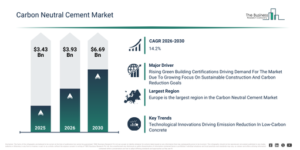
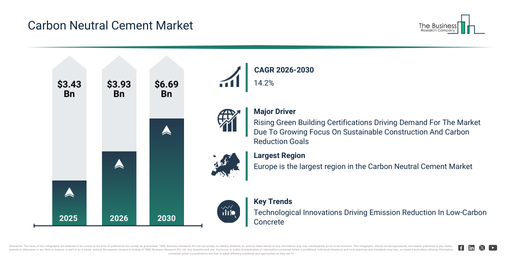
In recent years, the size of the carbon neutral cement market has experienced rapid growth. It is projected to expand from $3.43 billion in 2025 to $3.93 billion in 2026, achieving a compound annual growth rate (CAGR) of 14.5%. Several factors contributed to this historic growth, including a stronger regulatory focus on CO2 emissions, a surge in the adoption of sustainable cement solutions, an increase in infrastructure developments, heightened environmental awareness in the construction sector, and innovations in alternative cement technologies.
The carbon neutral cement market is projected for substantial expansion in the coming years, with its size anticipated to reach $6.69 billion in 2030, exhibiting a compound annual growth rate (CAGR) of 14.2%. This projected growth during the forecast period can be linked to factors such as the broadening of carbon-neutral cement applications, enhanced integration of digital carbon monitoring, increased adoption of high-performance blended concrete, advancements in low-carbon binder technologies, and a surge in sustainable infrastructure investments. Key trends expected during this period involve the implementation of carbon-neutral cement production systems, the uptake of alternative binder technologies, the incorporation of intelligent emission monitoring solutions, the proliferation of AI-assisted tools for carbon optimization, and the utilization of interconnected supply chains for accurate carbon accounting.
See What’s Inside The Carbon Neutral Cement Market Report With A Free Sample:
Carbon Neutral Cement Market Expansion: The Major Factor Driving Growth
The rising number of green building certifications is projected to drive the growth of the carbon neutral cement market. Carbon neutral cement is a type of cement produced using technologies and materials that minimize or offset carbon dioxide (CO2) emissions throughout its entire lifecycle, from raw material extraction to manufacturing and use, aiming for net-zero carbon emissions through methods like alternative binders, carbon capture, renewable energy, or carbon offsets. Green building certifications are formal systems that evaluate and recognize buildings for meeting specific standards of sustainability, energy efficiency, and environmental performance. These certifications are increasing due to growing environmental awareness, as more developers and organizations strive to reduce carbon emissions and promote sustainable construction practices to meet global climate goals. Low-carbon concrete helps achieve green building certifications by reducing the carbon footprint of construction materials, enhancing energy efficiency, and contributing to sustainability credits related to emissions reduction, resource efficiency, and environmental performance. For instance, in July 2024, the Green Building Council, a US-based non-profit organization, reported that over 46,000 residential projects earned LEED green building certification, showing nearly a 5% rise in new registrations compared to 2023. Therefore, the increasing green building certifications are propelling the expansion of the carbon neutral cement market.
Understanding Carbon Neutral Cement Market Segmentation For Strategic Planning
The carbon neutral cement market covered in this report is segmented –
1) By Type: Geopolymer Cement, Limestone Calcined Clay Cement (LC3), Magnesium-Based Cement, CarbonCured Cement, Bio-Cement, Alkali-Activated Cement, Other Types
2) By Technology: Alternative Calcium Sources, Clinker Substitution Techniques, Digital Emission Monitoring, Carbon Capture And Storage (CCS) Materials, Agriculture Waste-Based Materials
3) By Distribution Channel: Direct Sales (B2B), Distributors And Dealers, Online Sales Platforms, Government Procurement, Other Distribution Channels
4) By Application: Residential, Industrial Infrastructure, Transportation And Roadways, Marine And Offshore Structures, Other Applications
5) By End User: Construction Companies, Cement And Concrete Manufacturers, Government And Public Infrastructure Projects, Real Estate Developers, Other End Users
Subsegments:
1) By Geopolymer Cement: Fly Ash-Based, Slag-Based, Metakaolin-Based
2) By Limestone Calcined Clay Cement (LC3): Portland-Limestone Calcined Clay, Blended Limestone Calcined Clay Cement
3) By Magnesium-Based Cement: Magnesium Oxide Cement, Magnesium Hydroxide Cement
4) By Carbon Cured Cement: CO2-Cured Concrete, CO2-Cured Mortar
5) By Bio-Cement: Microbially Induced Calcium Carbonate, Enzyme-Induced Carbonate
6) By Alkali-Activated Cement: Slag-Based, Fly Ash-Based, Hybrid Blends
7) By Other Types: Sulfoaluminate Cement, Calcium Aluminate Cement
Key Carbon Neutral Cement Market Trends To Watch In 2026
Leading companies operating within the carbon neutral cement market are prioritizing the development of technological breakthroughs, such as clinker carbon capture, to minimize CO2 emissions during cement production and bolster the sustainability of concrete manufacturing. Clinker carbon capture refers to a technique that captures carbon dioxide (CO2) emissions generated during the clinker production phase in cement manufacturing, preventing their atmospheric release and consequently reducing concrete’s carbon footprint. For instance, in November 2023, Heidelberg Materials AG, a Germany-based building materials company, introduced evoZero, a carbon-neutral cement brand that stands as the world’s first carbon-captured net-zero cement. This product delivers a near-zero carbon footprint without sacrificing cement performance, offering builders a versatile and dependable material that supports environmentally friendly construction practices. This particular innovation is instrumental in decreasing the cement industry’s carbon emissions and driving global sustainability objectives through transparent, verified carbon reductions.
Key Companies Active In The Carbon Neutral Cement Market
Major companies operating in the carbon neutral cement market are Holcim Ltd., Cemex S.A.B. de C.V., Siam Cement Public Company Limited, Taiheiyo Cement Corporation, Vicat S.A., Votorantim Cimentos S.A., Fortera Corporation, JSW Cement Ltd., HeidelbergCement AG, Sublime Systems Inc., Kiran Global Chem Limited, Ecocem Global Ltd., Cemvision AB, Navrattan Group, SeraTech Technologies Inc., Brimstone Materials Inc., EcoBinder Solutions Ltd., Ecomaterials India Pvt. Ltd., Material Evolution, Concrete4Change Ltd.
Explore Detailed Carbon Neutral Cement Market Research And Forecasts:
Which Geography Dominates The Carbon Neutral Cement Market?
Europe was the largest region in the carbon neutral cement market in 2025. Asia-Pacific is expected to be the fastest-growing region in the forecast period. The regions covered in the carbon neutral cement market report are Asia-Pacific, South East Asia, Western Europe, Eastern Europe, North America, South America, Middle East, Africa.
Reach Out To Our Team:
The Business Research Company: https://www.thebusinessresearchcompany.com/
Americas: +1 310-496-7795
Asia: +44 7882 955267 & +91 8897263534
Europe: +44 7882 955267
Email us at: marketing@tbrc.info
Follow us on:
LinkedIn: https://in.linkedin.com/company/the-business-research-company
YouTube: https://www.youtube.com/channel/UC24_fI0rV8cR5DxlCpgmyFQ
Global Market Model: https://www.thebusinessresearchcompany.com/global-market-model

Wasay has over a decade of experience in market research, data modelling, and analytics, with prior experience at GlobalData and Decision Tree Consulting Services. At The Business Research Company , he leads research operations across syndicated studies, customized consulting engagements, and the Global Market Model platform. His professional experience includes supporting organizations such as Boston Consulting Group, KPMG, and Ernst & Young. Wasay holds a degree in Electronics and Communications Engineering, postgraduate management qualifications from International Management Institute Belgium and Indian School of Business and Entrepreneurship, and completed the Integrated Program in Business Analytics from Indian Institute of Management Indore.