Designed to make market research more actionable and strategically valuable, The Business Research Company’s 2026 market reports feature market attractiveness scoring, total addressable market sizing, company benchmarking matrices, interactive Excel dashboards, deeper supply chain intelligence, emerging startup tracking, and granular product-level insights.
How Big Is The Intake Pressure Control Valve Market In 2026, And How Fast Will It Grow?
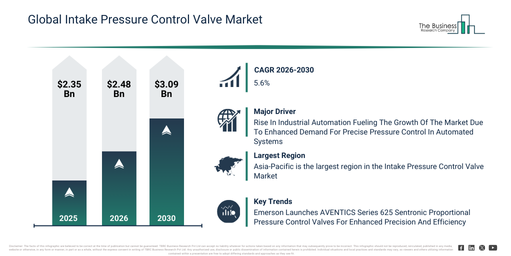
The intake pressure control valve market has experienced substantial growth in recent years. It is projected to expand from $2.35 billion in 2025 to $2.48 billion in 2026, achieving a compound annual growth rate (CAGR) of 5.5%. This historical growth can be attributed to factors such as automotive engine optimization, industrial airflow control needs, the reliance on mechanical valves, the expansion of combustion engines, and compliance with emission regulations.
The intake pressure control valve market is anticipated to experience substantial growth in the next few years. It is projected to expand to $3.09 billion by 2030, showing a compound annual growth rate (CAGR) of 5.6%. This expansion during the forecast period is driven by factors such as the increase in electric and hybrid vehicles, the integration of smart controls, stricter emission standards, the automation of industrial systems, and the adoption of predictive maintenance. Prominent trends expected in the forecast period include the incorporation of intelligent pressure control systems, a growing demand for emission control, the use of electronically actuated valves, the expansion of turbocharged engines, and advancements in industrial automation.
Download A Free Intake Pressure Control Valve Market Sample Report With Size And Forecast Data:
Intake Pressure Control Valve Market Growth Driver: The Key Factor Behind Rising Demand
The future expansion of the intake pressure control valve market is anticipated, propelled by the escalating trend of industrial automation. This concept describes the application of control systems, including computers, robots, and information technologies, to operate diverse industrial processes and machinery with reduced human input. The surge in industrial automation stems from swift technological progress in areas such as AI, IoT, and robotics, facilitating more intelligent, quicker, and accurate manufacturing operations. Intake pressure control valves contribute to industrial automation by maintaining consistent pressure levels, which fosters smooth machine coordination through precise regulation of airflow or gas intake, essential for the timing and efficacy of automated systems. Consequently, the expanding industrial automation is fueling the development of the intake pressure control valve market.
Intake Pressure Control Valve Market Segmentation: Key Segments And Subsegments Covered
The intake pressure control valve market covered in this report is segmented –
1) By Type: Electric, Pneumatic
2) By Functionality: Pressure Regulation, Flow Control
3) By Mode Of Operation: Manual Operation, Automatic Operation, Remote Control Operation, Smart Control Systems
4) By Application: Aerospace, Automotive, Energy Production, Manufacturing, Marine, Power Generation, Other Industrial Applications
5) By End-User: Original Equipment Manufacturers, Aftermarket
Subsegments:
1) By Electric: Servo-Operated Electric Pressure Control Valves, Stepper Motor-Driven Valves, Solenoid-Controlled Proportional Valves, Digital Electronic Pressure Regulators, Smart Pressure Control Valves With Feedback Sensors
2) By Pneumatic: Direct-Acting Pneumatic Pressure Regulators, Pilot-Operated Pneumatic Valves, Proportional Pneumatic Valves, Electro-Pneumatic Pressure Control Valves
Intake Pressure Control Valve Market Trends: Key Developments Shaping 2026 And Beyond
Leading firms within the intake pressure control valve market are concentrating on creating advanced technologies, like proportional pressure control valves, to boost the accuracy, effectiveness, and quick response in managing airflow and pressure in automated and high-performance industrial setups. A proportional pressure control valve (PCV) works by modifying pressure within a hydraulic or pneumatic system relative to an incoming signal, adjusting its opening to maintain a desired setpoint pressure.
Leading Companies Operating In The Intake Pressure Control Valve Market
Major companies operating in the intake pressure control valve market are Siemens AG, Schneider Electric SE, Parker-Hannifin Corporation, Emerson Electric Co., Bosch Rexroth AG, SMC Corporation, Ingersoll Rand Inc., Festo SE & Co. KG, Moog Inc., HYDAC International GmbH, Hoerbiger Holding AG, Takasago Electric Inc., Kendrion N.V., Ayvaz Sanayi Mamulleri Pazarlama A.S., Clippard Instrument Laboratory Inc., CKD Corporation, Watts Water Technologies Inc., ROSS Operating Valve Company, AVK International A/S, OCV Control Valves LLC
Access The Full Intake Pressure Control Valve Market Research Report:
Intake Pressure Control Valve Market Regional Analysis: Largest Region And Key Geographies Covered
Asia-Pacific was the largest region in the intake pressure control valve market in 2025. Asia-Pacific is expected to be the fastest-growing region in the forecast period. The regions covered in the intake pressure control valve market report are Asia-Pacific, South East Asia, Western Europe, Eastern Europe, North America, South America, Middle East, Africa
Reach Out To Our Team:
The Business Research Company: https://www.thebusinessresearchcompany.com/
Americas: +1 310-496-7795
Asia: +44 7882 955267 & +91 8897263534
Europe: +44 7882 955267
Email us at: marketing@tbrc.info
Follow us on:
LinkedIn: https://in.linkedin.com/company/the-business-research-company
YouTube: https://www.youtube.com/channel/UC24_fI0rV8cR5DxlCpgmyFQ
Global Market Model: https://www.thebusinessresearchcompany.com/global-market-model

Wasay has over a decade of experience in market research, data modelling, and analytics, with prior experience at GlobalData and Decision Tree Consulting Services. At The Business Research Company , he leads research operations across syndicated studies, customized consulting engagements, and the Global Market Model platform. His professional experience includes supporting organizations such as Boston Consulting Group, KPMG, and Ernst & Young. Wasay holds a degree in Electronics and Communications Engineering, postgraduate management qualifications from International Management Institute Belgium and Indian School of Business and Entrepreneurship, and completed the Integrated Program in Business Analytics from Indian Institute of Management Indore.