Designed to make market research more actionable and strategically valuable, The Business Research Company’s 2026 market reports feature market attractiveness scoring, total addressable market sizing, company benchmarking matrices, interactive Excel dashboards, deeper supply chain intelligence, emerging startup tracking, and granular product-level insights.
What Is The Projected CAGR Of The Lifting Equipment Market Through 2030?
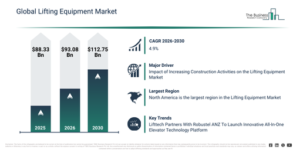
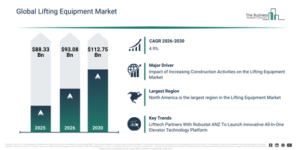
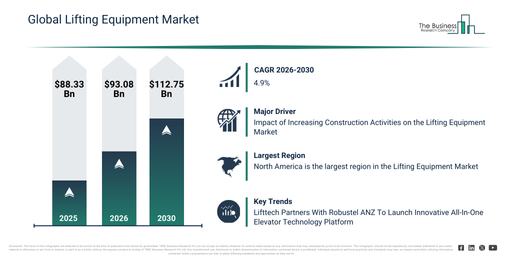
The lifting equipment market has experienced significant growth in recent years. It is projected to expand from $88.33 billion in 2025 to $93.08 billion in 2026, at a compound annual growth rate (CAGR) of 5.4%. Historically, this growth can be attributed to factors such as infrastructure development, increased construction activities, industrial expansion, the demand for material handling solutions, and urbanization trends.
The lifting equipment market size is forecasted to undergo steady expansion in the upcoming years. It is predicted to reach $112.75 billion in 2030, exhibiting a compound annual growth rate (CAGR) of 4.9%. This anticipated growth during the forecast period is primarily driven by investments in smart construction, the adoption of automated lifting systems, the increasing number of renewable energy projects, a rising demand for efficient load handling, and advancements in digital fleet management. Significant trends expected during this period involve the integration of smart lifting equipment, the expansion of electric lifting systems, a growing demand for heavy-duty construction equipment, the broadening of rental equipment services, and an enhanced focus on workplace safety.
Claim Your Free Lifting Equipment Market Sample Report With Key Data And Trends:
Lifting Equipment Market Demand Analysis: The Driving Force Behind Expansion
Growing construction activities are anticipated to boost the expansion of the lifting equipment market in the future. These activities encompass diverse tasks and procedures related to the planning, design, construction, renovation, and upkeep of structures and infrastructure. They involve multiple phases and specializations within the construction sector, all crucial for the successful execution of construction projects. The surge in construction is driven by the demand for new structures and infrastructure, rising urbanization, and advancements in building techniques and materials. In construction, lifting apparatus assists in the safe transportation of heavy materials and parts, speeding up project schedules, and improving both worker productivity and safety. Consequently, the expansion of construction endeavors will propel the lifting equipment market.
Breaking Down The Lifting Equipment Market By Segment
The lifting equipment market covered in this report is segmented –
1) By Type: Trucks, Lifts, Cranes, Hoists, Jacks, Aerial Work Lift Platforms, Other Types
2) By Mechanism: Mechanical, Hydraulic, Pneumatic, Electric, Magnetic
3) By Application: Construction, Government, Power, Industrial, Telecommunication
Subsegments:
1) By Trucks: Flatbed Trucks, Hydraulic Lifting Trucks, Crane Trucks
2) By Lifts: Scissor Lifts, Personnel Lifts, Platform Lifts
3) By Cranes: Mobile Cranes, Tower Cranes, Overhead Cranes, Crawler Cranes
4) By Hoists: Electric Hoists, Manual Hoists, Pneumatic Hoists
5) By Jacks: Hydraulic Jacks, Mechanical Jacks, Bottle Jacks
6) By Aerial Work Lift Platforms: Boom Lifts, Scissor Lifts, Vertical Mast Lifts
7) By Other Types: Conveyors, Winches, Forklifts
Top Trend Influencing The Lifting Equipment Market Outlook
Leading companies within the lifting equipment market are concentrating on developing innovative technologies, such as advanced elevator systems, to maintain their standing. Elevator technology refers to improvements and advancements in elevator systems that enhance their efficiency, safety, comfort, and sustainability. These innovations are designed to address the escalating demands of modern buildings, especially high-rise constructions, and to improve the overall user experience.
Lifting Equipment Market Competitive Landscape And Major Players
Major companies operating in the lifting equipment market are Komatsu Ltd., Toyota Industries Corporation, Anhui Heli Co. Ltd., Liebherr International AG, XCMG Group, Kion Group AG, Zoomlion Heavy Industry Science and Technology Co Ltd, Ingersoll Rand Inc., Mitsubishi Logisnext Co. Ltd., Jungheinrich AG, Terex Corporation, Cargotec Corporation, Daifuku Co. Ltd., Hyster-Yale Materials Handling Inc., Konecranes plc, Mammoet Holding BV, Palfinger AG, Columbus McKinnon Corporation, Haulotte Group, Kito Corporation
Read The Full Lifting Equipment Market Report By The Business Research Company:
Where Is The Lifting Equipment Market Largest? Key Regional Insights
North America was the largest region in the lifting equipment market in 2025. Asia-Pacific is expected to be the fastest-growing region in the forecast period. The regions covered in the lifting equipment market report are Asia-Pacific, South East Asia, Western Europe, Eastern Europe, North America, South America, Middle East, Africa
Reach Out To Our Team:
The Business Research Company: https://www.thebusinessresearchcompany.com/
Americas: +1 310-496-7795
Asia: +44 7882 955267 & +91 8897263534
Europe: +44 7882 955267
Email us at: marketing@tbrc.info
Follow us on:
LinkedIn: https://in.linkedin.com/company/the-business-research-company
YouTube: https://www.youtube.com/channel/UC24_fI0rV8cR5DxlCpgmyFQ
Global Market Model: https://www.thebusinessresearchcompany.com/global-market-model

Wasay has over a decade of experience in market research, data modelling, and analytics, with prior experience at GlobalData and Decision Tree Consulting Services. At The Business Research Company , he leads research operations across syndicated studies, customized consulting engagements, and the Global Market Model platform. His professional experience includes supporting organizations such as Boston Consulting Group, KPMG, and Ernst & Young. Wasay holds a degree in Electronics and Communications Engineering, postgraduate management qualifications from International Management Institute Belgium and Indian School of Business and Entrepreneurship, and completed the Integrated Program in Business Analytics from Indian Institute of Management Indore.