The Business Research Company’s 2026 market reports are designed to deliver research that is more actionable and strategically valuable. Key offerings include market attractiveness scoring, total addressable market sizing, company benchmarking matrices, interactive Excel dashboards, deeper supply chain intelligence, emerging startup tracking, and granular product-level insights.
Marine Hybrid Propulsion Market Revenue Projected To Rise To $8.41 Billion By 2030
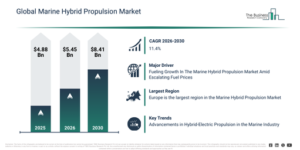
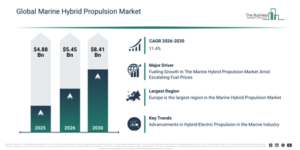
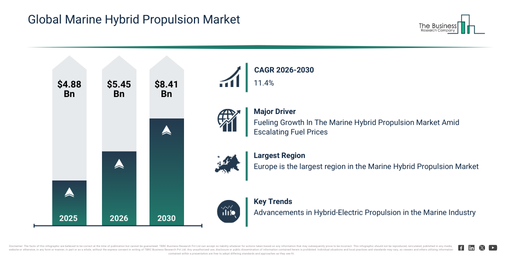
The marine hybrid propulsion market size has experienced significant expansion in recent years. This market is projected to increase from $4.88 billion in 2025 to $5.45 billion in 2026, exhibiting a compound annual growth rate (CAGR) of 11.6%. Historically, the market’s growth has been driven by factors such as emission regulations, fuel cost volatility, the adoption of diesel-electric systems, a rising demand for operational efficiency, and various pilot hybrid vessel projects.
The marine hybrid propulsion market size is projected to undergo significant expansion in the coming years, reaching $8.41 billion by 2030 with an impressive compound annual growth rate (CAGR) of 11.4%. This anticipated growth can be attributed to several factors including decarbonization targets, improvements in battery technology, incentives promoting green shipping, the rising demand for autonomous vessels, and enhanced smart energy management. Throughout the forecast period, major trends are expected to involve the increasing adoption of hybrid marine systems, the integration of battery energy storage, a heightened demand for emission reduction solutions, the expansion of electric propulsion, and advances in smart vessel design.
Want Deeper Marine Hybrid Propulsion Market Insights? Get A Free Sample Report:
Primary Growth Driver Shaping The Marine Hybrid Propulsion Market Outlook
Rising fuel costs are anticipated to stimulate the expansion of the marine hybrid propulsion market in the future. A fuel price represents the expenditure individuals or companies incur for various types of fuel, including gasoline, diesel, natural gas, or other energy sources utilized for vehicles, machinery, or heating. Marine hybrid propulsion systems are engineered for enhanced fuel efficiency, thereby curbing the use of costly marine fuels. With increasing fuel prices, the prospective savings in expenditure become increasingly appealing to shipowners and operators. For example, reports from February 2025 by the Bureau of Transportation Statistics, a US federal statistical agency under the U.S. Department of Transportation, indicated that motor gasoline prices for end users in the Rocky Mountain region of North America reached $2.90 per gallon in January 2025. Consequently, the upward trend in fuel prices is fueling the expansion of the marine hybrid propulsion market.
Marine Hybrid Propulsion Market Structure: A Detailed Look At Segments And Subsegments
The marine hybrid propulsion market covered in this report is segmented –
1) By Propulsion Type: Diesel-Electric, Parallel Hybrid, Serial Hybrid, Fuel cell
2) By Ship Type: Anchor Handling Tug Supply Vessels, Platform Supply Vessels, Yachts, Motor Ferry, Cruise Liner, Other Ship Types
3) By Application: Commercial, Logistics, Offshore Drilling, Naval, Other Applications
Subsegments:
1) By Diesel-Electric: Hybrid Diesel-Electric Propulsion Systems, Diesel-Electric Generators
2) By Parallel Hybrid: Mechanical Parallel Hybrid Systems, Electrical Parallel Hybrid Systems
3) By Serial Hybrid: Electric Drive With Diesel Generator, Battery-Assisted Diesel Engines
4) By Fuel Cell: Proton Exchange Membrane Fuel Cells (PEMFC), Solid Oxide Fuel Cells (SOFC)
Marine Hybrid Propulsion Market Innovation And Strategy Trends Among Leading Companies
Leading companies active in the marine hybrid propulsion market are engaged in developing innovative offerings, including hybrid electric propulsion systems. These systems facilitate operations using both battery-powered electric motors and diesel generators, enabling precise maneuvering in shallow or congested waters while maintaining adaptability for extended journeys. Hybrid electric propulsion itself is a marine drive system that integrates conventional engines with electric motors and batteries to power a vessel, allowing it to switch between or combine electric and diesel power based on operational demands.
Top Companies Competing In The Marine Hybrid Propulsion Market
Major companies operating in the marine hybrid propulsion market are Schottel GmbH, MAN Energy Solutions SE, Siemens AG, ABB Ltd., General Electric Company, Mitsubishi Heavy Industries Ltd., Torqeedo GmbH, Wärtsilä Corporation, Yanmar Co. Ltd., Cummins Inc., Volvo Penta AB, Oceanvolt Oy, TRANSFLUID Maschinenbau GmbH, Caterpillar Inc., Rolls-Royce Plc, Hyundai Heavy Industries Co. Ltd., IHI Power Systems Co. Ltd., Aspin Kemp & Associates Inc., Hybrid Marine Ltd., Kongsberg Maritime AS, Praxis Automation Technology B.V.
View The Complete Marine Hybrid Propulsion Market Study With Segment And Regional Data:
Marine Hybrid Propulsion Market Regional Outlook Across Major Geographies
Europe was the largest region in the marine hybrid propulsion market share in 2025. The regions covered in the marine hybrid propulsion market report are Asia-Pacific, South East Asia, Western Europe, Eastern Europe, North America, South America, Middle East, Africa
Reach Out To Our Team:
The Business Research Company: https://www.thebusinessresearchcompany.com/
Americas: +1 310-496-7795
Asia: +44 7882 955267 & +91 8897263534
Europe: +44 7882 955267
Email us at: marketing@tbrc.info
Follow us on:
LinkedIn: https://in.linkedin.com/company/the-business-research-company
YouTube: https://www.youtube.com/channel/UC24_fI0rV8cR5DxlCpgmyFQ
Global Market Model: https://www.thebusinessresearchcompany.com/global-market-model

Wasay has over a decade of experience in market research, data modelling, and analytics, with prior experience at GlobalData and Decision Tree Consulting Services. At The Business Research Company , he leads research operations across syndicated studies, customized consulting engagements, and the Global Market Model platform. His professional experience includes supporting organizations such as Boston Consulting Group, KPMG, and Ernst & Young. Wasay holds a degree in Electronics and Communications Engineering, postgraduate management qualifications from International Management Institute Belgium and Indian School of Business and Entrepreneurship, and completed the Integrated Program in Business Analytics from Indian Institute of Management Indore.