The Business Research Company’s 2026 market reports combine market attractiveness scoring, total addressable market sizing, company benchmarking matrices, interactive Excel dashboards, deeper supply chain intelligence, emerging startup tracking, and granular product-level insights to deliver research that is more actionable and strategically valuable.
Marine Propulsion Engines Market Revenue Forecast: $28.21 Billion In 2026 Rising To $33.75 Billion In 2030
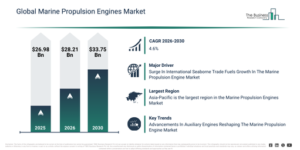
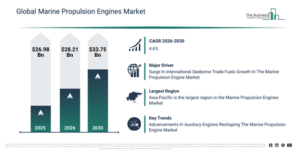
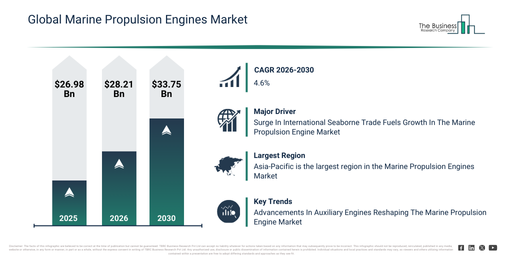
The marine propulsion engines market has seen steady growth in its size over recent years. It is projected to increase from $26.98 billion in 2025 to $28.21 billion in 2026, exhibiting a compound annual growth rate (CAGR) of 4.5%. This historical growth can be attributed to several factors including global maritime trade growth, the dominance of diesel propulsion, a rising demand for high-power engines, expansion in shipbuilding, and efforts toward fuel cost optimization.
The marine propulsion engines market size is anticipated to experience consistent growth over the next few years. It is projected to reach $33.75 billion by 2030, exhibiting a compound annual growth rate (CAGR) of 4.6%. This expansion during the forecast period can be attributed to factors such as decarbonization mandates, the adoption of alternative fuels, the development of digital engine control systems, vessel upgrades driven by efficiency, and various green shipping initiatives. Furthermore, major trends in this period include the uptake of low-emission propulsion systems, a transition towards LNG and dual-fuel engines, an increase in fleet modernization programs, a rising demand for high-efficiency engines, and the broader implementation of smart engine monitoring.
Free Sample Report: Marine Propulsion Engines Market Size, Trends And Forecast To 2030:
Marine Propulsion Engines Market Growth Catalyst: What Is Creating New Demand?
The marine propulsion engine market is projected to grow significantly, driven by the increasing international seaborne trade. Seaborne trade refers to the transport of goods across the sea using ships. Marine propulsion systems are essential for moving these vessels, simultaneously enhancing marine ecosystem safety, offering economic benefits, and minimizing emissions within the maritime industry. As a direct result, the expansion of international seaborne trade fuels the demand for the marine propulsion engine market. Consequently, the uptick in international seaborne trade is a primary factor propelling the marine propulsion engine market.
Marine Propulsion Engines Market Segment Overview: Categories Covered In The 2026 Report
The marine propulsion engines market covered in this report is segmented –
1) By Engine Type: 2-Stroke Engine, 4- Stroke Engine
2) By Ship Type: Cargo Or Container Ships, Tanker, Bulk Carrier, Offshore Vessel, Passenger Ship
3) By Power Range: 1,001-5,000 HP, 5,001-10,000 HP, 10,001-20,000 HP, Above 20,000 HP
4) By Fuel Type: Diesel, Heavy Fuel Oil, Natural Gas
5) By Application: Commercial, Defense, Passenger
Subsegments:
1) By 2-Stroke Engine: Low-Speed Crosshead 2-Stroke Engines, Medium-Speed Trunk Piston 2-Stroke Engines, Diesel-Fueled 2-Stroke Engines, Dual-Fuel 2-Stroke Engines (Diesel And Gas), Liquefied Natural Gas (LNG) 2-Stroke Engines, Heavy Fuel Oil 2-Stroke Engines, Electronically Controlled 2-Stroke Engines, Mechanically Controlled 2-Stroke Engines
2) By 4-Stroke Engine: Medium-Speed 4-Stroke Engines, High-Speed 4-Stroke Engines, Diesel-Fueled 4-Stroke Engines, Gas-Fueled 4-Stroke Engines, Dual-Fuel 4-Stroke Engines (Diesel And Gas), Liquefied Natural Gas (LNG) 4-Stroke Engines, Lean-Burn 4-Stroke Engines, Spark-Ignited 4-Stroke Engines, Turbocharged 4-Stroke Engines
How Are Leading Companies Shaping Marine Propulsion Engines Market Trends?
Leading firms within the marine propulsion engine market are introducing novel auxiliary engines to enhance their market competitiveness. An auxiliary engine serves as a supplementary power unit in a vehicle or vessel, supplying additional energy for distinct operations apart from main propulsion.
Marine Propulsion Engines Market Players: Key Companies Shaping Competition
Major companies operating in the marine propulsion engines market are Caterpillar lnc., Daihatsu Diesel Mfg Co. Ltd, Hyundai Heavy Industries Co. Ltd., Mitsubishi Heavy Industries Ltd., Rolls-Royce Holdings Plc, Wärtsilä Corporation, Yanmar Holdings Co. Ltd., Scania AB, MAN Energy Solutions, Cummins Inc., AB Volvo Penta, Kawasaki Heavy Industries Ltd., Fairbanks Morse Defense, Anglo Belgian Corporation, Nigata Power Systems Co. Ltd., Deutz AG, WinGD, Yamaha Motor Co. Ltd., China Shipbuilding Corporation, Mitsubishi Turbocharger and Engine Europe B.V.
Access Complete Marine Propulsion Engines Market Data, Forecasts And Competitive Insights:
Marine Propulsion Engines Market Regional Performance And Geographic Coverage
Asia-Pacific was the largest region in the marine propulsion engines market in 2025. The regions covered in the marine propulsion engines market report are Asia-Pacific, South East Asia, Western Europe, Eastern Europe, North America, South America, Middle East, Africa
Reach Out To Our Team:
The Business Research Company: https://www.thebusinessresearchcompany.com/
Americas: +1 310-496-7795
Asia: +44 7882 955267 & +91 8897263534
Europe: +44 7882 955267
Email us at: marketing@tbrc.info
Follow us on:
LinkedIn: https://in.linkedin.com/company/the-business-research-company
YouTube: https://www.youtube.com/channel/UC24_fI0rV8cR5DxlCpgmyFQ
Global Market Model: https://www.thebusinessresearchcompany.com/global-market-model

Wasay has over a decade of experience in market research, data modelling, and analytics, with prior experience at GlobalData and Decision Tree Consulting Services. At The Business Research Company , he leads research operations across syndicated studies, customized consulting engagements, and the Global Market Model platform. His professional experience includes supporting organizations such as Boston Consulting Group, KPMG, and Ernst & Young. Wasay holds a degree in Electronics and Communications Engineering, postgraduate management qualifications from International Management Institute Belgium and Indian School of Business and Entrepreneurship, and completed the Integrated Program in Business Analytics from Indian Institute of Management Indore.