Delivering more actionable and strategically valuable research, The Business Research Company’s 2026 market reports feature market attractiveness analysis, total addressable market evaluation, company benchmarking matrices, interactive Excel dashboards, expanded supply chain intelligence, emerging startup coverage, and detailed product insights.
#Synthetic Polymers Market Size And Revenue Forecast Through 2030
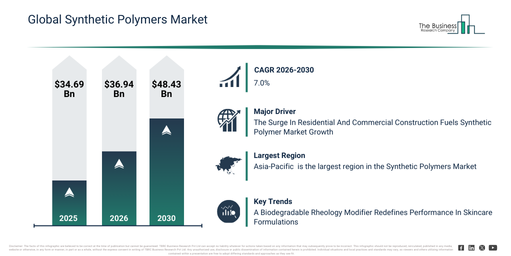
The synthetic polymers market has recently seen significant expansion. Forecasts predict its value will increase from $34.69 billion in 2025 to $36.94 billion by 2026, demonstrating a compound annual growth rate (CAGR) of 6.5%. Historically, this growth can be linked to factors such as the expansion of construction and infrastructure activities, the development of automotive manufacturing, the growing use of polymers in packaging and coatings, improved availability of petrochemical feedstocks, and progress in polymer chemistry.
The synthetic polymers market size is expected to grow significantly over the next few years, with forecasts indicating it will achieve a valuation of $48.43 billion by 2030, exhibiting a compound annual growth rate (CAGR) of 7.0%. This anticipated expansion throughout the forecast timeframe stems from various elements, including an increased need for environmentally friendly and reusable polymers, expanded use in electric vehicle parts, the widening range of smart material uses, a stronger emphasis on materials for the circular economy, and boosted funding in cutting-edge polymer technologies. Major trends expected within this period include a rising requirement for high-performance synthetic substances, more extensive deployment in lightweight automotive uses, the broadening incorporation of polymers into construction materials, a concentrated focus on recyclable polymer options, and enhanced tailor-making of polymer characteristics.
Download A Free Sample Report For Comprehensive Market Insights:
Synthetic Polymers Market Development Factors: Which Trends Are Supporting Demand?
The expanding automotive sector is anticipated to drive the future expansion of the synthetic pigments market. This industry covers the conceptualization, creation, production, promotion, and sale of motor vehicles such as cars, trucks, and motorcycles, in addition to their parts and related services. Its growth stems from rising worldwide demand for vehicles, progress in electric and self-driving technologies, and an increasing requirement for sustainable and efficient transport options. Synthetic pigments are essential in the automotive sector for delivering long-lasting, vivid, and customizable colors that offer improved resilience against environmental elements such as UV light, heat, and chemical exposure. For example, as reported in January 2024 by the European Automobile Manufacturers’ Association (ACEA), a Belgium-based lobbying and standards group for the automobile industry, the EU car market saw substantial growth of 13.9% in 2023, with sales hitting 867,052 units compared to 2022, leading to an overall annual volume of 10.5 million units. Most markets recorded double-digit increases, particularly among three of the biggest: Italy (+18.9%), Spain (+16.7%), and France (+16.1%). Conversely, Germany registered a more moderate year-on-year expansion of 7.3%. Consequently, the expanding automotive industry is fueling the growth of the synthetic pigments market.
Synthetic Polymers Market Segment Analysis: What Are The Major Market Categories?
The synthetic polymers market covered in this report is segmented –
1) By Type: Styrene Acrylic, Styrene Butadiene, Acrylic, Vinyl Acetate Copolymer, Polyvinyl Acetate, Vinyl Acetate Ethylene, Other Types
2) By Application: Paints And Coatings, Adhesives And Sealants, Nonwovens, Other Applications
3) By End User: Construction, Automotive, Electronics, Textile, Healthcare, Other End-Users
Subsegments:
1) By Styrene Acrylic: Styrene Acrylic Emulsions, Styrene Acrylic Resins
2) By Styrene Butadiene: Styrene Butadiene Rubber (SBR), Styrene Butadiene Latex
3) By Acrylic: Acrylic Resins, Acrylic Polymers
4) By Vinyl Acetate Copolymer: Vinyl Acetate Ethylene Copolymer, Vinyl Acetate Butyl Acrylate Copolymer
5) By Polyvinyl Acetate: Polyvinyl Acetate Emulsions, Polyvinyl Acetate Films
6) By Vinyl Acetate Ethylene: Vinyl Acetate Ethylene Emulsions, Vinyl Acetate Ethylene Copolymers
7) By Other Types: Polyurethane, Polyethylene, Polypropylene, Other Specialty Polymers
Synthetic Polymers Market Transformation Trends: Which Innovations Are Driving Change?
Leading companies within the synthetic polymer market are developing environmentally friendly products, such as biodegradable rheology modifiers, to gain a competitive advantage. These biodegradable rheology modifiers are compounds that alter how materials flow and deform, and they naturally break down over a period, thereby promoting environmental sustainability. As an illustration, in February 2023, Clariant AG, a chemicals company based in Switzerland, launched Aristoflex Eco T, a novel rheology modifier. This patented technology combines the effectiveness of synthetic polymers with the ecological advantages of biopolymers. This advanced rheology modifier offers excellent thickening and stabilizing capabilities, while also being readily biodegradable and derived from natural sources, boasting a renewable carbon index (RCI) of 71%. Its composition includes tara gum and 2-acrylamido-2-methylpropane sulfonic acid (AMPS).
Synthetic Polymers Market Leading Companies Driving Competitive Growth
Major companies operating in the synthetic polymers market are BASF SE, Dow Inc., ExxonMobil Chemical Company, SABIC, LyondellBasell Industries N.V., DuPont de Nemours, Inc., Mitsubishi Chemical Corporation, LG Chem Ltd., Evonik Industries AG, Toray Industries, Inc., Celanese Corporation, Wacker Chemie AG, Huntsman Corporation, Trinseo LLC, Asahi Kasei Corporation, Apcotex Industries Limited, Lubrizol Corporation, Covestro AG, Sumitomo Chemical Co., Ltd., Braskem S.A., Chevron Phillips Chemical Company LLC, Formosa Plastics Corporation
Access The Complete Synthetic Polymers Market Report:
Synthetic Polymers Market Regional Distribution: Which Areas Drive Market Expansion?
Asia-Pacific was the largest region in the synthetic polymers market in 2025. The regions covered in the synthetic polymers market report are Asia-Pacific, South East Asia, Western Europe, Eastern Europe, North America, South America, Middle East, Africa
Get in touch with us:
The Business Research Company: https://www.thebusinessresearchcompany.com/
Americas: +1 310-496-7795
Asia: +44 7882 955267 & +91 8897263534
Europe: +44 7882 955267
Email us at: marketing@tbrc.info
Follow us on:
LinkedIn: https://in.linkedin.com/company/the-business-research-company
YouTube: https://www.youtube.com/channel/UC24_fI0rV8cR5DxlCpgmyFQ
Global Market Model: https://www.thebusinessresearchcompany.com/global-market-model

Wasay has over a decade of experience in market research, data modelling, and analytics, with prior experience at GlobalData and Decision Tree Consulting Services. At The Business Research Company , he leads research operations across syndicated studies, customized consulting engagements, and the Global Market Model platform. His professional experience includes supporting organizations such as Boston Consulting Group, KPMG, and Ernst & Young. Wasay holds a degree in Electronics and Communications Engineering, postgraduate management qualifications from International Management Institute Belgium and Indian School of Business and Entrepreneurship, and completed the Integrated Program in Business Analytics from Indian Institute of Management Indore.