
Through market attractiveness analysis, total addressable market evaluation, company benchmarking matrices, interactive Excel dashboards, expanded supply chain intelligence, emerging startup coverage, and detailed product insights, The Business Research Company’s 2026 market reports provide more actionable and strategically valuable research.
Automotive Fabric Market Revenue Outlook: What CAGR Is Expected Through 2030?
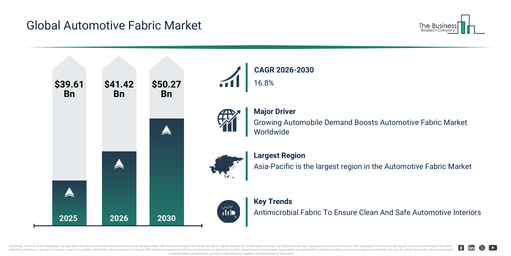
The automotive fabric market has experienced steady expansion in recent years. It is projected to grow from $39.61 billion in 2025 to $41.42 billion in 2026, reflecting a compound annual growth rate (CAGR) of 4.6%. The market’s historical growth can be attributed to factors such as vehicle interior customization, an increase in passenger vehicle sales, compliance with safety regulations, the rising demand for comfort features, and advancements in textile manufacturing.
The automotive fabric market is projected to experience consistent expansion over the upcoming years. By 2030, its value is anticipated to reach $50.27 billion, demonstrating a compound annual growth rate (CAGR) of 5.0%. Factors contributing to this growth during the forecast period include the redesign of electric vehicle interiors, the increasing adoption of recycled fabrics, efforts towards lightweighting, a rising demand for premium interiors, and advancements in smart textiles. Key trends identified for the forecast period encompass a greater emphasis on sustainable interior materials, the need for lightweight automotive textiles, broader applications for safety textiles, the integration of advanced composite fabrics, and an enhanced focus on passenger comfort within vehicle interiors.
Download A Free Sample Report For Comprehensive Market Insights:
#Automotive Fabric Market Growth Factors: Which Forces Are Supporting Market Expansion?
The automotive fabric market is anticipated to expand due to an increase in automobile demand. Global economies have seen consistent growth, elevating living standards and consequently boosting purchasing power. The onset of the COVID-19 pandemic also led individuals to favor safer transportation methods that allowed for social distancing, thus stimulating automobile growth. This escalating demand for vehicles, in turn, drives the need for automotive fabrics, as they provide passengers with maximum comfort, safety, and security during their journey. For instance, in September 2024, the European Automobile Manufacturers’ Association, a Belgium-based European Commission, reported that car production in the European Union reached 12.2 million units in 2023, marking an 11.6% rise from 2022. Therefore, the heightened demand for both passenger and commercial vehicles is propelling the growth of the automotive fabric market.
Automotive Fabric Market Segment Outlook: Which Categories Are Expanding The Fastest?
The automotive fabric market covered in this report is segmented –
1) By Fabric Type: Polyester, Vinyl, Leather, Nylon, Other Fabric Types
2) By Vehicle Type: Passenger Vehicles, Commercial Vehicles
3) By Application: Carpets or Floor Covering, Upholstery, Pre-Assembled Interior Components, Safety-Belts, Airbags, Other Applications
Subsegments:
1) By Polyester: Woven Polyester, Non-Woven Polyester, Blended Polyester
2) By Vinyl: PVC Vinyl, PU Vinyl
3) By Leather: Genuine Leather, Synthetic Leather, Suede Leather
4) By Nylon: Woven Nylon, Non-woven Nylon, Blended Nylon
5) By Other Fabric Types: Cotton, Acrylic, Wool, Specialty Fabrics
Automotive Fabric Market Industry Trends: What Changes Are Reshaping Demand?
Leading companies in the automotive fabric market are developing innovative products, such as antimicrobial fabric. This fabric is engineered to inhibit the proliferation of microorganisms, thereby preventing bacterial spread and ensuring a hygienic and odor-resistant textile. For example, in March 2023, ACME Mills, a manufacturer and exporter of home and hotel textiles, announced the introduction of its new antimicrobial fabric, SafeTEX. This fabric is specifically designed to help prevent the growth of bacteria and mold, which can frequently pose issues in automotive interiors.
Automotive Fabric Market Key Companies And Competitive Benchmarking
Major companies operating in the automotive fabric market report include Acme Mills Pvt Ltd., Suminoe Textile Co. Ltd., Arvind Limited, Grupo Antolin Irausa SA, Heathcoat Fabrics Limited, Lear Corporation, Martur Automotive Seating Systems, Navbharat Textile Industries Ltd., Seiren Co. Ltd., Sage Automotive Interiors Inc., Toyoda Boshoku Asia Co. Ltd., Aunde Faze Three Autofab Ltd., Haartz Corporation, Tenowo GmbH, Shandong Exceeding Auto Interior Parts Co. Ltd., Adient plc, Faurecia SA, Yanfeng Automotive Trim Systems Co Ltd., Trevira GmbH, Joyson Safety Systems Holdings Limited, Seton Company Inc., Bader GmbH & Co. KG
Access The Complete Automotive Fabric Market Report:
#Automotive Fabric Market Largest Region: Which Geography Holds The Highest Market Share?
Asia-Pacific was the largest region in the automotive fabric market in 2025. The regions covered in the automotive fabric market report include Asia-Pacific, South East Asia, Western Europe, Eastern Europe, North America, South America, Middle East, Africa.
Get in touch with us:
The Business Research Company: https://www.thebusinessresearchcompany.com/
Americas: +1 310-496-7795
Asia: +44 7882 955267 & +91 8897263534
Europe: +44 7882 955267
Email us at: marketing@tbrc.info
Follow us on:
LinkedIn: https://in.linkedin.com/company/the-business-research-company
YouTube: https://www.youtube.com/channel/UC24_fI0rV8cR5DxlCpgmyFQ
Global Market Model: https://www.thebusinessresearchcompany.com/global-market-model

Wasay has over a decade of experience in market research, data modelling, and analytics, with prior experience at GlobalData and Decision Tree Consulting Services. At The Business Research Company , he leads research operations across syndicated studies, customized consulting engagements, and the Global Market Model platform. His professional experience includes supporting organizations such as Boston Consulting Group, KPMG, and Ernst & Young. Wasay holds a degree in Electronics and Communications Engineering, postgraduate management qualifications from International Management Institute Belgium and Indian School of Business and Entrepreneurship, and completed the Integrated Program in Business Analytics from Indian Institute of Management Indore.