Delivering more actionable and strategically valuable research, The Business Research Company’s 2026 market reports feature market attractiveness analysis, total addressable market evaluation, company benchmarking matrices, interactive Excel dashboards, expanded supply chain intelligence, emerging startup coverage, and detailed product insights.
Automotive Human Machine Interface (HMI) Market Growth Potential: How Will Market Size Change Through 2030?
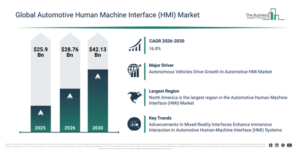
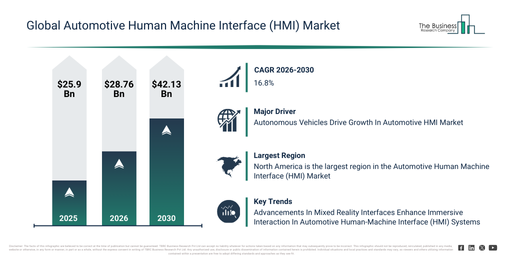
The market size for automotive human machine interfaces (HMI) has experienced rapid growth in recent years. It is anticipated to expand from $25.9 billion in 2025 to $28.76 billion in 2026, exhibiting a compound annual growth rate (CAGR) of 11.0%. The expansion observed in the past can be attributed to increasing vehicle electrification, infotainment system adoption, demand for enhanced driver experience, growth in passenger car production, and the integration of digital clusters.
The automotive human machine interface (hmi) market is projected to experience substantial expansion in the coming years. This market is anticipated to reach $42.13 billion by 2030, exhibiting a compound annual growth rate (CAGR) of 10.0%. Key factors driving this growth during the forecast period include the advancement of autonomous vehicles, the need for intuitive interfaces, the rise of software-defined vehicles, greater connectivity integration, and sophisticated advanced driver assistance systems. Noteworthy trends expected over this period encompass a wider use of touchscreen and digital displays, increasing integration of voice-based interfaces, the incorporation of augmented reality HUDs, a growing preference for multimodal HMI systems, and a heightened emphasis on interfaces designed for driver safety.
Download A Free Sample Report For Comprehensive Market Insights:
#Automotive Human Machine Interface (HMI) Market Demand Drivers Creating New Revenue Opportunities
The rising prevalence of autonomous vehicles is projected to stimulate the expansion of the automotive human-machine interface (HMI) market in the future. These self-driving vehicles utilize sophisticated sensor technologies, computer systems, and artificial intelligence to function and navigate independently, free from continuous human oversight or control. The surge in autonomous vehicles stems from progress in artificial intelligence and sensor technology, coupled with significant funding and backing from both private enterprises and governmental bodies aimed at improving transportation safety and efficiency. Automotive human-machine interfaces (HMIs) are vital in autonomous vehicles, enabling seamless communication and interaction between the vehicle’s internal systems and those inside, including drivers and passengers. For example, as reported in December 2024 by the National Highway Traffic Safety Administration, a US-based government agency, it is anticipated that by 2030, approximately 4.5 million self-driving vehicles will be operating on U.S. roads. Consequently, the growing count of autonomous vehicles fuels the expansion of the automotive human-machine interface (HMI) market.
Automotive Human Machine Interface (HMI) Market Segmentation Trends And Revenue Drivers
The automotive human machine interface (hmi) market covered in this report is segmented –
1) By Product Type: Voice Control, Central Display, Instrument Cluster, Steering Mounted Control, Rear-Seat Entertainment (RSE) Display, Heads-Up Display (HUD)
2) By Technology: Visual Interface, Acoustic, Mechanical, Other Technologies
3) By Access Type: Standard, Multimodal
4) By Vehicle Type: Passenger Cars, Commercial Vehicle
Subsegments:
1) By Voice Control: Voice-Activated Infotainment Systems, Voice-Controlled Navigation And Maps, Voice Assistance For Climate Control, Speech Recognition For Safety Features (Emergency Calls)
2) By Central Display: Touchscreen Displays, Multi-Functional Display Units (Mfd), Infotainment And Navigation Screens, Gesture-Controlled Displays
3) By Instrument Cluster: Analog Instrument Clusters, Digital Instrument Clusters, Virtual Instrument Clusters, Combined Digital And Analog Clusters, Tft-Icd Instrument Panels
4) By Steering Mounted Control: Steering Wheel Buttons For Infotainment Control, Multi-Function Steering Wheel Controls, Audio And Call Control Buttons, Driver Assistance And Cruise Control Buttons
5) By Rear-Seat Entertainment (Rse) Display: Video Displays For Rear Passengers, Interactive Entertainment Systems For Rear Seats, Touchscreen Rse Systems, Wireless Rse Systems (Wi-Fi Enabled)
6) By Heads-Up Display (Hud): Windshield Projection Hud Systems, Augmented Reality (Ar) Hud Systems, Full-Screen Huds, Navigation And Safety Information Huds, Multi-Layered Display Huds
Automotive Human Machine Interface (HMI) Market Trends Driving Strategic Industry Expansion
Key players in the automotive human-machine interface (HMI) market are concentrating on creating sophisticated solutions, including mixed reality interfaces, aiming to boost user involvement, refine driving interactions, and provide a more intuitive experience within vehicles. These mixed reality interfaces combine real-world and digital components to forge immersive interaction settings for both drivers and passengers. As an illustration, in January 2023, the German automotive manufacturer BMW introduced its I Vision Dee concept. This next-generation HMI advancement incorporates a full-width head-up display, designed to supersede conventional touchscreens. The concept features a mixed reality slider built into the dashboard fabric, allowing users to customize the amount of digital content displayed, complemented by touch-sensitive controls smoothly integrated into the doors and central console. Its interior exhibits a minimalist design, utilizing sustainable materials and monochromatic styling, while the exterior presents color-changing e-ink panels, digital LED headlights capable of expressive animations, and individualized welcome projections. The i Vision Dee offers a glimpse into BMW’s forthcoming Neue Klasse models, scheduled for production in 2025, thereby establishing a fresh standard for immersive and adaptive automotive HMI technologies.
#Automotive Human Machine Interface (HMI) Market Industry Leaders: Which Organizations Are Driving Competition?
Major companies operating in the automotive human machine interface (hmi) market report include Volkswagen AG, Toyota Motor Corporation, Luxoft Holding Inc., Ford Motor Company, General Motors Company, Honda Motor Co. Ltd., Hyundai Motor Group, Robert Bosch GmbH, Tesla Inc., Nissan Motor Co. Ltd., Kia Corporation, Panasonic Corporation, Denso Corporation, Continental AG, Valeo S.A., Mitsubishi Motors Corporation, Aptiv PLC, HARMAN International Industries Incorporated, Alpine Electronics Inc., Visteon Corporation, Synaptics Incorporated, Nuance Communications Inc., Clarion Co. Ltd., Tata Elxsi Limited, Magneti Marelli S.p.A.
Access The Complete Automotive Human Machine Interface (HMI) Market Report:
Automotive Human Machine Interface (HMI) Market Geographic Distribution And Regional Opportunities
North America was the largest region in the automotive human machine interface (HMI) market in 2025. The regions covered in the automotive human machine interface (hmi) market report include Asia-Pacific, South East Asia, Western Europe, Eastern Europe, North America, South America, Middle East, Africa.
Get in touch with us:
The Business Research Company: https://www.thebusinessresearchcompany.com/
Americas: +1 310-496-7795
Asia: +44 7882 955267 & +91 8897263534
Europe: +44 7882 955267
Email us at: marketing@tbrc.info
Follow us on:
LinkedIn: https://in.linkedin.com/company/the-business-research-company
YouTube: https://www.youtube.com/channel/UC24_fI0rV8cR5DxlCpgmyFQ
Global Market Model: https://www.thebusinessresearchcompany.com/global-market-model

Wasay has over a decade of experience in market research, data modelling, and analytics, with prior experience at GlobalData and Decision Tree Consulting Services. At The Business Research Company , he leads research operations across syndicated studies, customized consulting engagements, and the Global Market Model platform. His professional experience includes supporting organizations such as Boston Consulting Group, KPMG, and Ernst & Young. Wasay holds a degree in Electronics and Communications Engineering, postgraduate management qualifications from International Management Institute Belgium and Indian School of Business and Entrepreneurship, and completed the Integrated Program in Business Analytics from Indian Institute of Management Indore.