Delivering more actionable and strategically valuable research, The Business Research Company’s 2026 market reports feature market attractiveness analysis, total addressable market evaluation, company benchmarking matrices, interactive Excel dashboards, expanded supply chain intelligence, emerging startup coverage, and detailed product insights.
Electric Vehicle Polymers Market Revenue Outlook: What CAGR Is Expected Through 2030?
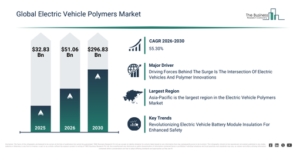
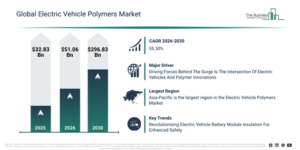
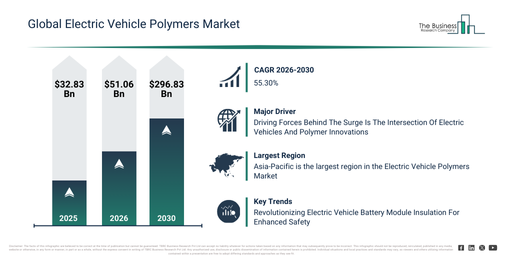
The market size for electric vehicle polymers has experienced substantial growth in recent years. It is anticipated to expand from $32.83 billion in 2025 to $51.06 billion by 2026, achieving a compound annual growth rate (CAGR) of 55.5%. The expansion observed historically can be ascribed to trends in electric vehicle lightweighting, enhancements in polymer performance, the necessity for cost reduction, the replacement of traditional metals, and the benefits derived from component integration.
The electric vehicle polymers market size is anticipated to undergo significant expansion over the next few years. It is projected to climb to $296.83 billion by 2030, demonstrating a compound annual growth rate (CAGR) of 55.3%. This surge in the forecast period stems from factors such as advanced polymer formulations, regulations for recyclability, the escalating demand for higher temperature resistance, the emergence of scalable EV platforms, and ongoing material innovation. Prominent trends within this period encompass the increasing use of engineering polymers, the expansion of elastomer applications in EVs, a rising need for structural polymer components, the integration of polymers into powertrain systems, and a dedicated focus on optimizing vehicle weight and range.
Download A Free Sample Report For Comprehensive Market Insights:
#Electric Vehicle Polymers Market Demand Drivers Creating New Revenue Opportunities
The future expansion of the electric vehicle polymers market is expected to be propelled by the increasing demand for electric vehicles. An electric vehicle is a type of vehicle that operates using one or more electric motors, which draw power from an external electricity source. Polymers are incorporated into electric vehicles to achieve weight reduction, boost efficiency, enhance durability, and provide greater design flexibility. For instance, in January 2024, the U.S. Energy information administration, a US-based organization, stated that in 2023, hybrid vehicles, plug-in hybrid electric vehicles, and battery electric vehicles (BEVs) collectively accounted for 16.3% of total new light-duty vehicle (LDV) sales in the US. Therefore, the growing demand for electric vehicles is driving the expansion of the electric vehicle polymers market.
Electric Vehicle Polymers Market Segment Landscape: Which Areas Lead Market Development?
The electric vehicle polymers market covered in this report is segmented –
1) By Type: Engineering Plastics, Elastomers
2) By Component: Powertrain System, Exterior, Interior
3) By End User: Battery Electric Vehicles (BEVs), Plug-In Hybrid Electric Vehicles (PHEVs), Hybrid Electric Vehicles (HEVs), Fuel Cell Electric Vehicles (FCEVs)
Subsegments:
1) By Engineering Plastics: Polycarbonate (PC), Polyamide (PA), Polyethylene Terephthalate (PET), Polypropylene (PP), Acrylonitrile Butadiene Styrene (ABS)
2) By Elastomers: Thermoplastic Elastomers (TPE), Ethylene Propylene Diene Monomer (EPDM), Silicone Elastomers, Natural Rubber
Electric Vehicle Polymers Market Trends Driving Strategic Industry Expansion
Leading companies within the electric vehicle polymers market are prioritizing the creation of innovative products, such as high-heat and flame-resistant polymers, to bolster battery safety and thermal performance. These advanced polymers are specifically engineered to endure extreme temperatures without melting or igniting, thereby safeguarding electric vehicle battery components, preventing thermal runaway, and enhancing overall safety. For instance, in March 2023, Solvay, a chemical company based in Belgium, launched Xydar LCP G-330 HH, a new polymer intended for high-heat electric vehicle battery module insulation. This novel liquid crystal polymer grade, Xydar LCP G-330 HH, is designed to significantly improve passenger safety during a battery thermal runaway event. It represents a brand-new high-heat and flame-resistant grade specifically developed for the battery module plates of electric vehicle models operating on higher voltage systems. This material satisfies rigorous thermal and insulation requirements. It is an injection-molded, glass-filled LCP capable of maintaining its electrical insulation after being subjected to 400°C for 30 minutes. Xydar LCP inherently possesses flame resistance, eliminating the need for added halogen or bromine additives.
Electric Vehicle Polymers Market Industry Leaders And Market Competition
Major companies operating in the electric vehicle polymers market report include BASF SE, Saudi Basic Industries Corporation, LG Chemical Ltd., Sumitomo Chemical Co Ltd., Toray Industries Inc., Evonik Industries AG, Covestro AG, Shin-Etsu Chemical Co Ltd., Asahi Kasei Corporation, Solvay S.A., Mitsui Chemicals Inc., DuPont de Nemours Inc., Arkema SA, Celanese Corporation, Koninklijke DSM NV, Lanxess AG, Tosoh Corporation, DIC Corporation, Teijin Limited, Kumho Petrochemical Co Ltd., Ube Industries Ltd., Zeon Corporation, JSR Corporation, Kuraray Co Ltd., Sumitomo Bakelite Co Ltd., Mitsubishi Engineering-Plastics Corporation, Polyplastics Co Ltd.
Access The Complete Electric Vehicle Polymers Market Report:
Electric Vehicle Polymers Market Largest Region By Revenue And Market Share
Asia-Pacific was the largest region in the electric vehicle polymers market in 2025. The regions covered in the electric vehicle polymers market report include Asia-Pacific, South East Asia, Western Europe, Eastern Europe, North America, South America, Middle East, Africa.
Get in touch with us:
The Business Research Company: https://www.thebusinessresearchcompany.com/
Americas: +1 310-496-7795
Asia: +44 7882 955267 & +91 8897263534
Europe: +44 7882 955267
Email us at: marketing@tbrc.info
Follow us on:
LinkedIn: https://in.linkedin.com/company/the-business-research-company
YouTube: https://www.youtube.com/channel/UC24_fI0rV8cR5DxlCpgmyFQ
Global Market Model: https://www.thebusinessresearchcompany.com/global-market-model

Wasay has over a decade of experience in market research, data modelling, and analytics, with prior experience at GlobalData and Decision Tree Consulting Services. At The Business Research Company , he leads research operations across syndicated studies, customized consulting engagements, and the Global Market Model platform. His professional experience includes supporting organizations such as Boston Consulting Group, KPMG, and Ernst & Young. Wasay holds a degree in Electronics and Communications Engineering, postgraduate management qualifications from International Management Institute Belgium and Indian School of Business and Entrepreneurship, and completed the Integrated Program in Business Analytics from Indian Institute of Management Indore.