Enhanced with market attractiveness analysis, total addressable market evaluation, company benchmarking matrices, interactive Excel dashboards, expanded supply chain intelligence, emerging startup coverage, and detailed product insights, The Business Research Company’s 2026 market reports deliver more actionable and strategically valuable research.
In-Cabin Monitoring Camera Market Expansion Outlook: What Revenue Opportunities Lie Ahead?
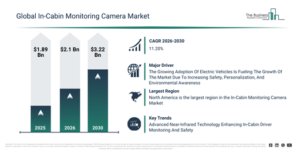
The in-cabin monitoring camera market has experienced rapid expansion in its size over recent years. Its value is projected to increase from $1.89 billion in 2025 to $2.1 billion in 2026, reflecting a compound annual growth rate (CAGR) of 11.5%. This growth in the historic period was fueled by factors such as safety regulation enforcement, increased camera sensor adoption, a rise in ride-sharing fleets, the growing demand for driver fatigue detection, and the overall growth of vehicle electronics.
The in-cabin monitoring camera market is anticipated to undergo significant expansion in the upcoming years. Its valuation is set to reach $3.22 billion by 2030, growing at a compound annual growth rate (CAGR) of 11.2%. This projected growth during the forecast period stems from developments in autonomous vehicles, stricter safety mandates, AI-based facial recognition capabilities, enhanced smart cabin experiences, and the increasing adoption of connected mobility. Prominent trends for this period encompass the adoption of driver monitoring systems, their integration with ADAS platforms, the expanding use of infrared cameras, the wider application of fleet safety solutions, and a rising demand for occupant behavior analytics.
Download A Free Sample Report For Comprehensive Market Insights:
In-Cabin Monitoring Camera Market Industry Drivers: What Is Driving Revenue Growth?
The expanding prevalence of electric vehicles is anticipated to fuel the growth of the in-cabin monitoring camera market going forward. These vehicles operate on electric motors and rechargeable batteries, diverging from traditional internal combustion engines. The adoption of Electric Vehicles (EVs) is primarily driven by heightened environmental consciousness, with a growing preference for cleaner transportation options to mitigate air pollution and address climate change. Within EVs, in-cabin monitoring cameras enhance safety through the detection of driver drowsiness, distraction, or seatbelt misuse, delivering timely alerts. They also facilitate personalized cabin settings and insights into passenger behavior, contributing to a smarter, more responsive driving experience. For example, a January 2024 report from Kelley Blue Book, a US-based Cox Automotive company, indicated that in 2023, a record 1.2 million car buyers in the United States selected electric vehicles, accounting for 7.6% of the entire U.S. vehicle market, an increase from 5.9% in 2022. Consequently, the increasing adoption of electric vehicles is a significant catalyst for the growth of the in-cabin monitoring camera market.
In-Cabin Monitoring Camera Market Segment Analysis: What Are The Major Market Categories?
The in-cabin monitoring camera market covered in this report is segmented –
1) By Type: Two-Dimensional (2D) Camera, Time-Of-Flight (TOF) Three-Dimensional (3D) Camera
2) By Technology: Infrared Cameras, Visible Light Cameras, Thermal Cameras, Depth Sensing Cameras
3) By Installation Type: Original Equipment Manufacturer (OEM), Aftermarket
4) By End-Use: Passenger Vehicles, Commercial Vehicles, Public Transport, Fleet Management
Subsegments:
1) By Two-Dimensional (2D) Camera: Monochrome Cameras, Color Cameras, High Dynamic Range (HDR) Cameras, Global Shutter Cameras
2) By Time-Of-Flight (TOF) Three-Dimensional (3D) Camera: Short-Range Time-Of-Flight (TOF) Camera, Long-Range Time-Of-Flight (TOF) Camera, Indirect Time-Of-Flight (TOF) Camera, Direct Time-Of-Flight (TOF) Camera, Hybrid Time-Of-Flight (TOF) Camera
#In-Cabin Monitoring Camera Market Growth Trends: What Is Influencing The Future Outlook?
Leading companies in the in-cabin monitoring camera market are concentrating on developing sophisticated products, such as near-infrared technology-based monitoring systems, to enhance driver detection accuracy. These near-infrared technology-based monitoring systems utilize invisible infrared light to track a driver’s eyes, head, and facial movements in low-light or nighttime conditions, facilitating continuous monitoring and improving in-cabin safety by accurately identifying fatigue or distraction. For example, in May 2025, Omnivision, a US-based fabless semiconductor company specializing in advanced digital imaging solutions, introduced OX01N1B, a 1.5-megapixel global shutter sensor designed for automotive driver monitoring systems (DMS). This sensor incorporates advanced Nyxel near-infrared technology with a 2.2-micron pixel size, achieving an industry-leading quantum efficiency of 36% for outstanding low-light performance and a high modulation transfer function for superior image quality. It is engineered for cost-effective, compact, and flexible deployment in vehicles, supports rapid motion capture without distortion, and includes integrated safety and cybersecurity features that meet ASIL B standards, targeting driver monitoring for improved road safety.
In-Cabin Monitoring Camera Market Leading Companies Driving Competitive Growth
Major companies operating in the in-cabin monitoring camera market report include Robert Bosch GmbH, Panasonic Holdings Corporation, DENSO Corporation, Hyundai Mobis Co. Ltd., Continental Aktiengesellschaft, ZF Friedrichshafen Aktiengesellschaft, Magna International Inc., Mitsubishi Electric Corporation, Aisin Corporation, Valeo SA, Parker-Hannifin Corporation, LG Innotek Co. Ltd., onsemi, Visteon Corporation, Ofilm Group Co. Ltd., Gentex Corporation, OmniVision Technologies Inc, IAV GmbH Ingenieurgesellschaft Auto und Verkehr, Seeing Machines Limited, Idneo Technologies S.A., Smart Eye AB
Access The Complete In-Cabin Monitoring Camera Market Report:
In-Cabin Monitoring Camera Market Geographic Distribution And Regional Opportunities
North America was the largest region in the in-cabin monitoring camera market in 2025. Asia-Pacific is expected to be the fastest-growing region in the forecast period. The regions covered in the in-cabin monitoring camera market report include Asia-Pacific, South East Asia, Western Europe, Eastern Europe, North America, South America, Middle East, Africa.
Get in touch with us:
The Business Research Company: https://www.thebusinessresearchcompany.com/
Americas: +1 310-496-7795
Asia: +44 7882 955267 & +91 8897263534
Europe: +44 7882 955267
Email us at: marketing@tbrc.info
Follow us on:
LinkedIn: https://in.linkedin.com/company/the-business-research-company
YouTube: https://www.youtube.com/channel/UC24_fI0rV8cR5DxlCpgmyFQ
Global Market Model: https://www.thebusinessresearchcompany.com/global-market-model

Wasay has over a decade of experience in market research, data modelling, and analytics, with prior experience at GlobalData and Decision Tree Consulting Services. At The Business Research Company , he leads research operations across syndicated studies, customized consulting engagements, and the Global Market Model platform. His professional experience includes supporting organizations such as Boston Consulting Group, KPMG, and Ernst & Young. Wasay holds a degree in Electronics and Communications Engineering, postgraduate management qualifications from International Management Institute Belgium and Indian School of Business and Entrepreneurship, and completed the Integrated Program in Business Analytics from Indian Institute of Management Indore.