Enhanced with market attractiveness analysis, total addressable market evaluation, company benchmarking matrices, interactive Excel dashboards, expanded supply chain intelligence, emerging startup coverage, and detailed product insights, The Business Research Company’s 2026 market reports deliver more actionable and strategically valuable research.
Luxury Car Market Growth Potential: How Will Market Size Change Through 2030?
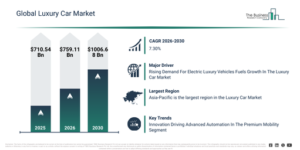
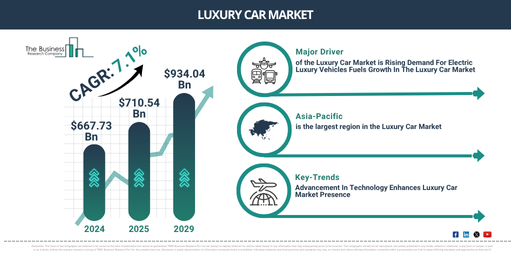
The luxury car market size has demonstrated robust expansion over recent years. It is anticipated to expand from $710.54 billion in 2025 to $759.11 billion in 2026, at a compound annual growth rate (CAGR) of 6.8%. This historical growth can be attributed to several factors including an increase in high net worth individuals, a rise in disposable income, the proliferation of premium automotive brands, the strong demand for prestige vehicles, and technological advancements in luxury cars.
The luxury car market size is projected to experience robust expansion over the coming years. Its size is anticipated to reach $1006.68 billion by 2030, demonstrating a compound annual growth rate (CAGR) of 7.3%. This expansion during the forecast period is driven by factors such as the rising uptake of electric luxury vehicles, a growing demand for autonomous capabilities, the development of digital vehicle experiences, the spread into new luxury markets, and investments aimed at premium mobility innovation. Key trends foreseen for this period encompass the incorporation of advanced driver assistance systems, an increasing appetite for connected luxury vehicles, the broadening range of electric luxury car models, enhanced customization and personalization options, and the increasing embrace of advanced safety technologies.
Download A Free Sample Report For Comprehensive Market Insights:
Luxury Car Market Growth Drivers: What Factors Are Accelerating Expansion?
The increasing prevalence of electric luxury vehicles is anticipated to foster the expansion of the luxury car market moving forward. An electric luxury vehicle is defined as an automobile that relies exclusively on battery-stored energy to be propelled by one or more electric traction motors. Heightened environmental awareness along with a desire for state-of-the-art technology and innovation within luxury automobiles are fueling the rising demand for electric luxury cars. This surge in the appeal of electric luxury automobiles represents the primary force driving increased demand within the luxury car market. For instance, in January 2024, the U.S. Department of Energy, a US-based government agency, reported that in December 2023, plug-in electric vehicles constituted 9.8% of all light-duty vehicle sales, marking an increase from 7.8% in December 2022. Throughout 2023, plug-in vehicles consistently represented at least 8% of monthly sales, whereas their proportion in 2022 varied between 5.5% and 7.8%. Therefore, the expanding trend of electric luxury vehicles is significantly contributing to the growth of the luxury car market.
#Luxury Car Market Segment Landscape And Growth Potential
The luxury car market covered in this report is segmented –
1) By Vehicle: Hatchback, Sedan, Sports Utility, Multi-Purpose Vehicle
2) By Vehicle Class: Entry-Level Luxury, Mid-Level Luxury, Ultra Luxury
3) By Propulsion: Internal Combustion Engine (ICE), Electric
4) By Fuel: Gasoline, Diesel, Electric
Subsegments:
1) By Hatchback: Premium Hatchback, Luxury Compact Hatchback
2) By Sedan: Luxury Sedan, Executive Sedan, Sports Sedan
3) By Sports Utility: Luxury, Compact Luxury, Mid-Size Luxury, Full-Size Luxury
4) By Multi-Purpose Vehicle (MPV): Luxury, Premium
Luxury Car Market Trends: What Is Shaping Future Industry Growth?
Leading companies operating in the luxury car market are concentrating on developing advanced solutions, such as Level 3 conditionally automated driving systems. This focus aims to satisfy the increasing consumer demand for safer, more convenient, and technologically rich premium mobility, as affluent buyers increasingly seek hands-free driving in congested traffic, uninterrupted connectivity, and unique in-car experiences. Level 3 conditionally automated driving implies the vehicle operates autonomously under specific conditions, though the human driver must be prepared to intervene when prompted by the system. As an illustration, in September 2023, Mercedes-Benz Group AG, a luxury automobile manufacturer based in Germany, introduced DRIVE PILOT. This production-ready SAE Level 3 automated driving feature was initially made available on a select number of EQS Sedan and S-Class luxury models in California. DRIVE PILOT integrates an extensive sensor suite comprising over 30 sensors, including Valeo LiDAR, multiple radars, surround-view cameras, ultrasonic units, and road-moisture sensors. These are combined with HERE HD Live Map data and an ultra-precise GPS system capable of pinpointing the vehicle’s location within inches, thereby establishing redundant 360-degree awareness that surpasses the capabilities of conventional ADAS. When activated on approved freeway sections and up to specified speeds, the system assumes both longitudinal and lateral control, allowing drivers to engage in activities such as reading, messaging, or utilizing in-car applications that would typically be restricted. Critically, Mercedes-Benz accepts liability for the driving task under defined conditions, marking a significant distinction from standard Level 2 luxury systems. Furthermore, DRIVE PILOT incorporates robust fail-safe logic that continuously monitors driver readiness, issues progressively urgent takeover requests, and, if the driver fails to respond, executes a controlled stop complete with hazard lights and emergency calling, thereby enhancing safety and consumer trust within high-end vehicle segments.
Luxury Car Market Competitive Landscape: Who Are The Leading Companies?
Major companies operating in the luxury car market report include Mercedes-Benz Group AG, BMW AG, Audi AG, Tesla Inc., Volvo Car Corporation, Jaguar Land Rover Automotive PLC, Rolls-Royce Motor Cars, Bentley Motors Limited, Ferrari N.V., Aston Martin Lagonda Group Limited, Lamborghini, Maserati, Porsche AG, Genesis Motor, Lexus, Acura, Infiniti, McLaren Automotive, Bugatti Automobiles, Pagani Automobili
Access The Complete Luxury Car Market Report:
Luxury Car Market Geographic Distribution And Regional Opportunities
Asia-Pacific was the largest region in the luxury car market in 2025. The regions covered in the luxury car market report include Asia-Pacific, South East Asia, Western Europe, Eastern Europe, North America, South America, Middle East, Africa.
Get in touch with us:
The Business Research Company: https://www.thebusinessresearchcompany.com/
Americas: +1 310-496-7795
Asia: +44 7882 955267 & +91 8897263534
Europe: +44 7882 955267
Email us at: marketing@tbrc.info
Follow us on:
LinkedIn: https://in.linkedin.com/company/the-business-research-company
YouTube: https://www.youtube.com/channel/UC24_fI0rV8cR5DxlCpgmyFQ
Global Market Model: https://www.thebusinessresearchcompany.com/global-market-model

Wasay has over a decade of experience in market research, data modelling, and analytics, with prior experience at GlobalData and Decision Tree Consulting Services. At The Business Research Company , he leads research operations across syndicated studies, customized consulting engagements, and the Global Market Model platform. His professional experience includes supporting organizations such as Boston Consulting Group, KPMG, and Ernst & Young. Wasay holds a degree in Electronics and Communications Engineering, postgraduate management qualifications from International Management Institute Belgium and Indian School of Business and Entrepreneurship, and completed the Integrated Program in Business Analytics from Indian Institute of Management Indore.