Delivering more actionable and strategically valuable research, The Business Research Company’s 2026 market reports feature market attractiveness analysis, total addressable market evaluation, company benchmarking matrices, interactive Excel dashboards, expanded supply chain intelligence, emerging startup coverage, and detailed product insights.
Bidirectional Electric Vehicle Charger Market Expected To Reach $15.1 Billion By 2030 At 2.48% CAGR
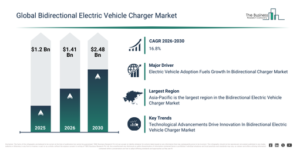
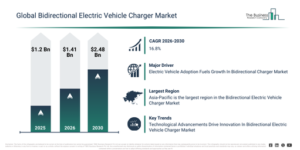
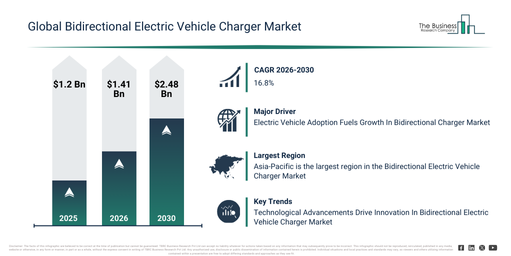
The bidirectional electric vehicle charger market has experienced swift expansion in recent years. Its value is projected to climb from $1.2 billion in 2025 to $1.41 billion in 2026, exhibiting a compound annual growth rate (CAGR) of 17.7%. Historically, this growth can be ascribed to several factors: EV adoption growth, early V2G pilot projects, grid modernization initiatives, the demand for smart energy management, and government charging incentives.
The bidirectional electric vehicle charger market size is projected to experience substantial expansion in the coming years. It is expected to reach $2.48 billion by 2030, with a compound annual growth rate (CAGR) of 15.1%. This projected growth can be attributed to factors such as grid balancing requirements, the integration of renewable energy, investments in smart grids, the increasing demand for energy resilience, and the commercialization of v2g technology. Significant trends anticipated during the forecast period include the broadening of vehicle-to-grid infrastructure, a rise in the adoption of smart charging systems, the expansion of residential bidirectional chargers, enhanced integration with renewable energy sources, and the ongoing development of high-power bidirectional chargers.
Download A Free Sample Report For Comprehensive Market Insights:
Bidirectional Electric Vehicle Charger Market Demand Drivers: What Is Fueling Industry Growth?
The future expansion of bidirectional electric vehicle charger markets is anticipated to be driven by the rising integration of electric vehicles. Electric vehicles (EVs) are defined as automobiles that operate on electricity stored in rechargeable batteries, thereby negating the requirement for conventional internal combustion engines and decreasing dependence on fossil fuels. This surge in EV adoption stems from technological progress that has improved battery longevity, charging infrastructure, and general operational efficiency. Bidirectional charging enables electric vehicles (EVs) to interact with the electricity grid flexibly and dynamically. In situations of elevated demand or grid instability, EVs have the capability to export excess energy back to the grid, providing auxiliary services such as frequency regulation, peak shaving, and demand response. For example, in 2024, the International Energy Agency, a France-based autonomous intergovernmental organization, reported that electric vehicle sales during 2023 increased by 3.5 million units relative to 2022, signifying a 35% year-on-year growth. Consequently, the expanding penetration of electric vehicles is a key factor propelling the development of the bidirectional electric vehicle charger market.
Bidirectional Electric Vehicle Charger Market Segment Outlook: Which Categories Are Expanding The Fastest?
The bidirectional electric vehicle charger market covered in this report is segmented –
1) By Charging Type: Less than 20 kW, 20-40kW, 40-100 kW, More Than 100 kW
2) By Propulsion Type: Battery Electric Vehicle (BEV), Plug-In Hybrid Electric Vehicle (PHEV)
3) By Source: Original Equipment Manufacturer (OEM), Aftermarket
4) By Deployment Of Charger: Domestic, Commercial
5) By Application: Vehicle-To-Grid (V2G), Vehicle-To-Home (V2H), Other Applications
Subsegments:
1) By Less Than 20 kW: Residential Chargers, Small Commercial Chargers
2) By 20-40 kW: Residential Chargers, Medium Commercial Chargers
3) By 40-100 kW: Commercial Chargers, Public Charging Stations
4) By More Than 100 kW: High-Power DC Fast Chargers, Supercharger Networks
Bidirectional Electric Vehicle Charger Market Innovation Trends: Which Developments Are Transforming The Industry?
Leading companies in the bidirectional electric vehicle charger market are focusing on developing vehicle-to-grid (V2G) bi-directional chargers, such as the advanced EQ 200 charger, to gain a competitive advantage. The advanced EQ 200 charger functions as a charging station that facilitates electric vehicles returning stored energy back to the grid. They accomplish this by supporting both charging from the grid and discharging energy back into it. For example, in November 2023, Blink Charging Co., a US-based electric vehicle charging solutions company, introduced an advanced EQ 200 charger. The EQ 200 represents a sophisticated category of bi-directional chargers aiming to transition from conventional static EV charging to a more adaptable and eco-friendly energy management system, aligning with the progression of grid technology. It features intelligent capabilities such as Bluetooth, Wi-Fi, Ethernet, and various connectivity options, including 2G and 4G. This charger integrates effortlessly with a range of load-balancing and smart energy management systems. This flexibility allows it to support emerging technologies like vehicle-to-grid (VTG) and vehicle-to-everything (VTX), ensuring its adaptability as new systems develop.
Bidirectional Electric Vehicle Charger Market Key Companies And Competitive Benchmarking
Major companies operating in the bidirectional electric vehicle charger market report include Volkswagen Group, Mercedes-Benz AG, Bayerische Motoren Werke AG, Hyundai Motor Company, Honda Motor Co. Ltd., Tesla Inc., Hitachi Ltd., Siemens AG, Audi AG, BYD Company Limited, Panasonic Corporation, Renault S.A., Schneider Electric SE, ABB Group, Eaton Corporation plc, LG Electronics Inc., ChargePoint Inc., EVBox Group, Tritium Pty Ltd, Blink Charging Co., Mitsubishi Electric Corporation, Toyota Industries Corporation, Nissan Motor Corporation, Delta Electronics Inc.
Access The Complete Bidirectional Electric Vehicle Charger Market Report:
#Bidirectional Electric Vehicle Charger Market Largest Region: Which Geography Holds The Highest Market Share?
Asia-Pacific was the largest region in the bidirectional electric vehicle charger market in 2025. The regions covered in the bidirectional electric vehicle charger market report include Asia-Pacific, South East Asia, Western Europe, Eastern Europe, North America, South America, Middle East, Africa.
Get in touch with us:
The Business Research Company: https://www.thebusinessresearchcompany.com/
Americas: +1 310-496-7795
Asia: +44 7882 955267 & +91 8897263534
Europe: +44 7882 955267
Email us at: marketing@tbrc.info
Follow us on:
LinkedIn: https://in.linkedin.com/company/the-business-research-company
YouTube: https://www.youtube.com/channel/UC24_fI0rV8cR5DxlCpgmyFQ
Global Market Model: https://www.thebusinessresearchcompany.com/global-market-model

Wasay has over a decade of experience in market research, data modelling, and analytics, with prior experience at GlobalData and Decision Tree Consulting Services. At The Business Research Company , he leads research operations across syndicated studies, customized consulting engagements, and the Global Market Model platform. His professional experience includes supporting organizations such as Boston Consulting Group, KPMG, and Ernst & Young. Wasay holds a degree in Electronics and Communications Engineering, postgraduate management qualifications from International Management Institute Belgium and Indian School of Business and Entrepreneurship, and completed the Integrated Program in Business Analytics from Indian Institute of Management Indore.