Enhanced with market attractiveness analysis, total addressable market evaluation, company benchmarking matrices, interactive Excel dashboards, expanded supply chain intelligence, emerging startup coverage, and detailed product insights, The Business Research Company’s 2026 market reports deliver more actionable and strategically valuable research.
Commercial Electric Vehicles Market Revenue Outlook: What CAGR Is Expected Through 2030?
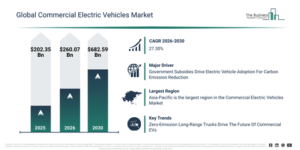
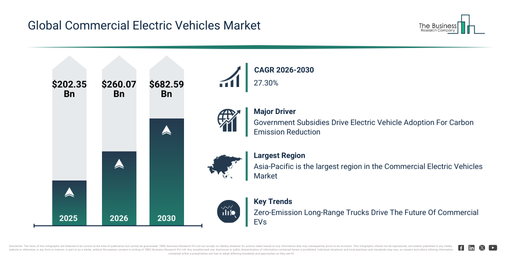
The commercial electric vehicles market size has experienced significant expansion in recent years. It is projected to increase from $202.35 billion in 2025 to $260.07 billion in 2026, demonstrating a compound annual growth rate (CAGR) of 28.5%. The historical growth of this market can be attributed to factors such as government EV incentives, escalating fuel costs, concerns regarding urban pollution, the implementation of pilot electric bus programs, and a decline in battery costs.
The commercial electric vehicles market size is anticipated to experience substantial growth in the coming years. It is projected to reach $682.59 billion in 2030, showing a compound annual growth rate (CAGR) of 27.3%. The expansion during this forecast period can be attributed to factors such as zero-emission mandates, the broadening of charging networks, improvements in battery energy density, the adoption of smart fleet management, and the rise of electrified logistics. Significant trends for the forecast period include the increasing size of electric commercial fleets, the development of fast-charging infrastructure, the implementation of fleet telematics, a growing demand for vehicles with low operating costs, and initiatives to reduce urban emissions.
Download A Free Sample Report For Comprehensive Market Insights:
Commercial Electric Vehicles Market Expansion Supported By Key Demand Factors
The future expansion of the commercial electric vehicles market is anticipated to be fueled by the increasing embrace of electric vehicles. Electric vehicles (EVs) are defined as automobiles that run either entirely or partially on electrical power stored in batteries, differentiating them from those powered exclusively by gasoline or diesel internal combustion engines. The uptake of electric vehicles is accelerating primarily due to heightened environmental awareness, with both governmental bodies and individual consumers increasingly favoring low-emission transport options to mitigate air pollution and address climate change. Specifically, commercial electric vehicles play a crucial role in accelerating this adoption by showcasing their efficiency and economic benefits in freight and passenger transport, simultaneously contributing to emission reductions in city and industrial settings. A relevant example is provided by the International Energy Agency, a France-based intergovernmental autonomous organization, which reported in April 2024 that global electric car sales in 2023 reached nearly 14 million units, representing 18% of all car sales—an increase from 14% in 2022. Consequently, the growing acceptance of electric vehicles is a key factor propelling the commercial electric vehicles market.
Commercial Electric Vehicles Market Segment Performance And Strategic Opportunities
The commercial electric vehicles market covered in this report is segmented –
1) By Technology: Battery Electric Vehicles, Hybrid Electric Vehicles, Plug-in Hybrid Electric Vehicles
2) By Vehicle: Bus, Truck, Pick-Up Truck, Van
3) By Charging Infrastructure: Pantograph, Plug-in, Inductive
Subsegments:
1) By Battery Electric Vehicles (BEVs): Light-Duty BEVs, Medium-Duty BEVs, Heavy-Duty BEVs
2) By Hybrid Electric Vehicles (HEVs): Series HEVs, Parallel HEVs, Series-Parallel HEVs
3) By Plug-In Hybrid Electric Vehicles (PHEVs): Light-duty PHEVs, Medium-Duty PHEVs, Heavy-Duty PHEVs
Commercial Electric Vehicles Market Growth Trends Influencing Competitive Dynamics
Companies operating within the commercial electric vehicles market are heavily invested in creating inventive solutions, notably long-range electric trucks. These initiatives aim to boost efficiency, lower emissions, and offer sustainable transport options that surpass conventional diesel-powered trucks. Long-range electric trucks are defined as heavy-duty electric vehicles designed to move goods over considerable distances on a single charge, featuring greater battery capacity and efficient power management, which facilitates dependable long-haul logistics while simultaneously reducing emissions. For instance, in September 2024, Volvo Group, a commercial vehicle manufacturing firm based in Sweden, introduced a new electric truck capable of a 600 km range. This particular truck integrates a high-capacity lithium-ion battery, electric motors providing substantial torque for heavy-duty uses, rapid-charging capabilities, embedded telematics for managing fleets, and sophisticated safety systems. Its applications include long-haul freight, urban deliveries, and regional transport, offering advantages such as zero tailpipe emissions, diminished operating expenses, and enhanced sustainability for commercial endeavors.
Commercial Electric Vehicles Market Key Players: Which Companies Shape Industry Competition?
Major companies operating in the commercial electric vehicles market report include Tesla Inc., Nissan Motor Co. Ltd., Bayerische Motoren Werke AG, General Motors Company, Ford Motor Company, Volkswagen AG, Kia Corporation, Audi AG, BYD Co. Ltd., Daimler AG, Volvo Group, JAC Motors, Zhejiang Geely Holding Group Co. Ltd., Hyundai Motor Company, Zotye Auto Co. Ltd., Beijing Automotive Industry Group Co. Ltd., Tata Motors Limited, Hero Electric Vehicles Pvt. Ltd., Mahindra Electric Mobility Limited, YOBykes Electric Bikes, TVS Motor Company, Ashok Leyland Limited, Fiat Group Automobiles S.p.A., Renault Group, Škoda Auto a.s., Stellantis N.V., GAC Group, SAIC Motor Corporation Limited, Chery Automobile Co. Ltd., Polestar AB, Changan Automobile Co. Ltd., DAF Trucks N.V., Dongfeng Motor Corporation, Great Wall Motors Company Limited, Hino Motors Ltd., Isuzu Motors Limited, Mitsubishi Fuso Truck and Bus Corporation, Navistar International Corporation, Nikola Corporation, PACCAR Inc., Proterra Inc., Traton SE
Access The Complete Commercial Electric Vehicles Market Report:
#Commercial Electric Vehicles Market Largest Region: Which Geography Holds The Highest Market Share?
Asia-Pacific was the largest region in the commercial electric vehicles market in 2025. The regions covered in the commercial electric vehicles market report include Asia-Pacific, South East Asia, Western Europe, Eastern Europe, North America, South America, Middle East, Africa.
Get in touch with us:
The Business Research Company: https://www.thebusinessresearchcompany.com/
Americas: +1 310-496-7795
Asia: +44 7882 955267 & +91 8897263534
Europe: +44 7882 955267
Email us at: marketing@tbrc.info
Follow us on:
LinkedIn: https://in.linkedin.com/company/the-business-research-company
YouTube: https://www.youtube.com/channel/UC24_fI0rV8cR5DxlCpgmyFQ
Global Market Model: https://www.thebusinessresearchcompany.com/global-market-model

Wasay has over a decade of experience in market research, data modelling, and analytics, with prior experience at GlobalData and Decision Tree Consulting Services. At The Business Research Company , he leads research operations across syndicated studies, customized consulting engagements, and the Global Market Model platform. His professional experience includes supporting organizations such as Boston Consulting Group, KPMG, and Ernst & Young. Wasay holds a degree in Electronics and Communications Engineering, postgraduate management qualifications from International Management Institute Belgium and Indian School of Business and Entrepreneurship, and completed the Integrated Program in Business Analytics from Indian Institute of Management Indore.