Delivering more actionable and strategically valuable research, The Business Research Company’s 2026 market reports feature market attractiveness analysis, total addressable market evaluation, company benchmarking matrices, interactive Excel dashboards, expanded supply chain intelligence, emerging startup coverage, and detailed product insights.
Commercial Vehicle Market Size Forecast: How Large Could The Market Become By 2030?
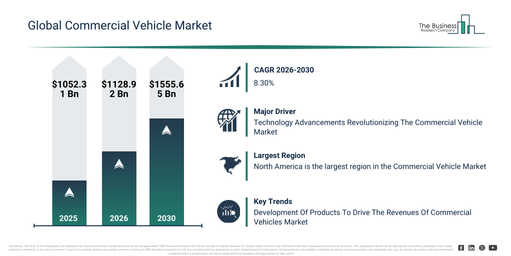
The commercial vehicle market has experienced substantial expansion in recent years. This market is projected to expand from $1052.31 billion in 2025 to $1128.92 billion in 2026, demonstrating a compound annual growth rate (CAGR) of 7.3%. Historically, this growth has been driven by factors such as freight transportation growth, infrastructure development, the prevalence of diesel vehicles, the expansion of logistics networks, and urbanization.
The commercial vehicle market is anticipated to experience substantial expansion over the upcoming years. Projections indicate it will reach $1555.65 billion by 2030, demonstrating a compound annual growth rate (CAGR) of 8.3%. This expansion during the projection period can be primarily attributed to factors such as increased adoption of electric vehicles, stringent emission regulations, advancements in autonomous fleet development, sophisticated smart fleet management systems, and the rising demand for efficient last-mile delivery solutions. Key trends anticipated during the same forecast timeframe encompass the proliferation of electric commercial vehicles, the enlargement of logistics and e-commerce fleets, the widespread implementation of telematics systems, a persistent demand for fuel-efficient vehicles, and the incorporation of advanced safety features.
Download A Free Sample Report For Comprehensive Market Insights:
#Commercial Vehicle Market Demand Drivers Creating New Revenue Opportunities
Technological advancements are projected to persistently fuel market expansion throughout the forecast period. Over the past decade, the commercial vehicle industry has undergone numerous technological developments, a trend anticipated to accelerate further. An example supporting this is found in October 2023; the Rail Infrastructure and Assets report from the Office of Rail and Road, a UK-based government agency, indicated that by 31 March 2023, 15,220 railway vehicles were registered and operating among all passenger train operators, of which electric vehicles constituted 70% of the total fleet. Such innovations are anticipated to propel the commercial vehicle market forward over the forecast period.
Commercial Vehicle Market Segment Analysis Highlighting Growth Areas
The commercial vehicle market covered in this report is segmented –
1) By Type: Light Commercial Vehicle, Heavy Trucks
2) By Fuel Type: Gasoline, Diesel, Other Fuel Types
3) By Application: Mining And Construction, Logistics, Other Applications
4) By Propulsion Type: IC Engine, Electric Vehicle
Subsegments:
1) By Light Commercial Vehicle: Vans, Pickup Trucks
2) By Heavy Trucks: Dump Trucks, Flatbed Trucks, Tanker Trucks, Refrigerated Trucks
Commercial Vehicle Market Trends Driving Strategic Industry Expansion
Leading companies in the commercial vehicles market are actively developing novel products, such as commercial vehicle cooling systems, to attract a wider customer base, increase sales volumes, and boost revenue. A commercial vehicle cooling system is designed to manage the temperature of the engine and other vital components within commercial vehicles like trucks, buses, and various types of construction machinery. For example, in September 2023, DENSO Corporation, a Japan-based automotive manufacturer, unveiled Everycool, an innovative cooling system for commercial vehicles that delivers comfort and energy efficiency even when the vehicle’s engine is not running. This system concurrently improves driver working conditions during summer heat, minimizes environmental impact, and enhances energy utilization by reducing fuel consumption. Everycool utilizes DENSO’s extensive experience in air conditioning technology to precisely direct cool air at the driver, thereby increasing comfort. It achieves significant energy efficiency by using approximately 57% less power than traditional cabin-wide cooling systems available in Japan, allowing it to be powered by the vehicle’s original battery.
Commercial Vehicle Market Leading Companies: Who Holds Significant Market Presence?
Major companies operating in the commercial vehicle market report include Daimler Truck AG, Volvo AB, PACCAR Inc., TRATON SE, Scania AB, MAN Truck & Bus SE, Tata Motors Ltd., Ashok Leyland, Isuzu Motors Limited, Hino Motors Ltd., Dongfeng Motor Corporation, FAW Group Corporation, Foton Motor, IVECO Group, Navistar International, Mack Trucks, UD Trucks, BYD Motors, Rivian Automotive, Hyundai Motor Company
Access The Complete Commercial Vehicle Market Report:
Commercial Vehicle Market Geographic Landscape: Which Region Dominates Industry Growth?
North America was the largest region in the commercial vehicles market in 2025. Asia-Pacific was the second-largest region in the commercial vehicle market. The regions covered in the commercial vehicle market report include Asia-Pacific, South East Asia, Western Europe, Eastern Europe, North America, South America, Middle East, Africa.
Get in touch with us:
The Business Research Company: https://www.thebusinessresearchcompany.com/
Americas: +1 310-496-7795
Asia: +44 7882 955267 & +91 8897263534
Europe: +44 7882 955267
Email us at: marketing@tbrc.info
Follow us on:
LinkedIn: https://in.linkedin.com/company/the-business-research-company
YouTube: https://www.youtube.com/channel/UC24_fI0rV8cR5DxlCpgmyFQ
Global Market Model: https://www.thebusinessresearchcompany.com/global-market-model

Wasay has over a decade of experience in market research, data modelling, and analytics, with prior experience at GlobalData and Decision Tree Consulting Services. At The Business Research Company , he leads research operations across syndicated studies, customized consulting engagements, and the Global Market Model platform. His professional experience includes supporting organizations such as Boston Consulting Group, KPMG, and Ernst & Young. Wasay holds a degree in Electronics and Communications Engineering, postgraduate management qualifications from International Management Institute Belgium and Indian School of Business and Entrepreneurship, and completed the Integrated Program in Business Analytics from Indian Institute of Management Indore.