
Through market attractiveness analysis, total addressable market evaluation, company benchmarking matrices, interactive Excel dashboards, expanded supply chain intelligence, emerging startup coverage, and detailed product insights, The Business Research Company’s 2026 market reports provide more actionable and strategically valuable research.
Workstation Graphics Processing Unit (GPU) Market Expected To Reach $16.72 Billion By 2030 At 9% CAGR
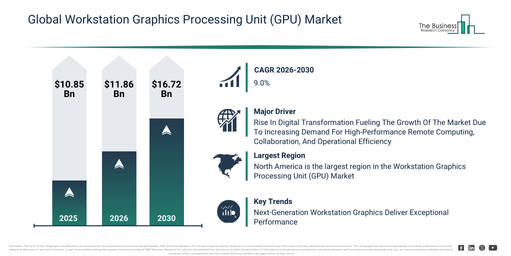
The workstation graphics processing unit market has experienced significant expansion in recent years. Projections indicate a rise from $10.85 billion in 2025 to $11.86 billion in 2026, demonstrating a compound annual growth rate (CAGR) of 9.3%. This historical increase is primarily due to factors such as the greater acceptance of remote work, heightened demand for high-performance computing, the increasing intricacy of visualization tasks, the proliferation of cloud-based rendering solutions, and an intensified emphasis on data security and IP protection.
The workstation graphics processing unit market size is anticipated to experience substantial growth over the next few years, with projections indicating an increase to $16.72 billion by 2030, demonstrating a compound annual growth rate (CAGR) of 9.0%. This expansion during the forecast period is driven by several factors, including the increasing adoption of hybrid cloud solutions, a rising need for energy-efficient GPUs, growing demand from AI and machine learning applications, the expansion of virtual desktop infrastructure, and increased investment in GPU-accelerated rendering software. Significant trends anticipated in this period involve technological advancements in low-latency streaming, innovations in GPU virtualization, developments in real-time ray tracing, ongoing research and developments in AI-driven graphics optimization, and advancements in edge computing for visualization workloads.
Download A Free Sample Report For Comprehensive Market Insights:
Workstation Graphics Processing Unit (GPU) Market Growth Factors Supporting Long-Term Expansion
The workstation graphics processing unit (GPU) market is expected to grow, propelled by the increasing prevalence of digital transformation. Digital transformation refers to the integration of digital technologies across all business functions to improve operations, enhance value delivery, and enable innovation, while also promoting agile and data-driven practices. This transformation is gaining momentum due to the rising imperative for businesses to provide faster, more personalized, and seamless customer experiences to remain competitive. Workstation graphics processing units (GPUs) contribute significantly to digital transformation by providing the high-performance parallel computing and advanced graphics capabilities necessary for data-intensive and visualization-driven applications. They accelerate workloads in AI, simulation, 3D rendering, and analytics, which leads to faster innovation, enhanced productivity, and more informed decision-making across various industries. For example, in July 2024, the Office for National Statistics, a UK-based government agency, stated that the digital infrastructure program had secured a $535 million (£434 million) investment by 2022, with an additional $907 million (£736 million) allocated for the period from 2023 to 2025. Therefore, the growth of the workstation graphics processing unit (GPU) market is being driven by the surge in digital transformation.
Workstation Graphics Processing Unit (GPU) Market Segmentation: How Is The Market Structured Across Key Categories?
The workstation graphics processing unit (gpu) market covered in this report is segmented –
1) By Product Type: Desktop Workstation Graphics Processing Unit, Mobile Workstation Graphics Processing Unit
2) By Distribution Channel: Direct Sales, Distributors Or Resellers, Online Retail
3) By Application: Design And Manufacturing, Media And Entertainment, Healthcare, Automotive, Aerospace And Defense, Research And Academia, Other Applications
4) By End-User: Small And Medium Enterprises, Large Enterprises
Subsegments:
1) By Desktop Workstation Graphics Processing Unit: High Performance Workstation Graphics Processing Unit, Standard Workstation Graphics Processing Unit, Entry Level Workstation Graphics Processing Unit
2) By Mobile Workstation Graphics Processing Unit: High Performance Mobile Workstation Graphics Processing Unit, Standard Mobile Workstation Graphics Processing Unit, Entry Level Mobile Workstation Graphics Processing Unit
Workstation Graphics Processing Unit (GPU) Market Industry Trends Shaping Future Revenue Growth
Leading companies in the workstation graphics processing unit (GPU) market are prioritizing the development of high-performance GPU innovations, such as multi-chiplet GPUs. This focus aims to expedite complex design, rendering, and compute processes while also elevating visual quality and color precision. Multi-chiplet GPUs are defined as graphics processing units constructed from several smaller silicon dies instead of a single large monolithic chip, functioning cohesively as one GPU. An illustrative example is Advanced Micro Devices Inc., a US-based semiconductor company, which in April 2023 introduced the Radeon PRO W7000 Series. This series includes the flagship W7900 and the W7800, recognized as the world’s first professional workstation graphics cards built upon an advanced chiplet design. This multi-chiplet GPU integrates a new AMD Radiance Display Engine with DisplayPort 2.1 support, delivering 3X the total data rate of DisplayPort 1.4, alongside dedicated AI acceleration. These features enable professionals to manage high-polygon models, complex timelines, and render photorealistic images seamlessly. Moreover, it includes up to 48GB of GDDR6 memory with error correction code (ECC), allowing users to undertake larger projects and more intricate data sets, providing exceptional performance-per-dollar for ground-station visualization operators.
Workstation Graphics Processing Unit (GPU) Market Competitive Landscape And Leading Companies
Major companies operating in the workstation graphics processing unit (gpu) market are Dell Technologies Inc., Lenovo Group Limited, HP Inc., Hewlett Packard Enterprise Company, NVIDIA Corporation, Advanced Micro Devices Inc., ASUSTeK Computer Inc., Micro-Star International Co. Ltd., Super Micro Computer Inc., ELSA Japan Inc., Leadtek Research Inc., Advantech Co. Ltd., PNY Technologies Inc., Exxact Corporation, Sapphire Technology Limited, ZOTAC International (MCO) Limited, Colfax International, Koi Computers, BOXX Technologies Inc., GUNNIR Limited
Access The Complete Workstation Graphics Processing Unit (GPU) Market Report:
Workstation Graphics Processing Unit (GPU) Market Geographic Landscape: Which Region Dominates Industry Growth?
North America was the largest region in the workstation graphics processing unit market in 2025. Asia-Pacific is expected to be the fastest-growing region in the forecast period. The regions covered in the workstation graphics processing unit (gpu) market report are Asia-Pacific, South East Asia, Western Europe, Eastern Europe, North America, South America, Middle East, Africa.
Get in touch with us:
The Business Research Company: https://www.thebusinessresearchcompany.com/
Americas: +1 310-496-7795
Asia: +44 7882 955267 & +91 8897263534
Europe: +44 7882 955267
Email us at: marketing@tbrc.info
Follow us on:
LinkedIn: https://in.linkedin.com/company/the-business-research-company
YouTube: https://www.youtube.com/channel/UC24_fI0rV8cR5DxlCpgmyFQ
Global Market Model: https://www.thebusinessresearchcompany.com/global-market-model

Wasay has over a decade of experience in market research, data modelling, and analytics, with prior experience at GlobalData and Decision Tree Consulting Services. At The Business Research Company , he leads research operations across syndicated studies, customized consulting engagements, and the Global Market Model platform. His professional experience includes supporting organizations such as Boston Consulting Group, KPMG, and Ernst & Young. Wasay holds a degree in Electronics and Communications Engineering, postgraduate management qualifications from International Management Institute Belgium and Indian School of Business and Entrepreneurship, and completed the Integrated Program in Business Analytics from Indian Institute of Management Indore.