
Enhanced with market attractiveness analysis, total addressable market evaluation, company benchmarking matrices, interactive Excel dashboards, expanded supply chain intelligence, emerging startup coverage, and detailed product insights, The Business Research Company’s 2026 market reports deliver more actionable and strategically valuable research.
Autonomous Vehicle Sensors Market Value Expansion And Long-Term Growth Outlook
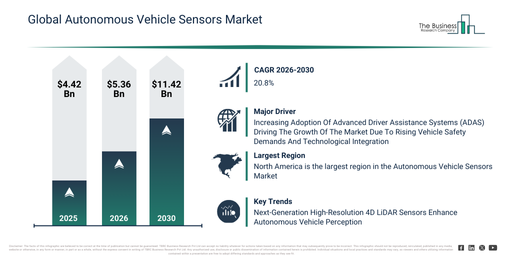
The autonomous vehicle sensors market size has experienced significant expansion in recent years. It is projected to increase from $4.42 billion in 2025 to $5.36 billion in 2026, at a compound annual growth rate (CAGR) of 21.1%. Historically, this growth can be attributed to an escalating demand for safety systems, the rising adoption of autonomous vehicles, an expanding use of radar technology, increased camera sensor integration, and greater government support for smart transportation.
The autonomous vehicle sensors market size is projected to experience substantial expansion in the coming years. Its valuation is anticipated to reach $11.42 billion by 2030, exhibiting a compound annual growth rate (CAGR) of 20.8%. This growth during the forecast period is primarily driven by increased investments in research and development, the expanding incorporation of artificial intelligence (AI)-enabled sensors, the wider deployment of lidar sensors, the spread of electric vehicles, and a heightened emphasis on advanced driver assistance systems. Key trends foreseen for this period encompass technological progress in sensor fusion, breakthroughs in high-resolution camera sensors, advancements in radar signal processing, ongoing research and development into ultrasonic sensor capabilities, and developments in machine learning (ML) for enhanced object detection.
Download A Free Sample Report For Comprehensive Market Insights:
Autonomous Vehicle Sensors Market Expansion Supported By Key Demand Factors
The increasing adoption of advanced driver assistance systems (ADAS) is expected to propel the growth of the autonomous vehicle sensors market going forward. Advanced driver assistance systems refer to electronic technologies that assist vehicle drivers in navigating and avoiding collisions, including features such as adaptive cruise control, lane departure warning, and automatic emergency braking, and these systems provide the technological foundation for higher levels of vehicle autonomy. Adoption of ADAS is rising as governments and consumers increasingly prioritize road safety, reduced traffic congestion, and improved driving comfort, supported by maturing sensor and AI technologies and favorable regulations. Autonomous vehicle sensors support advanced driver assistance systems by providing real-time detection and monitoring of the vehicle’s surroundings. They enhance safety and driving efficiency by enabling features such as collision avoidance, lane keeping, adaptive cruise control, and automated navigation. For instance, in September 2024, according to the Massachusetts Institute of Technology Research and Engineering (MITRE), a US-based research organization, by 2023, 10 of 14 advanced driver-assistance system (ADAS) features had achieved over 50% market penetration, with five features, including forward collision warning, automatic emergency braking, pedestrian detection, and lane departure warning reaching around 91–94% penetration in new vehicles. Therefore, the increasing adoption of advanced driver assistance systems (ADAS) is driving the growth of the autonomous vehicle sensor market.
Autonomous Vehicle Sensors Market Segmentation And Category Breakdown
The autonomous vehicle sensors market covered in this report is segmented –
1) By Component: Hardware, Software, Electronic Control Unit (ECU)
2) By Type of Sensor: Radio Detection And Ranging (RADAR), Light Detection And Ranging (LiDAR), Ultrasound, Camera, Other Types of Sensor
3) By Vehicle Type: Passenger Vehicles, Commercial Vehicles, Two-Wheelers, Other Vehicles
4) By Vehicle Autonomy Level: Level 1 (Driver Assistance), Level 2 (Partial Automation), Level 3 (Conditional Automation), Level 4 (High Automation), Level 5 (Full Automation)
5) By Application: Obstacle Detection, Navigation, Collision Avoidance, Other Applications
Subsegments:
1) By Hardware: Sensor Modules, Detection Units, Signal Processing Units, Communication Interfaces
2) By Software: Sensor Management Software, Data Interpretation Software, Navigation Processing Software, Vehicle Perception Software
3) By Electronic Control Unit (ECU): Control Processing Unit, Power Management Unit, Monitoring Control Unit, Safety Control Unit
Autonomous Vehicle Sensors Market Growth Trends Influencing Competitive Dynamics
Leading companies within the autonomous vehicle sensors market are concentrating on creating sophisticated sensors, including frequency modulated continuous wave (FMCW) 4d LiDAR technology, aimed at enhancing object detection, sensing range, and precision in perception for elevated automation levels. Frequency modulated continuous wave (FMCW) 4D LiDAR technology is defined as a sensing method employing frequency‑chirped continuous laser waves to concurrently assess objects’ distance, velocity, and spatial position across three dimensions over time, facilitating highly accurate dynamic mapping. As an illustration, in January 2025, Aeva Technologies Inc., a sensing and perception systems firm located in the US, introduced the Aeva Atlas Ultra 4D LiDAR sensor. This sensor boasts up to three times the resolution of its previous version, offers a configurable 150 degree field of view, and provides a detection range of up to 500 meters, thereby improving automated driving features at highway speeds and allowing effortless integration into both passenger and commercial vehicles. Aeva’s pioneering Frequency Modulated Continuous Wave (FMCW) 4D LiDAR technology, which simultaneously determines position and velocity, enables elevated levels of automation and safety. The utilization of immediate velocity data allows automated driving systems to identify important objects with greater speed, increased assurance, and from extended distances.
Autonomous Vehicle Sensors Market Competitive Analysis Of Major Industry Participants
Major companies operating in the autonomous vehicle sensors market are Robert Bosch GmbH, DENSO Corporation, Continental AG, Valeo SA, Texas Instruments Incorporated, Infineon Technologies AG, NXP Semiconductors N.V., ON Semiconductor Corporation, Trimble Inc., Nippon Seiki Co. Ltd., Sick AG, Hesai Technology Co. Ltd., Ouster Inc., Luminar Technologies Inc., Brigade Electronics Limited, Innoviz Technologies Ltd., Cepton Technologies Inc., Quanergy Systems Inc., Aeva Technologies Inc., Arbe Robotics Ltd.
Access The Complete Autonomous Vehicle Sensors Market Report:
#Autonomous Vehicle Sensors Market Largest Region: Which Geography Holds The Highest Market Share?
North America was the largest region in the autonomous vehicle sensors in 2025. Asia-Pacific is expected to be the fastest-growing region in the forecast period. The regions covered in the autonomous vehicle sensors market report are Asia-Pacific, South East Asia, Western Europe, Eastern Europe, North America, South America, Middle East, Africa.
Get in touch with us:
The Business Research Company: https://www.thebusinessresearchcompany.com/
Americas: +1 310-496-7795
Asia: +44 7882 955267 & +91 8897263534
Europe: +44 7882 955267
Email us at: marketing@tbrc.info
Follow us on:
LinkedIn: https://in.linkedin.com/company/the-business-research-company
YouTube: https://www.youtube.com/channel/UC24_fI0rV8cR5DxlCpgmyFQ
Global Market Model: https://www.thebusinessresearchcompany.com/global-market-model

Wasay has over a decade of experience in market research, data modelling, and analytics, with prior experience at GlobalData and Decision Tree Consulting Services. At The Business Research Company , he leads research operations across syndicated studies, customized consulting engagements, and the Global Market Model platform. His professional experience includes supporting organizations such as Boston Consulting Group, KPMG, and Ernst & Young. Wasay holds a degree in Electronics and Communications Engineering, postgraduate management qualifications from International Management Institute Belgium and Indian School of Business and Entrepreneurship, and completed the Integrated Program in Business Analytics from Indian Institute of Management Indore.