
Through market attractiveness analysis, total addressable market evaluation, company benchmarking matrices, interactive Excel dashboards, expanded supply chain intelligence, emerging startup coverage, and detailed product insights, The Business Research Company’s 2026 market reports provide more actionable and strategically valuable research.
#Immersive Virtual Stores Market Size And Revenue Forecast Through 2030
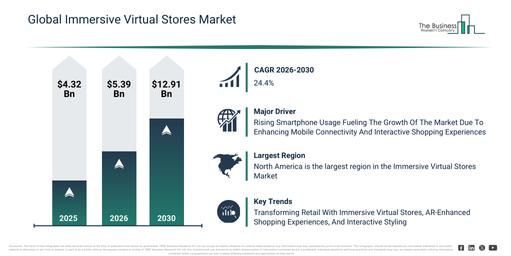
The market for immersive virtual stores has witnessed significant expansion in recent years. It is projected to increase from $4.32 billion in 2025 to $5.39 billion in 2026, achieving a compound annual growth rate (CAGR) of 24.7%. Historically, this growth can be ascribed to a rising appetite for interactive online shopping, the expanding integration of augmented reality tools in retail, an uptick in the utilization of three-dimensional product visualization, the global spread of e-commerce platforms, and an enhanced focus from retailers on digital customer engagement.
The immersive virtual stores market is projected to experience rapid expansion in the coming years. This sector is anticipated to reach $12.91 billion by 2030, exhibiting a compound annual growth rate (CAGR) of 24.4%. This expansion during the projection period stems from factors such as the increasing incorporation of virtual reality commerce into omnichannel approaches, the rising uptake of cloud-based immersive store platforms, a heightened desire for customized and engaging digital shopping experiences, the broadening of virtual real estate and showroom uses, and greater retail investment in experiential digital branding. Key trends foreseen for the forecast horizon encompass technological progress in real-time three-dimensional rendering, novelties in artificial intelligence-powered virtual try-on solutions, progress in web-based immersive settings, ongoing studies and advancements in spatial computing and mixed reality, and improvements in three-dimensional content creation workflows.
Download A Free Sample Report For Comprehensive Market Insights:
#Immersive Virtual Stores Market Growth Drivers And Industry Catalysts
The expanding adoption of smartphones is anticipated to significantly propel the growth of the immersive virtual stores market moving forward. These advanced mobile devices, equipped with internet connectivity, app functionality, and real-time communication capabilities, are seeing increased usage primarily due to the rapid expansion of mobile internet connectivity. This connectivity empowers consumers to access online platforms and engage in global shopping activities anytime, anywhere. Smartphones notably enhance immersive virtual stores by providing a portable and interactive platform for augmented and virtual reality shopping experiences. This advancement improves customer engagement and convenience by enabling real-time product visualization, personalized recommendations, and seamless online purchasing from any location. For instance, according to Eurostat’s November 2024 report, about 89% of EU residents aged 16–74 in cities used their smartphones for internet access in 2023, compared to 86% in towns and suburbs, and 82% in rural areas. Therefore, the widespread increase in smartphone penetration is a primary driver for the expansion of the immersive virtual stores market.
Immersive Virtual Stores Market Segment Analysis Highlighting Growth Areas
The immersive virtual stores market covered in this report is segmented –
1) By Technology Platform: Virtual Reality Based Stores, Augmented Reality Based Stores, Mixed Reality Based Stores, Web-Based Three Dimensional Stores
2) By Deployment Mode: Cloud-Based, On-Premises
3) By Application: Retail And E-commerce, Fashion And Apparel, Real Estate, Other Applications
5) By End User: Retailers, Electronic Commerce Companies, Fashion Brands, Real Estate Companies, Consumer Electronics Companies, Other End Users
Subsegments:
1) By Virtual Reality Based Stores: Headset Dependent Full Immersion Stores, Social Virtual Reality Platform Stores, Controller Based Navigation Stores, Room Scale Interactive Stores
2) By Augmented Reality Based Stores: Marker Based Augmented Reality Stores, Markerless Augmented Reality Stores, Projection Based Augmented Reality Stores, Mobile Application Augmented Reality Stores
3) By Mixed Reality Based Stores: Holographic Device Enabled Stores, Spatial Computing Platform Stores, Interactive Blended Reality Stores, Wearable Display Integrated Stores
4) By Web-Based Three Dimensional Stores: Browser Rendered Three Dimensional Stores, Game Engine Powered Web Stores, E-Commerce Platform Integrated Three Dimensional Stores, No Download Instant Access Stores
#Immersive Virtual Stores Market Trends Influencing Long-Term Demand
Major companies operating within the immersive virtual stores market are prioritizing the development of advanced technologies, including immersive AR-enabled virtual closet environments, to improve customer engagement, enhance digital shopping, and bridge the divide between physical and virtual retail experiences. Immersive AR-enabled virtual closet environments leverage augmented reality and spatial computing platforms, allowing users to navigate products in lifelike 3D spaces, interact with merchandise intuitively, and view highly realistic visuals that simulate in-store browsing digitally. As an illustration, in February 2024, J.Crew Group Inc., a fashion retailer based in the US, launched the J.Crew Virtual Closet app for Apple Vision Pro, bringing an AR-enabled virtual closet experience to spatial computing devices. This feature allows users to browse and mix-and-match clothing within a hyper-realistic 3D environment, examine textures and materials with high magnification, and interact with stylists via SharePlay during FaceTime calls. This AR-enhanced virtual store not only enriches the process of product discovery but also provides personalized styling and social shopping capabilities that extend beyond traditional e-commerce.
Immersive Virtual Stores Market Leading Companies: Who Holds Significant Market Presence?
Major companies operating in the immersive virtual stores market are Alibaba Group Holding Limited, Roblox Corporation, Unity Software Inc., HTC Corporation, Flexsin Technologies Pvt. Ltd., Vection Technologies Ltd., Trigma Solutions Inc., Decentraland Foundation, iCreative Technologies Pvt. Ltd., Esferasoft Solutions Pvt. Ltd., Pixelette Technologies Pvt. Ltd., Innowise Group, ByondXR Ltd., Emperia Ltd., rooom GmbH, KiXR Ltd., Digital Agents Interactive Inc., GlamAR Inc., VB Metaverse Ltd., Obsess Inc., Arimars Technologies Pvt. Ltd.
Access The Complete Immersive Virtual Stores Market Report:
Immersive Virtual Stores Market Geographic Analysis: Where Is Demand Growing The Fastest?
North America was the largest region in the immersive virtual stores market in 2025. Asia-Pacific is expected to be the fastest-growing region in the forecast period. The regions covered in the immersive virtual stores market report are Asia-Pacific, South East Asia, Western Europe, Eastern Europe, North America, South America, Middle East, Africa.
Get in touch with us:
The Business Research Company: https://www.thebusinessresearchcompany.com/
Americas: +1 310-496-7795
Asia: +44 7882 955267 & +91 8897263534
Europe: +44 7882 955267
Email us at: marketing@tbrc.info
Follow us on:
LinkedIn: https://in.linkedin.com/company/the-business-research-company
YouTube: https://www.youtube.com/channel/UC24_fI0rV8cR5DxlCpgmyFQ
Global Market Model: https://www.thebusinessresearchcompany.com/global-market-model

Wasay has over a decade of experience in market research, data modelling, and analytics, with prior experience at GlobalData and Decision Tree Consulting Services. At The Business Research Company , he leads research operations across syndicated studies, customized consulting engagements, and the Global Market Model platform. His professional experience includes supporting organizations such as Boston Consulting Group, KPMG, and Ernst & Young. Wasay holds a degree in Electronics and Communications Engineering, postgraduate management qualifications from International Management Institute Belgium and Indian School of Business and Entrepreneurship, and completed the Integrated Program in Business Analytics from Indian Institute of Management Indore.