
Delivering more actionable and strategically valuable research, The Business Research Company’s 2026 market reports feature market attractiveness analysis, total addressable market evaluation, company benchmarking matrices, interactive Excel dashboards, expanded supply chain intelligence, emerging startup coverage, and detailed product insights.
Re-Commerce Market Value Expansion And Long-Term Growth Outlook
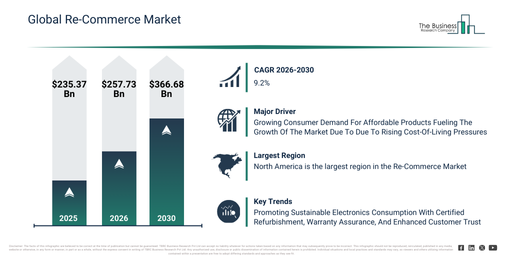
The re-commerce market size has seen substantial growth over recent years. It is anticipated to expand from $235.37 billion in 2025 to $257.73 billion in 2026, showing a compound annual growth rate (CAGR) of 9.5%. The historical increase can be ascribed to factors such as enhanced consumer awareness regarding sustainability, a rising need for economical second-hand items, increasing concerns about e-waste management, the proliferation of online resale platforms, and a greater embrace of refurbishment services.
The re-commerce market size is anticipated to demonstrate significant growth in the coming years, with projections indicating it will reach $366.68 billion by 2030, exhibiting a compound annual growth rate (CAGR) of 9.2%. This expansion during the forecast period is fueled by the increasing adoption of circular economy models, rising investments in re-commerce platforms, a heightened focus on sustainable supply chains, the broadening of buyback and trade-in programs, and greater technological integration into refurbishment processes. Prominent trends for this period include technological advancements in refurbishment and quality grading, innovations in online marketplace platforms, developments in reverse logistics solutions, research and development efforts in product authentication and verification, and progress in AI-based resale optimization and inventory management.
Download A Free Sample Report For Comprehensive Market Insights:
Re-Commerce Market Development Factors: Which Trends Are Supporting Demand?
The re-commerce market’s future expansion is anticipated to be significantly driven by the escalating consumer demand for affordable products. This demand represents a rising consumer inclination towards lower-priced goods, including pre-owned, refurbished, or surplus items, aiming to reduce expenditure while still satisfying their consumption requirements. The surge in demand for affordable products is attributable to persistent cost-of-living pressures and the higher prices of new goods, which are encouraging more consumers to seek out economical alternatives. The re-commerce sector effectively addresses this consumer need by offering an expanding array of quality pre-owned products at prices considerably below those of new items, thereby enabling consumers to maintain their purchasing power even with tighter budgets. For instance, in October 2025, data from the Ethical Consumer Research Association, a UK-based nonprofit organization, indicated that the proportion of goods purchased second-hand rose from 16.74 % in 2024 to 17.98 % in 2025, clearly demonstrating increased consumer engagement in acquiring used products. Consequently, the growing consumer demand for affordable products serves as a key driver for the re-commerce market’s growth.
Re-Commerce Market Segment Analysis Highlighting Growth Areas
The re-commerce market covered in this report is segmented –
1) By Product: Electronics, Fashion And Apparel, Furniture And Home Goods, Automotive, Sports And Fitness Equipment, Other Products
2) By Service Offering: Product Refurbishment And Restoration, Device Repair And Maintenance, Quality Inspection And Grading, Authentication And Verification Services, Resale And Remarketing Services, Inventory Management And Resale Optimization, Reverse Logistics And Returns Management, Recycling And E-Waste Processing, Online Marketplace Listing Services
3) By Business Model: Peer-To-Peer (P2P) Marketplaces, Business-To-Consumer (B2C) Resale Marketplaces, Consignment Platforms, Brand-Led And Retailer-Led Recommerce Programs, Trade-In And Buyback Service Providers
4) By Sales Channel: Online Marketplaces And Platforms, Offline Or Physical Stores, Hybrid Models
5) By End User Or Customer Segment: Individual Consumers, Small And Medium Enterprises (SMEs), Large Enterprises Or Corporates, Educational And Government Institutions
Subsegments:
1) By Electronics: Refurbished Mobile Devices, Pre Owned Laptop Systems, Restored Home Appliance Units, Certified Used Audio Visual Equipment, Repaired And Tested Computing Devices
2) By Fashion And Apparel: Pre Owned Clothing Items, Second Hand Footwear Collections, Vintage Fashion Accessories, Designer Wear Resale Products, Reusable Textile And Garment Items
3) By Furniture And Home Goods: Pre Loved Wooden Furniture, Refurbished Home Decor Items, Reconditioned Kitchen Appliances, Second Hand Storage And Shelving Units, Restored Upholstered Furniture
5) By Automotive: Pre Owned Passenger Vehicles, Certified Used Motorcycle Units, Reconditioned Auto Parts, Second Hand Commercial Vehicles, Restored Electric Vehicle Components
6) By Sports And Fitness Equipment: Pre Owned Gym Machines, Second Hand Outdoor Sports Gear, Restored Fitness Accessory Items, Reconditioned Training Equipment, Pre Used Athletic Gear
7) By Other Products: Pre Owned Musical Instruments, Second Hand Baby Products, Reusable Household Utility Items, Restored Hobby And Craft Equipment, Certified Used Industrial Tools
Re-Commerce Market Transformation Trends: Which Innovations Are Driving Change?
Leading companies in the re-commerce market are prioritizing the creation of sustainable initiatives, including certified refurbishment programs, to prolong the operational life of electronic devices, lessen electronic waste, and offer economical alternatives for consumers. A certified refurbishment program involves the comprehensive inspection, repair, and validation of pre-owned devices, ensuring they adhere to quality, performance, and safety benchmarks before being made available for resale. For instance, in September 2025, Google LLC, a US-based technology company, introduced its Authorised Refurbished Phone Sale program in India, collaborating with re-commerce platform Cashify to distribute refurbished Pixel 7 and Pixel 8 Pro devices. These items undergo extensive quality assessments, are packaged with suitable chargers, and come with a one-year warranty. This approach also bolsters confidence in pre-owned devices, reduces obstacles to purchase, and contributes to an enduring electronics lifecycle.
Re-Commerce Market Leading Companies: Who Holds Significant Market Presence?
Major companies operating in the re-commerce market are Amazon.com Inc., JD.com Inc., Rakuten Group Inc., The RealReal Inc., ThredUp Inc., Decluttr Ltd., MusicMagpie Group plc, Cashify.in, Depop Limited, Rebuy GmbH, Vestiaire Collective S.A.S., CEX Webuy Entertainment Ltd., Swappa LLC, Gazelle Inc., Recurate Inc., Poshmark Inc., Carousell Pte. Ltd., OLX Group B.V., eBay Inc., Back Market S.A.S., Archive Resale Inc.
Access The Complete Re-Commerce Market Report:
#Re-Commerce Market Largest Region: Which Geography Holds The Highest Market Share?
North America was the largest region in the re-commerce market in 2025. Asia-Pacific is expected to be the fastest-growing region in the forecast period. The regions covered in the re-commerce market report are Asia-Pacific, South East Asia, Western Europe, Eastern Europe, North America, South America, Middle East, Africa.
Get in touch with us:
The Business Research Company: https://www.thebusinessresearchcompany.com/
Americas: +1 310-496-7795
Asia: +44 7882 955267 & +91 8897263534
Europe: +44 7882 955267
Email us at: marketing@tbrc.info
Follow us on:
LinkedIn: https://in.linkedin.com/company/the-business-research-company
YouTube: https://www.youtube.com/channel/UC24_fI0rV8cR5DxlCpgmyFQ
Global Market Model: https://www.thebusinessresearchcompany.com/global-market-model

Wasay has over a decade of experience in market research, data modelling, and analytics, with prior experience at GlobalData and Decision Tree Consulting Services. At The Business Research Company , he leads research operations across syndicated studies, customized consulting engagements, and the Global Market Model platform. His professional experience includes supporting organizations such as Boston Consulting Group, KPMG, and Ernst & Young. Wasay holds a degree in Electronics and Communications Engineering, postgraduate management qualifications from International Management Institute Belgium and Indian School of Business and Entrepreneurship, and completed the Integrated Program in Business Analytics from Indian Institute of Management Indore.