Delivering more actionable and strategically valuable research, The Business Research Company’s 2026 market reports feature market attractiveness analysis, total addressable market evaluation, company benchmarking matrices, interactive Excel dashboards, expanded supply chain intelligence, emerging startup coverage, and detailed product insights.
Augmented Reality (AR) And Virtual Reality (VR) Hardware Market Expansion Outlook: What Revenue Opportunities Lie Ahead?
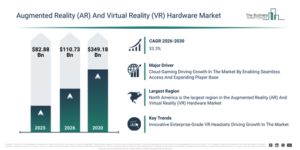
The augmented reality (ar) and virtual reality (vr) hardware market size has experienced significant expansion in recent years. It is forecast to grow from $82.88 billion in 2025 to $110.73 billion in 2026, achieving a compound annual growth rate (CAGR) of 33.6%. This historical growth can be attributed to several factors, including the rise of gaming and entertainment, increasing adoption in education and training, growth in healthcare simulations, early investment by automotive and aerospace, and advancements in processor and sensor technology.
The augmented reality (ar) and virtual reality (vr) hardware market size is expected to experience significant growth in the upcoming years. It is projected to reach $349.18 billion by 2030, demonstrating a compound annual growth rate (CAGR) of 33.3%. This projected growth is driven by several factors, including the expansion of enterprise training solutions, the integration with AI-driven analytics, increasing adoption in smart manufacturing, the growth in remote healthcare and telemedicine, and the development of next-generation haptic and wearable devices. Key trends for the forecast period include the integration of edge computing, advancements in wearable AR or VR devices, enhanced haptic feedback, the emergence of cloud-based AR or VR platforms, and improved real-time motion tracking.
Download A Free Sample Report For Comprehensive Market Insights:
Augmented Reality (AR) And Virtual Reality (VR) Hardware Market Growth Momentum: Which Factors Are Influencing Demand?
The expanded presence of cloud gaming is projected to significantly drive the augmented reality (AR) and virtual reality (VR) hardware market in the coming years. Cloud gaming allows users to play video games that are streamed from remote servers, thus removing the requirement for powerful processing hardware on the player’s device. The increasing adoption of cloud gaming is fueled by faster internet connections, reduced expenses associated with hardware, and the convenience of immediate, cross-device accessibility through various subscription services. AR and VR hardware enhances cloud gaming by delivering immersive and interactive experiences that integrate smoothly with cloud-based platforms, providing high-quality, real-time graphics and responsive gameplay. For instance, a report from Uswitch Limited, a UK-based online and telephone comparison and switching service, released in August 2024, projected that the number of online gamers in the UK will increase by 6.64%, growing from 10.84 million in 2023 to 11.56 million by 2027. Furthermore, according to the Interactive Games and Entertainment Association, an Australia-based trade association, in 2023, 81% of Australians (21 million) played video games, an increase from 67% (17 million) in 2021. Therefore, the growth of cloud gaming is a key factor boosting the augmented reality (AR) and virtual reality (VR) hardware market.
Augmented Reality (AR) And Virtual Reality (VR) Hardware Market Segmentation: How Is The Market Structured Across Key Categories?
The augmented reality (ar) and virtual reality (vr) hardware market covered in this report is segmented –
1) By Hardware Type: Cameras, Controllers, Display Monitors, Headphones, Processors, Sensors, Other Hardware Types
2) By Application: Handheld Devices, Head Mounted Display, Head Up Display
3) By Industry Vertical: Aerospace And Defense, Automotive, Education And Training, Gaming And Entertainment, Healthcare, Other Industry Verticals
Subsegments:
1) By Cameras: Depth Cameras, RGB Cameras, Stereoscopic Cameras
2) By Controllers: Motion Controllers, Handheld Controllers, Wearable Controllers
3) By Display Monitors: AR Glasses, VR Headsets, Smart Glasses, Projection Displays
4) By Headphones: Stereo Headphones, 3D Audio Headphones, Noise Cancelling Headphones
5) By Processors: Graphics Processing Units (GPUs), Central Processing Units (CPUs), Application-Specific Integrated Circuits (ASICs)
6) By Sensors: Motion Sensors, Proximity Sensors, Positional Sensors, Eye-Tracking Sensors
7) By Other Hardware Types: Haptic Devices, AR Or VR Gloves, Tracking Devices
Augmented Reality (AR) And Virtual Reality (VR) Hardware Market Innovation Trends: Which Developments Are Transforming The Industry?
Major companies operating in the augmented reality (AR) and virtual reality (VR) hardware market are focusing on developing innovative solutions, such as enterprise-grade virtual reality headsets, to enhance immersive experiences across various sectors. An enterprise-grade virtual reality headset refers to one designed for professional use, offering high-resolution displays, precise tracking, and robust build quality for industries like training, design, and engineering. For instance, in September 2023, Deepoon (DPVR), a China-based technology company, launched the DPVR P2, an enterprise-grade virtual reality headset designed to enhance immersive experiences in education, business, and healthcare. This headset boasts superior visual quality with high-resolution displays and wide field-of-view optics, delivering immersive experiences crucial for training, simulations, and collaborative work environments. Its robust connectivity options, including wireless and tethered capabilities, ensure seamless integration with existing enterprise systems. Additionally, the headset supports customizable software solutions, enabling businesses to tailor the VR experience to their unique requirements.
Augmented Reality (AR) And Virtual Reality (VR) Hardware Market Competitive Landscape And Leading Companies
Major companies operating in the augmented reality (ar) and virtual reality (vr) hardware market are Apple Inc., Samsung Electronics Co. Ltd., Microsoft Corporation, Sony Interactive Entertainment LLC, Lenovo Group Limited, NVIDIA Corporation, Goertek Inc., NXP Semiconductor N.V., Valve Corporation, Acer Incorporated, High Tech Computer Corporation, Bose Corporation, Robert Bosch GmbH, Magic Leap Inc., TCL Technology Group Corporation, Pimax Technology Co. Ltd., Varjo Technologies Oy, Vuzix Corporation, Deepoon VR, AjnaLens Private Limited
Access The Complete Augmented Reality (AR) And Virtual Reality (VR) Hardware Market Report:
#Augmented Reality (AR) And Virtual Reality (VR) Hardware Market Largest Region: Which Geography Holds The Highest Market Share?
North America was the largest region in the augmented reality (AR) and virtual reality (VR) hardware market in 2025. Asia-Pacific is expected to be the fastest-growing region in the forecast period. The regions covered in the augmented reality (ar) and virtual reality (vr) hardware market report are Asia-Pacific, South East Asia, Western Europe, Eastern Europe, North America, South America, Middle East, Africa.
Get in touch with us:
The Business Research Company: https://www.thebusinessresearchcompany.com/
Americas: +1 310-496-7795
Asia: +44 7882 955267 & +91 8897263534
Europe: +44 7882 955267
Email us at: marketing@tbrc.info
Follow us on:
LinkedIn: https://in.linkedin.com/company/the-business-research-company
YouTube: https://www.youtube.com/channel/UC24_fI0rV8cR5DxlCpgmyFQ
Global Market Model: https://www.thebusinessresearchcompany.com/global-market-model

Wasay has over a decade of experience in market research, data modelling, and analytics, with prior experience at GlobalData and Decision Tree Consulting Services. At The Business Research Company , he leads research operations across syndicated studies, customized consulting engagements, and the Global Market Model platform. His professional experience includes supporting organizations such as Boston Consulting Group, KPMG, and Ernst & Young. Wasay holds a degree in Electronics and Communications Engineering, postgraduate management qualifications from International Management Institute Belgium and Indian School of Business and Entrepreneurship, and completed the Integrated Program in Business Analytics from Indian Institute of Management Indore.