Delivering more actionable and strategically valuable research, The Business Research Company’s 2026 market reports feature market attractiveness analysis, total addressable market evaluation, company benchmarking matrices, interactive Excel dashboards, expanded supply chain intelligence, emerging startup coverage, and detailed product insights.
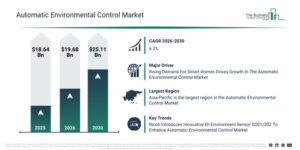
Automatic Environmental Control Market Forecast Highlighting Growth From $19.68 Billion To $25.11 Billion
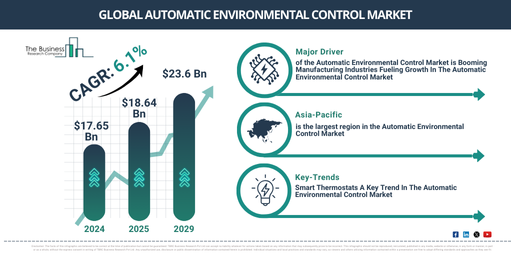
The automatic environmental control market has demonstrated strong growth over recent years. Its value is projected to expand from $18.64 billion in 2025 to $19.68 billion by 2026, at a compound annual growth rate (CAGR) of 5.6%. Historically, the expansion in this market can be attributed to increasing urbanization, escalating energy costs, the demand for improved indoor air quality, the adoption of centralized heating systems, and the presence of limited regulatory frameworks.
The automatic environmental control market size is anticipated to undergo significant growth in the upcoming years, with projections indicating it will expand to $25.11 billion by 2030, achieving a compound annual growth rate (CAGR) of 6.3%. This projected growth throughout the forecast period stems from factors such as the integration of IoT devices, the development of smart buildings, an increase in renewable energy adoption, regulatory incentives for energy efficiency, and the rising demand for real-time environmental data. Prominent trends for this period are expected to include AI-powered environmental monitoring, energy-efficient heating and cooling systems, smart HVAC and refrigeration automation, IoT-enabled environmental sensors, and the application of predictive maintenance in HVAC systems.
Download A Free Sample Report For Comprehensive Market Insights:
Automatic Environmental Control Market Growth Drivers: What Factors Are Accelerating Expansion?
The anticipated market expansion for the automatic environmental control market is fueled by the growing requirement for smart residences in the foreseeable future. An intelligent dwelling, alternatively termed an interconnected residence or home automation system, describes a living space outfitted with multiple interconnected devices and mechanisms operable and monitorable from a distance. Its primary objective is to enhance the comfort, practicality, security, and energy efficiency of the living environment by integrating technology and automated processes. Automatic environmental control contributes to better indoor air quality by enabling energy conservation, remote surveillance, greater comfort, and a reduced carbon footprint. Within smart homes, sensors and automation play a crucial role in regulating the ambient conditions. Such smart homes, incorporating automatic environmental management, can aid in reducing energy consumption, optimizing its use, and minimizing waste. For example, data from Samsung Electronics, a South Korean consumer electronics firm, indicated in June 2024 that 79% of people intending to relocate (either rent or purchase) over the next five years show an interest in smart homes. These individuals are prepared to spend a 7.7% premium on the typical UK house price, which amounts to roughly £21,774 ($27,816). Consequently, the growing desire for smart residences is a key impetus for the automatic environmental control market.
Automatic Environmental Control Market Segment Outlook: Which Categories Are Expanding The Fastest?
The automatic environmental control market covered in this report is segmented –
1) By Control System Category: Heating Equipment, Refrigeration Equipment, Air Conditioning Equipment
2) By Product Type: Environmental Monitors, Environmental Monitoring Sensors, Wearable Environmental Monitors
3) By Application: Residential, Commercial, Industrial
Subsegments:
1) By Heating Equipment: Boilers, Heat Pumps, Furnaces, Radiators, Underfloor Heating Systems
2) By Refrigeration Equipment: Commercial Refrigerators, Industrial Refrigerators, Refrigerated Display Cases, Cold Storage Units, Ice Makers
3) By Air Conditioning Equipment: Split Air Conditioners, Central Air Conditioning Systems, Ductless Air Conditioners, Portable Air Conditioners, Window Air Conditioners
Automatic Environmental Control Market Strategic Trends: What Is Defining The Next Phase Of Growth?
Leading firms within the automatic environmental control market are increasingly focusing on technological innovations, particularly automated building management platforms, with the goal of boosting operational efficiency while simultaneously decreasing energy usage and environmental footprint across diverse sectors. This automated building management involves the centralized application of technology to oversee and regulate various building systems, including HVAC, lighting, and security, thereby optimizing both efficiency and the comfort of occupants. As an illustration, in January 2024, Honeywell International Inc., a US-based multinational corporation, launched its Advance Control for Buildings platform. This automated building management system is designed to promote energy efficiency and enhance operational effectiveness. The platform incorporates integrated cybersecurity and technology enabling faster network speeds, all while utilizing existing wiring, which subsequently lowers installation expenses, time requirements, and the generation of waste.
Automatic Environmental Control Market Key Companies And Competitive Benchmarking
Major companies operating in the automatic environmental control market are Johnson Controls Inc., Schneider Electric, United Technologies Corporation, Honeywell International Inc., Ingersoll Rand, Siemens AG, Emerson Electric Co., Forbes Marshall, Carrier Corporation, Daikin Industries Ltd., LG Electronics Inc., Mitsubishi Electric Corporation, Panasonic Corporation, Samsung Electronics Co. Ltd., Sharp Corporation, Toshiba Corporation, Trane Inc., York International Corporation, ABB Ltd., Eaton Corporation, General Electric Company, Rockwell Automation Inc.
Access The Complete Automatic Environmental Control Market Report:
Automatic Environmental Control Market Geographic Analysis: Where Is Demand Growing The Fastest?
Asia-Pacific was the largest region in the automatic environmental control market in 2025. North America is the second-largest region in the automatic environmental control market. The regions covered in the automatic environmental control market report are Asia-Pacific, South East Asia, Western Europe, Eastern Europe, North America, South America, Middle East, Africa.
Get in touch with us:
The Business Research Company: https://www.thebusinessresearchcompany.com/
Americas: +1 310-496-7795
Asia: +44 7882 955267 & +91 8897263534
Europe: +44 7882 955267
Email us at: marketing@tbrc.info
Follow us on:
LinkedIn: https://in.linkedin.com/company/the-business-research-company
YouTube: https://www.youtube.com/channel/UC24_fI0rV8cR5DxlCpgmyFQ
Global Market Model: https://www.thebusinessresearchcompany.com/global-market-model

Wasay has over a decade of experience in market research, data modelling, and analytics, with prior experience at GlobalData and Decision Tree Consulting Services. At The Business Research Company , he leads research operations across syndicated studies, customized consulting engagements, and the Global Market Model platform. His professional experience includes supporting organizations such as Boston Consulting Group, KPMG, and Ernst & Young. Wasay holds a degree in Electronics and Communications Engineering, postgraduate management qualifications from International Management Institute Belgium and Indian School of Business and Entrepreneurship, and completed the Integrated Program in Business Analytics from Indian Institute of Management Indore.