
Enhanced with market attractiveness analysis, total addressable market evaluation, company benchmarking matrices, interactive Excel dashboards, expanded supply chain intelligence, emerging startup coverage, and detailed product insights, The Business Research Company’s 2026 market reports deliver more actionable and strategically valuable research.
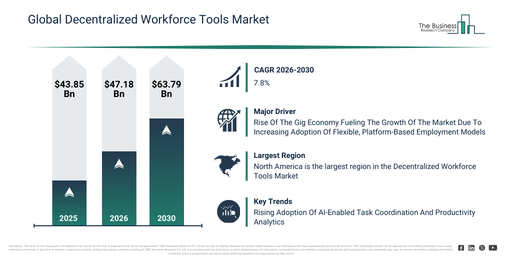
Decentralized Workforce Tools Market Expected To Reach $63.79 Billion By 2030 At 7.8% CAGR
The decentralized workforce tools market has demonstrated strong growth in recent years. It is projected to expand from $43.85 billion in 2025 to $47.18 billion in 2026, at a compound annual growth rate (CAGR) of 7.6%. This historical growth can be attributed to the rise of remote work, global talent sourcing, the adoption of collaboration software, the digitization of the workforce, and the demand for productivity tracking.
The decentralized workforce tools market is poised for robust expansion over the next few years. By 2030, this market is projected to reach $63.79 billion, exhibiting a compound annual growth rate (CAGR) of 7.8%. Factors contributing to this anticipated growth include the adoption of hybrid work models, the rise of AI-driven productivity tools, increased use of decentralized identity, the expansion of the global freelance economy, and the automation of HR processes. Key trends expected during this period encompass the coordination of remote workforces, decentralized task management, performance analysis for geographically dispersed teams, secure platforms for collaboration, and automated governance for workforces.
Download A Free Sample Report For Comprehensive Market Insights:
Decentralized Workforce Tools Market Expansion Supported By Key Demand Factors
The increasing prevalence of gig work is anticipated to fuel the expansion of the decentralized workforce tools market in the future. The rise of the gig denotes a growing involvement of workers in temporary, independent, contract, and platform-driven employment arrangements, shifting from traditional full-time roles. This increase in gig work primarily stems from workers’ growing preference for flexible work arrangements, enabled by digital platforms and remote connectivity. Decentralized workforce tools support this trend by allowing distributed teams to collaborate, manage tasks, process payments, and verify work outcomes without needing centralized organizational infrastructure. For instance, in September 2023, the Bureau of Labor Statistics, a US-based government agency, reported data from its contingent worker supplement showing approximately 5.9 million workers in the United States were classified as independent contractors. Millions more participated in electronically mediated and short-term gig work, highlighting continued growth in non-traditional employment compared with prior survey periods. Therefore, the expansion of gig employment is a key impetus for the development of the decentralized workforce tools market.
Decentralized Workforce Tools Market Segmentation Trends And Revenue Drivers
The decentralized workforce tools market covered in this report is segmented –
1) By Type: Project And Task Management, Time And Productivity Tracking, Human Resources (HR) And Payroll, Other Types
2) By Deployment Outlook: On-Premise, Cloud-Based
3) By Organization: Small And Medium-Sized Enterprises (SMEs), Large Enterprises
4) By Application: Enterprise Workforce Management, Remote Team Collaboration, Freelance And Gig Workforce Management, Hybrid Work Environments, Productivity Optimization
5) By End-Use: Information Technology (IT), Finance, Healthcare, Other End Users
Subsegments:
1) By Project And Task Management: Task Scheduling, Workflow Automation, Collaboration Boards, Project Tracking, Resource Allocation
2) By Time And Productivity Tracking: Time Logging, Attendance Monitoring, Performance Analytics, Employee Activity Tracking, Productivity Reports
3) By Human Resources And Payroll: Payroll Processing, Employee Onboarding, Benefits Management, Attendance Management, Compliance Management
4) By Other Types: Communication Platforms, File Sharing Tools, Virtual Meeting Software, Knowledge Management Systems, Employee Engagement Tools
Decentralized Workforce Tools Market Growth Trends Influencing Competitive Dynamics
Leading companies in the decentralized workforce tools market are prioritizing the development of AI-driven platforms focused on work matching, automated task coordination, and performance analytics. These solutions aim to streamline the assignment, monitoring, and optimization processes for distributed work. Specifically, AI-driven work matching, automated task coordination, and performance analytics platforms are digital instruments that employ artificial intelligence to automatically connect tasks with appropriate workers, assess productivity and work outcomes in real time, and decrease the need for manual oversight in decentralized and gig-based work settings. As an illustration, in April 2024, Upwork, a US-based freelancing platform company, introduced upwork AI, an AI-powered suite crafted to support decentralized work. This suite automates job-to-talent matching using machine-learning models, creates AI-assisted job descriptions and proposals to quicken task initiation, and provides data-driven insights to help clients and freelancers enhance project outcomes. Such capabilities boost efficiency and transparency for distributed teams while minimizing friction in task execution. Therefore, advancements in AI-based task automation and analytics are bolstering the scalability and effectiveness of decentralized work ecosystems, thereby reinforcing the evolution of the decentralized workforce tools market.
#Decentralized Workforce Tools Market Industry Leaders: Which Organizations Are Driving Competition?
Major companies operating in the decentralized workforce tools market are Meta Inc., Oracle Corp., SAP SE, ADP Inc., Paychex Inc., Dayforce Inc., Paycom Software Inc., Deel Inc., Slack Technologies Inc., monday.com Ltd., Paycor Inc., Rippling Inc., Workday Inc., Remote Technology Inc., Personio GmbH, Velocity Global LLC, Mattermost Inc., Lyve Global, Oyster Inc., Aragon, Filecoin.
Access The Complete Decentralized Workforce Tools Market Report:
Decentralized Workforce Tools Market Regional Analysis And Leading Geography
North America was the largest region in the decentralized workforce tools market in 2025. Asia-Pacific is expected to be the fastest-growing region in the forecast period. The regions covered in the decentralized workforce tools market report are Asia-Pacific, South East Asia, Western Europe, Eastern Europe, North America, South America, Middle East, Africa.
Get in touch with us:
The Business Research Company: https://www.thebusinessresearchcompany.com/
Americas: +1 310-496-7795
Asia: +44 7882 955267 & +91 8897263534
Europe: +44 7882 955267
Email us at: marketing@tbrc.info
Follow us on:
LinkedIn: https://in.linkedin.com/company/the-business-research-company
YouTube: https://www.youtube.com/channel/UC24_fI0rV8cR5DxlCpgmyFQ
Global Market Model: https://www.thebusinessresearchcompany.com/global-market-model

Wasay has over a decade of experience in market research, data modelling, and analytics, with prior experience at GlobalData and Decision Tree Consulting Services. At The Business Research Company , he leads research operations across syndicated studies, customized consulting engagements, and the Global Market Model platform. His professional experience includes supporting organizations such as Boston Consulting Group, KPMG, and Ernst & Young. Wasay holds a degree in Electronics and Communications Engineering, postgraduate management qualifications from International Management Institute Belgium and Indian School of Business and Entrepreneurship, and completed the Integrated Program in Business Analytics from Indian Institute of Management Indore.