
Delivering more actionable and strategically valuable research, The Business Research Company’s 2026 market reports feature market attractiveness analysis, total addressable market evaluation, company benchmarking matrices, interactive Excel dashboards, expanded supply chain intelligence, emerging startup coverage, and detailed product insights.
Indoor Air Quality Solutions Market Expansion Outlook: What Revenue Opportunities Lie Ahead?
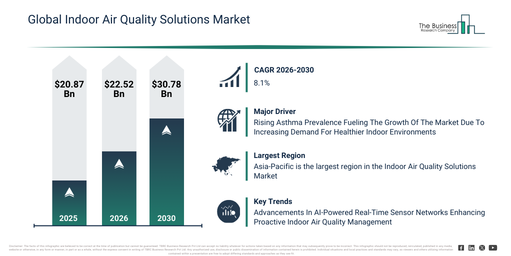
The indoor air quality solutions market size has experienced robust growth in recent years. It is anticipated to increase from $20.87 billion in 2025 to $22.52 billion in 2026, exhibiting a compound annual growth rate (CAGR) of 7.9%. The expansion observed in the historic period can be attributed to rising awareness of indoor air pollution, increasing prevalence of respiratory diseases, adoption of residential air purifiers, growth of commercial building management systems, and early innovations in hepa and activated carbon filtration.
The indoor air quality solutions market is projected to experience substantial expansion over the upcoming years, with its size anticipated to reach $30.78 billion by 2030, exhibiting a compound annual growth rate (CAGR) of 8.1%. This projected growth is primarily driven by factors such as the integration of IoT-enabled sensors, an increasing need for smart ventilation solutions, more stringent indoor air quality regulations, the rising implementation of UV and photocatalytic oxidation technologies, and greater investment in air quality management across commercial and educational settings. Key trends identified for this period encompass smart indoor air quality monitoring, sophisticated filtration and purification methods, optimized ventilation systems, solutions for humidity and odor regulation, and comprehensive integrated air quality management platforms.
Download A Free Sample Report For Comprehensive Market Insights:
Indoor Air Quality Solutions Market Opportunity Drivers: What Is Creating New Revenue Potential?
The increasing occurrence of asthma is projected to drive the expansion of the indoor air quality solutions market in the future. Asthma is defined as a long-term respiratory ailment marked by inflammation and constriction of the airways, resulting in repeated occurrences of wheezing, shortness of breath, a feeling of tightness in the chest, and coughing. Contributing elements to asthma encompass exposure to allergens like dust mites, pollen, and animal dander. A heightened exposure to allergens found indoors, such as dust mites, mold, and pet dander, is contributing to a rise in respiratory ailments like asthma. This, in turn, fuels the demand for indoor air quality solutions designed to monitor, filter, and control airborne contaminants, thereby fostering healthier internal settings. To illustrate, in July 2025, data from the Centers for Disease Control and Prevention (CDC), a US-based government agency, indicated that 8.6% of adults aged 18 years and older and 6.5% of children younger than 18 years currently suffered from asthma. Consequently, the growing incidence of asthma is a key factor propelling the expansion of the indoor air quality solutions market.
Indoor Air Quality Solutions Market Segments: Where Are The Largest Growth Opportunities?
The indoor air quality solutions market covered in this report is segmented –
1) By Product Type: Air Purifiers, Ventilation Systems, Humidifiers Or Dehumidifiers, Sensors And Monitors, Other Product Types
2) By Technology: High Efficiency Particulate Air (HEPA) Filtration, Activated Carbon Filtration, Ultraviolet (UV) Light Technology, Ionization, Nano Filtration, Photocatalytic Oxidation
3) By Application: Single-Family Homes, Multi-Family Apartments
4) By Distribution Channel: Online, Offline
5) By End-User: Home Owners, Facility Managers, Health Professionals, School Administrators, Business Owners
Subsegments:
1) By Air Purifiers: Portable Air Purifiers, Whole House Air Purifiers, Room Based Air Purifiers, Commercial Grade Air Purifiers
2) By Ventilation Systems: Mechanical Ventilation Systems, Natural Ventilation Systems, Balanced Ventilation Systems, Demand Controlled Ventilation Systems
3) By Humidifiers Or Dehumidifiers: Central Humidity Control Systems, Portable Humidifier Units, Portable Dehumidifier Units, Industrial Humidity Control Systems
4) By Sensors And Monitors: Particulate Matter Sensors, Gas Detection Sensors, Temperature And Humidity Monitors, Integrated Air Quality Monitoring Systems
5) By Other Product Types: Air Quality Control Software, Air Freshening Systems, Source Control Solutions, Air Duct Cleaning Equipment
Indoor Air Quality Solutions Market Innovation Trends Driving Future Development
Major companies within the indoor air quality solutions market are concentrating on creating innovative offerings, such as AI-powered real-time sensor networks, designed to enable continuous monitoring and sophisticated analysis of indoor pollutants. This development aims to improve preventive health management and enhance occupant well-being in diverse indoor environments. AI-based real-time sensor networks are defined as integrated systems that combine high-precision environmental sensors with artificial intelligence and advanced analytics to consistently measure, analyze, and interpret indoor air quality parameters, providing immediate and actionable insights. As an example, in December 2025, the Abu Dhabi Public Health Centre, a public health authority from the United Arab Emirates, launched the Indoor Air Quality Observatory (HawAQM). This HawAQM observatory integrates cutting-edge monitoring technologies, highly accurate sensors, and advanced analytics to supply real-time indoor air quality data across schools, homes, and public facilities. Its digital dashboard presents continuous pollutant measurements and trends visually, enabling specialists and decision-makers to implement timely, data-driven interventions. This advancement supports the indoor air quality solutions market by shifting air quality management from reactive assessments to proactive, intelligence-driven monitoring, thereby strengthening indoor environmental health management at scale.
Indoor Air Quality Solutions Market Major Participants And Competitive Dynamics
Major companies operating in the indoor air quality solutions market are Siemens AG, LG Electronics Inc., Panasonic Holdings Corporation, Honeywell International Inc., Mitsubishi Electric Corporation, Daikin Industries Ltd., 3M Company, Johnson Controls International plc, Carrier Global Corporation, Trane Technologies plc, Philips Electronics N.V., Dyson Technology Limited, Camfil AB, TSI Incorporated, Blueair AB, QleanAir AB, Sharp Corporation, Airthings AS, Aircuity Inc., IQAir AG, Aeroqual Limited.
Access The Complete Indoor Air Quality Solutions Market Report:
Indoor Air Quality Solutions Market Geographic Landscape: Which Region Dominates Industry Growth?
Asia-Pacific was the largest region in the indoor air quality solutions market in 2025. Asia-Pacific is expected to be the fastest-growing region in the forecast period. The regions covered in the indoor air quality solutions market report are Asia-Pacific, South East Asia, Western Europe, Eastern Europe, North America, South America, Middle East, Africa.
Get in touch with us:
The Business Research Company: https://www.thebusinessresearchcompany.com/
Americas: +1 310-496-7795
Asia: +44 7882 955267 & +91 8897263534
Europe: +44 7882 955267
Email us at: marketing@tbrc.info
Follow us on:
LinkedIn: https://in.linkedin.com/company/the-business-research-company
YouTube: https://www.youtube.com/channel/UC24_fI0rV8cR5DxlCpgmyFQ
Global Market Model: https://www.thebusinessresearchcompany.com/global-market-model

Wasay has over a decade of experience in market research, data modelling, and analytics, with prior experience at GlobalData and Decision Tree Consulting Services. At The Business Research Company , he leads research operations across syndicated studies, customized consulting engagements, and the Global Market Model platform. His professional experience includes supporting organizations such as Boston Consulting Group, KPMG, and Ernst & Young. Wasay holds a degree in Electronics and Communications Engineering, postgraduate management qualifications from International Management Institute Belgium and Indian School of Business and Entrepreneurship, and completed the Integrated Program in Business Analytics from Indian Institute of Management Indore.