
Delivering more actionable and strategically valuable research, The Business Research Company’s 2026 market reports feature market attractiveness analysis, total addressable market evaluation, company benchmarking matrices, interactive Excel dashboards, expanded supply chain intelligence, emerging startup coverage, and detailed product insights.
#Maritime Decarbonization Market Size And Revenue Forecast Through 2030
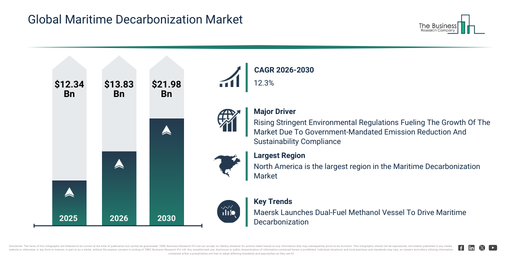
The maritime decarbonization market has observed rapid expansion in recent years. Its valuation is anticipated to climb from $12.34 billion in 2025 to $13.83 billion in 2026, achieving a compound annual growth rate (CAGR) of 12.0%. This historical growth can be linked to factors such as stringent IMO emission regulations, escalating fuel costs, heightened environmental awareness, the early adoption of energy-efficient technologies, and the broadening of global shipping trade.
The maritime decarbonization market is projected to experience substantial growth over the next few years. Its valuation is expected to reach $21.98 billion by 2030, expanding at a compound annual growth rate (CAGR) of 12.3%. This projected expansion during the forecast period is driven by increasing demand for zero-emission vessels, the adoption of green hydrogen and ammonia, investments in digital decarbonization platforms, the integration of predictive maintenance software, and the expansion of low-carbon fuel infrastructure. Key trends anticipated in this period include the uptake of alternative fuels, optimization of energy efficiency, integration of carbon capture technologies, digital emission monitoring, and advisory services for regulatory compliance.
Download A Free Sample Report For Comprehensive Market Insights:
Maritime Decarbonization Market Opportunity Drivers: What Is Creating New Revenue Potential?
Increasingly strict environmental rules are anticipated to fuel the expansion of the maritime decarbonization market in the future. These regulations are legally binding norms and criteria set by governmental bodies to manage pollution, safeguard natural resources, and minimize the detrimental effects of industrial, commercial, and economic operations on the environment and human well-being. The escalation of rigorous environmental regulations stems from growing worries about climate change, as governments endeavor to cut greenhouse gas emissions and curb the consequences of global warming. Maritime decarbonization aids these strict regulations by allowing vessel owners and operators to meet emission requirements through the incorporation of greener fuels, energy-saving technologies, and operational methods with reduced carbon footprints. As an illustration, in November 2025, the Australian parliament enacted revisions to the Environment Protection and Biodiversity Conservation (EPBC) Act, as reported by the Australian Government Department of Climate Change, Energy, Environment and Water, an Australian government body. These changes bolstered Australia’s foundational structure for preserving environmental assets of national importance. The amendments established a novel system of national environmental standards, offering more explicit, legally binding guidelines for approving developments, conserving biodiversity, and achieving environmental objectives. The purpose of these alterations is to enhance clarity, decrease delays in approvals, and guarantee that economic progress is more closely aligned with enduring environmental sustainability and conservation aims. Consequently, the growing stringency of environmental regulations propels the maritime decarbonization market.
Maritime Decarbonization Market Segmentation: How Is The Market Structured Across Key Categories?
The maritime decarbonization market covered in this report is segmented –
1) By Technology: Alternative Fuels, Energy Efficiency Technologies, Carbon Capture And Storage, Digitalization Solutions
2) By Vessel Type: Container Ships, Bulk Carriers, Tankers, Cruise Ships, Other Vessels
3) By Fuel Type: Green Ammonia, Hydrogen, Bio Methanol, Other Low Carbon Fuels
4) By End Use: Shipping Companies, Shipowners, Port Operators, Fuel Suppliers, Bunker Providers, Technology Providers
Subsegments:
1) By Alternative Fuels: Green Hydrogen, Green Ammonia, Sustainable Marine Biofuels, Methanol-Based Marine Fuels, Liquefied Natural Gas Alternatives
2) By Energy Efficiency Technologies: Advanced Propulsion Systems, Hull Optimization Technologies, Wind-Assisted Propulsion Systems, High-Efficiency Engine Upgrades, Waste Heat Recovery Systems
3) By Carbon Capture And Storage: Onboard Carbon Capture Units, Post-Combustion Capture Systems, Pre-Combustion Capture Modules, Shipboard Carbon Storage Tanks, Integrated Capture And Compression Systems
4) By Digitalization Solutions: Voyage Optimization Platforms, Fuel Consumption Monitoring Systems, Predictive Maintenance Software, Real-Time Emission Tracking Tools, Smart Fleet Management Systems
Maritime Decarbonization Market Innovation Trends Driving Future Development
Leading companies within the maritime decarbonization market are directing their efforts towards advancements in alternative marine fuel technologies, such as dual-fuel methanol propulsion systems. This focus aims to diminish greenhouse gas emissions, comply with stricter environmental regulations, and enable cleaner, more sustainable shipping operations. Dual-fuel methanol propulsion allows vessels to operate using both methanol and conventional fuel, thereby significantly reducing greenhouse gas emissions compared to heavy fuel oil, all while utilizing existing engine architectures adapted for cleaner fuels. For instance, in March 2025, Maersk, a Denmark-based shipping company, launched a dual-fuel methanol vessel. This vessel contributes to maritime decarbonization by allowing ships to run on both methanol and conventional marine fuels, facilitating a gradual transition to cleaner energy. They are capable of substantially reducing greenhouse gas emissions when powered by bio-methanol or e-methanol, depending on the fuel feedstock and its complete production lifecycle. Furthermore, these vessels also assist shipping companies in adhering to increasingly stringent global emissions regulations and aligning with net-zero targets.
Maritime Decarbonization Market Competitive Landscape And Leading Companies
Major companies operating in the maritime decarbonization market are Wärtsilä Corporation, Bureau Veritas S.A., DNV AS, Arup Group Limited, Yinson GreenTech Sdn. Bhd., Lloyd’s Register Group Limited, StormGeo AS, RightShip Pty Ltd., Silverstream Technologies Ltd., Veson Nautical Corporation, Norsepower Oy Ltd., NAPA Ltd., Sofar Ocean Technologies Inc., Houlder Limited, Molgas Energy Group, ZeroNorth A/S, Metis Cyberspace Technology Co. Ltd., Cryospain S.L., Hecla Emissions Management Ltd., and Manta Marine Technologies AS.
Access The Complete Maritime Decarbonization Market Report:
Maritime Decarbonization Market Regional Distribution: Which Areas Drive Market Expansion?
North America was the largest region in the maritime decarbonization market in 2025. Asia-Pacific is expected to be the fastest-growing region in the forecast period. The regions covered in the maritime decarbonization market report are Asia-Pacific, South East Asia, Western Europe, Eastern Europe, North America, South America, Middle East, Africa.
Get in touch with us:
The Business Research Company: https://www.thebusinessresearchcompany.com/
Americas: +1 310-496-7795
Asia: +44 7882 955267 & +91 8897263534
Europe: +44 7882 955267
Email us at: marketing@tbrc.info
Follow us on:
LinkedIn: https://in.linkedin.com/company/the-business-research-company
YouTube: https://www.youtube.com/channel/UC24_fI0rV8cR5DxlCpgmyFQ
Global Market Model: https://www.thebusinessresearchcompany.com/global-market-model

Wasay has over a decade of experience in market research, data modelling, and analytics, with prior experience at GlobalData and Decision Tree Consulting Services. At The Business Research Company , he leads research operations across syndicated studies, customized consulting engagements, and the Global Market Model platform. His professional experience includes supporting organizations such as Boston Consulting Group, KPMG, and Ernst & Young. Wasay holds a degree in Electronics and Communications Engineering, postgraduate management qualifications from International Management Institute Belgium and Indian School of Business and Entrepreneurship, and completed the Integrated Program in Business Analytics from Indian Institute of Management Indore.