
Through market attractiveness analysis, total addressable market evaluation, company benchmarking matrices, interactive Excel dashboards, expanded supply chain intelligence, emerging startup coverage, and detailed product insights, The Business Research Company’s 2026 market reports provide more actionable and strategically valuable research.
Automotive Seat Frame Market CAGR Analysis And Future Market Development
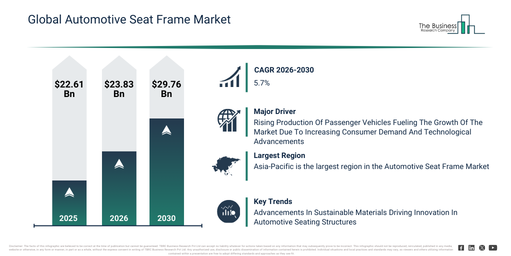
The automotive seat frame market has experienced significant expansion recently. Projections indicate its value will increase from $22.61 billion in 2025 to $23.83 billion in 2026, demonstrating a compound annual growth rate (CAGR) of 5.4%. Key factors contributing to this market’s historical growth include vehicle safety regulations, initial efforts in lightweighting, consumer demand for passenger comfort, the increasing integration of power seats, and advancements in manufacturing automation.
The automotive seat frame market is projected to experience robust expansion over the coming years. This market is forecast to reach $29.76 billion by 2030, exhibiting a compound annual growth rate (CAGR) of 5.7%. Factors contributing to this growth during the forecast period include an emphasis on EV range optimization, enhanced seating ergonomics, autonomous cabin reconfigurations, the incorporation of recyclable materials, and the integration of smart seat technologies. Key trends anticipated during the forecast period encompass lightweight seat frame designs, the integration of multiple materials in frames, advanced power and adjustable seat systems, crash-optimized frame structures, and a modular seat architecture.
Download A Free Sample Report For Comprehensive Market Insights:
#Automotive Seat Frame Market Growth Drivers And Industry Catalysts
The increasing manufacturing volume of passenger vehicles is projected to stimulate the expansion of the automotive seat frame market moving ahead. Passenger vehicles encompass road transport options like cars and light commercial vehicles, primarily designed for carrying individuals. This rise in passenger vehicle output is predominantly driven by urbanization, as growing urban centers escalate daily commuting requirements and prompt consumers to acquire personal vehicles for enhanced convenience, adaptability, and efficient use of time. Automotive seat frames contribute to efficient passenger vehicle production by offering a standardized, lightweight structural foundation that simplifies seat construction, guarantees adherence to safety regulations, and facilitates quicker, more economical manufacturing processes. For example, in April 2024, data from the Serbian Association of Vehicle and Parts Importers, a professional automotive entity located in Serbia, indicated that worldwide vehicle production reached 93,546,599 vehicles (including cars and light commercial vehicles) in 2023, with 67,133,570 being passenger vehicles, marking an increase from 84,830,376 vehicles produced in 2022. Consequently, the growing fabrication of passenger vehicles is a key factor propelling the development of the automotive seat frame market.
Automotive Seat Frame Market Segmentation And Category Breakdown
The automotive seat frame market covered in this report is segmented –
1) By Material Type: Steel Seat Frames, Aluminum Seat Frames, Magnesium Seat Frames, Composite, Mixed-Material
2) By Seat Configuration: Bucket Seat, Bench Seat, Reclining Seat, Foldable Seat
3) By Vehicle Type: Passenger Cars, Commercial Vehicles, Electric Vehicles (EVs)
4) By Distribution Channel: Original Equipment Manufacturer (OEM), Aftermarket
5) By End User: Automotive Manufacturers, Seat System Suppliers, Automotive Component Manufacturers
Subsegments:
1) By Steel Seat Frames: High Strength Steel Frames, Pressed Steel Frames, Welded Steel Frames, Tubular Steel Frames, Coated Steel Frames
2) By Aluminum Seat Frames: Cast Aluminum Frames, Extruded Aluminum Frames, Stamped Aluminum Frames, Lightweight Aluminum Frames, Reinforced Aluminum Frames
3) By Magnesium Seat Frames: Die Cast Magnesium Frames, Lightweight Magnesium Frames, Structural Magnesium Frames, Hybrid Magnesium Frames, Corrosion Resistant Magnesium Frames
4) By Composite: Carbon Fiber Composite Frames, Glass Fiber Composite Frames, Thermoplastic Composite Frames, Hybrid Composite Frames, Reinforced Polymer Composite Frames
5) By Mixed-Material: Steel Aluminum Hybrid Frames, Steel Composite Hybrid Frames, Magnesium Aluminum Hybrid Frames, Multi-Layered Hybrid Frames, Advanced Lightweight Hybrid Frames
#Automotive Seat Frame Market Trends Influencing Long-Term Demand
Major companies operating within the automotive seat frame market are concentrating on developing innovative products, such as fossil-free steel seat structures, to decrease vehicle carbon emissions and achieve sustainability targets. Fossil-free steel seat structures are components of seat frames fabricated using steel produced without fossil fuels, which helps to mitigate automotive CO2 emissions while preserving strength, safety, and durability comparable to conventional steel structures. For instance, in September 2023, Forvia, a France-based automotive technology company, introduced the world’s first carbon-free steel seat structure through a pioneering collaboration with SSAB, a Sweden-based steel company. This innovative seat structure is manufactured using fossil-free steel made with hydrogen-based technology and renewable electricity, enabling a substantial decrease in carbon emissions compared to conventional steel seat frames. It is designed to deliver equivalent structural strength, crash performance, and durability as traditional steel seat frames, ensuring full adherence to automotive safety standards. The carbon-free seat structure is engineered for seamless integration into existing vehicle seat architectures without necessitating major changes to manufacturing processes. Its fully recyclable composition and suitability for mass production render it appropriate for passenger vehicles, electric vehicles, and next-generation mobility platforms.
Automotive Seat Frame Market Competitive Analysis Of Major Industry Participants
Major companies operating in the automotive seat frame market are Toyota Motor Corporation, Magna International Inc., FORVIA SE, Lear Corporation, Adient plc, Brose Fahrzeugteile GmbH & Co. KG, NHK Spring Co. Ltd., TS TECH Co. Ltd., Martur Fompak International Pvt. Ltd., TACHI-S Co. Ltd., Bridgewater Interiors LLC, RECARO Holding GmbH, Daechang Seat Co. Ltd., Bharat Seats Ltd., RCO Engineering Inc., Yanfeng International Automotive Technology Co. Ltd., SKH Group GmbH, Sunrise Enterprises Private Limited, IFB Automotive Pvt. Ltd., and Victura Technologies Private Limited.
Access The Complete Automotive Seat Frame Market Report:
Automotive Seat Frame Market Geographic Distribution And Regional Opportunities
Asia-Pacific was the largest region in the automotive seat frame market in 2025, and it is expected to be the fastest-growing region in the forecast period. The regions covered in the automotive seat frame market report are Asia-Pacific, South East Asia, Western Europe, Eastern Europe, North America, South America, Middle East, Africa.
Get in touch with us:
The Business Research Company: https://www.thebusinessresearchcompany.com/
Americas: +1 310-496-7795
Asia: +44 7882 955267 & +91 8897263534
Europe: +44 7882 955267
Email us at: marketing@tbrc.info
Follow us on:
LinkedIn: https://in.linkedin.com/company/the-business-research-company
YouTube: https://www.youtube.com/channel/UC24_fI0rV8cR5DxlCpgmyFQ
Global Market Model: https://www.thebusinessresearchcompany.com/global-market-model

Wasay has over a decade of experience in market research, data modelling, and analytics, with prior experience at GlobalData and Decision Tree Consulting Services. At The Business Research Company , he leads research operations across syndicated studies, customized consulting engagements, and the Global Market Model platform. His professional experience includes supporting organizations such as Boston Consulting Group, KPMG, and Ernst & Young. Wasay holds a degree in Electronics and Communications Engineering, postgraduate management qualifications from International Management Institute Belgium and Indian School of Business and Entrepreneurship, and completed the Integrated Program in Business Analytics from Indian Institute of Management Indore.