
Delivering more actionable and strategically valuable research, The Business Research Company’s 2026 market reports feature market attractiveness analysis, total addressable market evaluation, company benchmarking matrices, interactive Excel dashboards, expanded supply chain intelligence, emerging startup coverage, and detailed product insights.
Inorganic Ceramic Membrane Module Market Expansion Outlook: What Revenue Opportunities Lie Ahead?
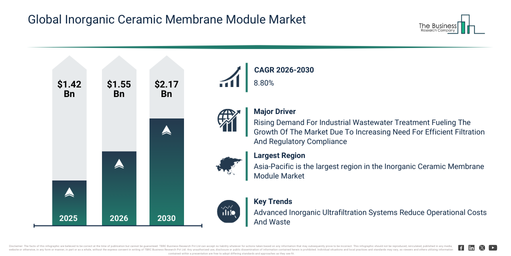
The inorganic ceramic membrane module market has seen substantial growth over recent years. It is anticipated to increase from $1.42 billion in 2025 to $1.55 billion in 2026, achieving a compound annual growth rate (CAGR) of 9.0%. The expansion observed in the past can be credited to factors such as increased regulatory scrutiny on wastewater discharge, a rising need for resilient and chemical-resistant filtration systems, wider acceptance in food and beverage filtration, broadening application in pharmaceutical purification, and an escalating industry shift from polymeric to ceramic membranes.
The inorganic ceramic membrane module market size is anticipated to experience robust growth in the upcoming years. It is projected to expand to $2.17 billion in 2030, achieving a compound annual growth rate (CAGR) of 8.8%. This expansion during the forecast period is driven by the escalating demand for ultrapure water in electronics, a heightened emphasis on industrial water reuse, the increasing implementation of ceramic membrane reactors, rising investments in decentralized water treatment, and increased pharmaceutical and biotech production. Significant trends for the forecast period encompass technological progress in membrane materials, novel approaches in ceramic membrane reactor designs, advancements in economical production techniques, ongoing research and development for high-flux ceramic membranes, and innovations in nanostructured ceramic coatings.
Download A Free Sample Report For Comprehensive Market Insights:
Inorganic Ceramic Membrane Module Market Opportunity Drivers: What Is Creating New Revenue Potential?
The increasing need for industrial wastewater treatment is anticipated to fuel the expansion of the inorganic ceramic membrane module market going forward. This treatment involves procedures employed across manufacturing, chemical, pharmaceutical, food processing, and various industrial sectors to eliminate pollutants, suspended particles, heavy metals, and hazardous substances from wastewater prior to its release or repurposing. The surge in demand for industrial wastewater treatment stems from strict environmental policies that mandate industries to reduce contamination and adhere to water discharge criteria. Inorganic ceramic membrane modules are instrumental in meeting this demand, offering robust durability, resistance to chemicals, thermal stability, and excellent filtration capabilities, thus allowing industries to attain enhanced purification effectiveness and dependable long-term operations. As an illustration, in May 2025, data from Imperial College London, a UK-based public research university, indicated that English water companies released untreated sewage for 3.614 million hours in 2024, a slight increase from the 3.606 million hours reported in 2023. This followed an already more than doubling of spills in 2023 compared to 1.75 million hours in 2022, highlighting the urgent requirement for wastewater treatment. Consequently, the escalating need for industrial wastewater treatment is propelling the expansion of the inorganic ceramic membrane module market.
Inorganic Ceramic Membrane Module Market Segments: Where Are The Largest Growth Opportunities?
The inorganic ceramic membrane module market covered in this report is segmented –
1) By Type: Ceramic Membrane Filter, Ceramic Membrane Reactor, Ceramic Membrane Sensor
2) By Module Type Or Configuration: Multichannel Or Tubular, Flat Sheet, Hollow Fiber, Other Module Type Or Configurations
3) By Technology: Microfiltration, Ultrafiltration, Nanofiltration, Other Technologies
4) By Material Type: Alumina, Zirconia (Zirconium Oxide), Silicon Carbide, Titania, Silica, Other Material Types
5) By Application: Water Treatment Plant, Food and Beverage Industry, Pharmaceutical Industry, Electronics Industry
Subsegments:
1) By Ceramic Membrane Filter: Microfiltration, Ultrafiltration, Nanofiltration, Crossflow Filtration, Dead-End Filtration
2) By Ceramic Membrane Reactor: Catalytic Membrane Reactors, Bioreactors, Photocatalytic Membrane Reactors, Hydrogen Separation Reactors, Oxidation Membrane Reactors
3) By Ceramic Membrane Sensor: Gas Sensing Sensors, Pressure Sensing Sensors, Temperature Sensing Sensors, Chemical Sensing Sensors, Humidity Sensing Sensors
Inorganic Ceramic Membrane Module Market Innovation Trends Driving Future Development
Key players within the inorganic ceramic membrane module market are prioritizing the creation of sophisticated offerings, such as high-selectivity filtration systems, with the goal of elevating efficiency, bolstering reliability, and minimizing both operational expenses and waste output. These high-selectivity filtration systems represent advanced ceramic membrane technologies capable of precisely separating challenging contaminants from process streams, thereby enabling water reuse and resource recovery. As an illustration, in May 2025, Nanostone Water Inc., a US-based manufacturer of ceramic membrane filtration systems, introduced the CUFshield PLUS. This advanced inorganic ceramic ultrafiltration (CUF) module was specifically engineered to tackle the semiconductor industry’s most complex wastewater issues, including managing abrasive CMP slurries and intricate chemistries. It incorporates an enhanced, highly resilient membrane material and a robust module construction that delivers superior resistance to extreme pH conditions, oxidants, and mechanical abrasion, substantially reducing the frequency of membrane replacement and associated downtime.
Inorganic Ceramic Membrane Module Market Major Participants And Competitive Dynamics
Major companies operating in the inorganic ceramic membrane module market are GEA Group Aktiengesellschaft, Meidensha Corporation, METAWATER Co. Ltd., Aquatech International LLC, Sterlitech Corporation, Pall Corporation, JIUWU Hi-Tech Membrane Technology Co. Ltd., Nanostone Water Inc., TAMI Industries, Berghof Membranes B.V., Aquabrane Water Technologies Private Limited, Alsys Group SAS, CERAFILTEC GmbH, Blufox Ecoventures LLP, Atech Innovations GmbH, Membracon UK Ltd., Ceraflo Pte Ltd., Atech Innovations GmbH, Inopor GmbH, Pervatech B.V.
Access The Complete Inorganic Ceramic Membrane Module Market Report:
Inorganic Ceramic Membrane Module Market Geographic Landscape: Which Region Dominates Industry Growth?
Asia-Pacific was the largest region in the inorganic ceramic membrane module market in 2025. Asia-Pacific is expected to be the fastest-growing region in the forecast period. The regions covered in the inorganic ceramic membrane module market report are Asia-Pacific, South East Asia, Western Europe, Eastern Europe, North America, South America, Middle East, Africa.
Get in touch with us:
The Business Research Company: https://www.thebusinessresearchcompany.com/
Americas: +1 310-496-7795
Asia: +44 7882 955267 & +91 8897263534
Europe: +44 7882 955267
Email us at: marketing@tbrc.info
Follow us on:
LinkedIn: https://in.linkedin.com/company/the-business-research-company
YouTube: https://www.youtube.com/channel/UC24_fI0rV8cR5DxlCpgmyFQ
Global Market Model: https://www.thebusinessresearchcompany.com/global-market-model

Wasay has over a decade of experience in market research, data modelling, and analytics, with prior experience at GlobalData and Decision Tree Consulting Services. At The Business Research Company , he leads research operations across syndicated studies, customized consulting engagements, and the Global Market Model platform. His professional experience includes supporting organizations such as Boston Consulting Group, KPMG, and Ernst & Young. Wasay holds a degree in Electronics and Communications Engineering, postgraduate management qualifications from International Management Institute Belgium and Indian School of Business and Entrepreneurship, and completed the Integrated Program in Business Analytics from Indian Institute of Management Indore.