
Enhanced with market attractiveness analysis, total addressable market evaluation, company benchmarking matrices, interactive Excel dashboards, expanded supply chain intelligence, emerging startup coverage, and detailed product insights, The Business Research Company’s 2026 market reports deliver more actionable and strategically valuable research.
Cellular Agriculture Market CAGR Analysis And Future Market Development
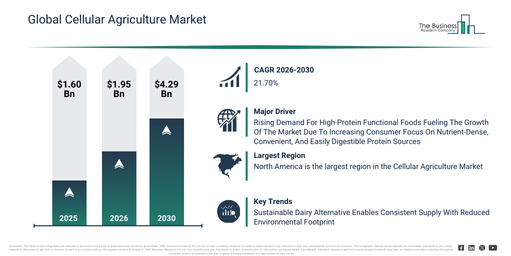
The cellular agriculture market size has experienced significant growth in recent years. It is projected to expand from $1.60 billion in 2025 to $1.95 billion in 2026, demonstrating a compound annual growth rate (CAGR) of 22.0%. The expansion observed historically can be attributed to an escalating demand for sustainable protein, increasing awareness of ethical food choices, greater investment in cell-based technologies, the proliferation of cultured meat startups, and a rising consumer interest in plant-based alternatives.
The market size for cellular agriculture is set for significant growth in the upcoming period, with projections indicating it will reach $4.29 billion in 2030, expanding at a compound annual growth rate (CAGR) of 21.7%. This anticipated growth over the forecast duration stems from several factors, including the rising adoption of cellular agriculture, enhanced governmental backing and financial provisions, a heightened emphasis on environmental sustainability, the scaling up of commercial production, and a surge in research collaborations and alliances. Key trends expected during this period encompass advancements in cell cultivation technology, novel approaches in bioreactor design, progress in protein scaffolding, intensive research and development within tissue engineering, and the integration of automated and artificial intelligence (AI)-powered production methods.
Download A Free Sample Report For Comprehensive Market Insights:
Cellular Agriculture Market Expansion Supported By Key Demand Factors
The increasing need for high-protein functional foods is anticipated to fuel the expansion of the cellular agriculture market in the future. These foods are products fortified with proteins and extra nutrients, aiding muscle growth, weight control, and general metabolic well-being. This surge in demand stems from consumers prioritizing healthier diets, searching for nutritious, easy-to-consume choices that back active living, exercise objectives, and everyday energy requirements. Cellular agriculture aids high-protein functional foods by supplying protein sources that are both nutrient-dense and free from animal products, making them highly suitable for health-aware and fitness-oriented individuals. This approach elevates product quality by offering complete, readily digestible proteins, thereby boosting nutritional content and ease of diet. For example, data from June 2024, provided by the International Food Information Council, a US-based nonprofit, indicates that a growing majority of Americans are concentrating on higher protein intake, climbing from 59% in 2022 to 67% in 2023 and reaching 71% in 2024. Furthermore, approximately half of consumers intend to increase their consumption of fresh foods, widely considered the most wholesome choice. Consequently, the growing desire for high-protein functional foods is propelling the expansion of the cellular agriculture market.
Cellular Agriculture Market Segmentation: How Is The Market Structured Across Key Categories?
The cellular agriculture market covered in this report is segmented –
1) By Product Type: Cell-Based Meat, Cell-Based Dairy, Cell-Based Egg Products, Cell-Based Seafood, Cellular Ingredients
2) By Source: Animal Cells, Microbial Fermentation, Plant Cells, Other Sources
3) By Technology: Bioreactors, 3D Bioprinting, Stem Cell Technology, Fermentation Technology, Cell Culture Techniques
4) By Distribution Channel: Direct Sales, Online Retail, Third-Party Distributors, Foodservice Channels, Wholesale Markets
5) By End-User: Food Manufacturers, Retail Chains, Restaurants And Food Service Providers, Research Institutions, Agricultural Producers
Subsegments:
1) By Cell-Based Meat: Cultivated Beef, Cultivated Pork, Cultivated Poultry, Cultivated Lamb, Cultivated Exotic Meat
2) By Cell-Based Dairy: Cell-Cultured Milk, Cell-Cultured Cheese, Cell-Cultured Butter, Cell-Cultured Yogurt, Cell-Cultured Cream
3) By Cell-Based Egg Products: Cultured Whole Eggs, Cultured Egg Whites, Cultured Egg Yolks, Cultured Egg Powders
4) By Cell-Based Seafood: Cultivated Fish, Cultivated Shrimp, Cultivated Crab, Cultivated Lobster, Cultivated Shellfish
5) By Cellular Ingredients: Bioengineered Proteins, Bioengineered Collagen, Bioengineered Gelatin, Bioengineered Enzymes, Bioengineered Fats
Cellular Agriculture Market Growth Trends Influencing Competitive Dynamics
Leading companies active in the cellular agriculture market are concentrating on developing advanced products, such as beta-lactoglobulin proteins, to enhance nutritional profiles, improve sustainability, and lessen reliance on animal agriculture. Beta-lactoglobulin proteins are the primary whey proteins in cow’s milk, providing nutritional and functional attributes, and can be created through precision fermentation as animal-free dairy proteins. For example, in March 2025, Vivici B.V., a producer of animal-free dairy ingredients based in the Netherlands, introduced the Vivitein BLG. This product is a pure, animal-free beta-lactoglobulin protein that offers a nutritional and functional profile identical to natural whey protein. It is produced via precision fermentation, ensuring a sustainable and steady supply with a significantly reduced environmental impact. The product boasts a high-purity, minimal-ingredient formulation and delivers excellent solubility and a clean taste, facilitating easy incorporation into performance nutrition, beverages, and dairy alternatives without compromising on flavor or texture. Moreover, it features non-GMO project verification and regulatory self-affirmed GRAS status, thereby accelerating its adoption by food and beverage manufacturers seeking scalable, sustainable protein solutions.
Cellular Agriculture Market Competitive Landscape And Leading Companies
Major companies operating in the cellular agriculture market are Formo GmbH, Perfect Day Inc., Eat Just Inc., UPSIDE Foods Inc., Mosa Meat B.V., BlueNalu Inc., Forsea Foods Ltd., Imagindairy Ltd., Finless Foods Inc., Meatiply Pte. Ltd., Aleph Farms Ltd., Biomilq Inc., Bene Meat Technologies s.r.o., Real Vegan Cheese, New Age Meats Inc., Wildtype Foods Inc., SuperMeat The Essence of Meat Ltd., Avant Meats Company Limited, Clever Carnivore Inc., Mission Barns Inc., IntegriCulture Inc., Jellatech Inc., Matrix Meats Inc.
Access The Complete Cellular Agriculture Market Report:
Cellular Agriculture Market Geographic Analysis: Where Is Demand Growing The Fastest?
North America was the largest region in the cellular agriculture market in 2025. Asia-Pacific is expected to be the fastest-growing region in the forecast period. The regions covered in the cellular agriculture market report are Asia-Pacific, South East Asia, Western Europe, Eastern Europe, North America, South America, Middle East, Africa.
Get in touch with us:
The Business Research Company: https://www.thebusinessresearchcompany.com/
Americas: +1 310-496-7795
Asia: +44 7882 955267 & +91 8897263534
Europe: +44 7882 955267
Email us at: marketing@tbrc.info
Follow us on:
LinkedIn: https://in.linkedin.com/company/the-business-research-company
YouTube: https://www.youtube.com/channel/UC24_fI0rV8cR5DxlCpgmyFQ
Global Market Model: https://www.thebusinessresearchcompany.com/global-market-model

Wasay has over a decade of experience in market research, data modelling, and analytics, with prior experience at GlobalData and Decision Tree Consulting Services. At The Business Research Company , he leads research operations across syndicated studies, customized consulting engagements, and the Global Market Model platform. His professional experience includes supporting organizations such as Boston Consulting Group, KPMG, and Ernst & Young. Wasay holds a degree in Electronics and Communications Engineering, postgraduate management qualifications from International Management Institute Belgium and Indian School of Business and Entrepreneurship, and completed the Integrated Program in Business Analytics from Indian Institute of Management Indore.