
Delivering more actionable and strategically valuable research, The Business Research Company’s 2026 market reports feature market attractiveness analysis, total addressable market evaluation, company benchmarking matrices, interactive Excel dashboards, expanded supply chain intelligence, emerging startup coverage, and detailed product insights.
Metal-Insulator-Semiconductor (MIS) Capacitor Market Revenue Outlook: What CAGR Is Expected Through 2030?
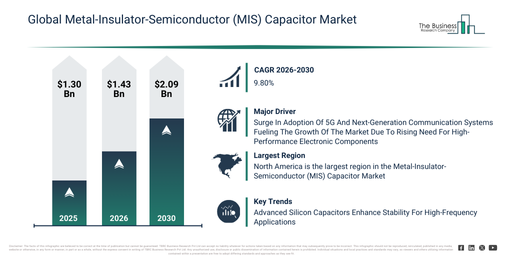
The metal–insulator–semiconductor (MIS) capacitor market has seen rapid growth in recent years. Its size is projected to increase from $1.30 billion in 2025 to $1.43 billion in 2026, with a compound annual growth rate (CAGR) of 10.1%. Historically, this expansion can be linked to the rising adoption of consumer electronics, a growing demand for compact high-frequency capacitors, the expansion of telecommunications infrastructure, an increase in automotive electronics content in vehicles, and the global growth of industrial automation and electronics manufacturing.
The metal–insulator–semiconductor (MIS) capacitor market is anticipated to experience substantial expansion over the coming years. Projections indicate it will reach a valuation of $2.09 billion by 2030, exhibiting a compound annual growth rate (CAGR) of 9.8%. This projected growth during the forecast period is primarily driven by an increasing demand stemming from the widespread adoption of 5G and Internet of Things (IoT) devices, alongside expanding electrification in the automotive sector and the uptake of electric vehicles (EVs). Further contributing factors include the progression of industrial automation and Industry 4.0 initiatives, the rising implementation of renewable energy systems that necessitate high-reliability capacitors, and the ongoing trend of miniaturization and enhanced integration within consumer and portable electronic devices. Key trends anticipated within this period encompass technological breakthroughs in high-density and high-performance dielectric materials, novel approaches to multilayer and on-chip integration for MIS capacitors, and advancements in designs capable of tolerating high frequencies and voltages. Furthermore, significant research and development efforts are focused on enhancing temperature stability and overall reliability. There is also an expanding application of metal–insulator–semiconductor (MIS) capacitors in various domains such as research and development (R&D), semiconductor testing, artificial intelligence (AI) edge computing, and high-performance computing applications.
Download A Free Sample Report For Comprehensive Market Insights:
Metal-Insulator-Semiconductor (MIS) Capacitor Market Demand Drivers: What Is Fueling Industry Growth?
The expanding uptake of 5G and advanced communication systems is anticipated to boost the metal insulator semiconductor (MIS) capacitor market’s growth. These systems represent sophisticated wireless networks delivering enhanced speeds, reduced latency, and improved connectivity for contemporary digital uses. Their increased adoption stems from a demand for ultra-low latency, high-bandwidth, and extensively connected networks capable of reliably supporting data-intensive applications. Metal-insulator-semiconductor (MIS) capacitors aid 5G and next-generation communication by mitigating performance constraints in high-frequency settings, allowing for stable functioning, minimal leakage, and effective energy management. For example, as per the Global System for Mobile Communications Association (GSMA) in February 2024, 5G connections are forecast to comprise 51% of mobile connections by 2029 and 56% by 2030. This highlights the technology’s rapid spread, with deployments exceeding one billion connections by the close of 2022, rising to 1.6 billion by the end of 2023, and predicted to reach 5.5 billion by 2030. Consequently, the heightened adoption of 5G and next-generation communication systems is fueling the expansion of the metal insulator semiconductor (MIS) capacitor market. The increasing prevalence of electric vehicles is projected to drive the growth of the metal insulator semiconductor (MIS) capacitors market in the future. Electric vehicles (EVs) are defined as vehicles powered either fully or partially by electricity, utilizing electric motors rather than (or alongside) internal combustion engines. The surge in electric vehicles is attributable to increasing consumer interest in energy-efficient transport options, which provide reduced operating expenses, lower emissions, and superior performance compared to traditional cars. Metal insulator semiconductor (MIS) capacitors facilitate the growth of electric vehicles and power electronics by providing stable gate control, optimizing voltage handling, boosting thermal resistance, and guaranteeing consistent performance in the high-power electronic circuits found in EV drivetrains, onboard chargers, inverters, and battery-management systems. For instance, in May 2025, the International Energy Agency (IEA) reported that global electric car sales surpassed 17 million in 2024, constituting over 20% of total car sales, marking an increase of 3.5 million electric cars sold compared to 2023. Hence, the expansion of electric vehicles and power electronics is propelling the metal insulator semiconductor (MIS) capacitors market forward.
Metal-Insulator-Semiconductor (MIS) Capacitor Market Segment Analysis And Revenue Opportunities
The metal-insulator-semiconductor (mis) capacitor market covered in this report is segmented –
1) By Type: High Voltage, Low Voltage
2) By Material: Metal Insulator Semiconductor, Metal Insulator Metal
3) By Technology: Traditional Capacitors, Smart Capacitors, Hybrid Capacitors
4) By Application: Consumer Electronics, Automotive, Industrial, Telecommunications, Aerospace And Defense, Others Applications
5) By End User: Original Equipment Manufacturers (OEMs), Aftermarket
Subsegments:
1) By High Voltage: High Voltage Power Management Modules, High Voltage Signal Conditioning Circuits, High Voltage Industrial Control Systems, High Voltage Energy Storage Networks, High Voltage Precision Measurement Devices
2) By Low Voltage: Low Voltage Portable Electronic Devices, Low Voltage Integrated Circuit Applications, Low Voltage Sensor Interface Circuits, Low Voltage Communication Devices, Low Voltage Consumer Electronic Modules
Metal-Insulator-Semiconductor (MIS) Capacitor Market Innovation Trends: Which Developments Are Transforming The Industry?
Major entities within the metal insulator semiconductor (MIS) capacitor market are prioritizing the augmentation of sophisticated production capacities, such as advanced high-volume silicon capacitor lines. This strategic focus aims to bolster supply chain robustness, elevate performance for high-frequency uses, and address the increasing requirements from the automotive and telecommunications sectors. Silicon capacitors are defined as passive elements fabricated directly onto a silicon wafer, delivering enhanced stability, reduced size, and superior high-frequency capabilities compared to conventional multilayer ceramic capacitors (MLCCs). As an illustration, in October 2024, Murata Manufacturing Co. Ltd., a Japanese supplier of passive electronic components, inaugurated a new silicon capacitor production facility at its site in Caen, France. This facility features a 200-millimeter wafer production line, specifically designed to broaden its silicon capacitor manufacturing operations. The new line is responsible for producing extremely compact, highly dependable silicon capacitors that exhibit outstanding electrical performance in challenging high-frequency and high-temperature settings. This expanded manufacturing capability caters to the stringent demands of cutting-edge applications, including ADAS sensors in automobiles, 5/6G telecommunications infrastructure, and miniaturized medical apparatus, thereby reinforcing supply consistency for clients across Europe and globally.
Metal-Insulator-Semiconductor (MIS) Capacitor Market Leading Players Shaping Industry Direction
Major companies operating in the metal-insulator-semiconductor (mis) capacitor market are TDK Corporation, EPCOS AG, Murata Manufacturing Co. Ltd., API Technologies Corp., Samsung Electro-Mechanics Co. Ltd., VIKING TECH CORPORATION, Skyworks Solutions Inc., Kyocera AVX Corporation, Vishay Intertechnology Inc., Rohm Semiconductor, Yageo Corporation, Taiyo Yuden Co. Ltd., Würth Elektronik Group, Knowles Corporation, MACOM Technology Solutions Holdings Inc., Cornell Dubilier Electronics Inc., Johanson Technology Inc., Presidio Components Inc., SemiGen Inc., Massachusetts Bay Technologies Inc.
Access The Complete Metal-Insulator-Semiconductor (MIS) Capacitor Market Report:
Metal-Insulator-Semiconductor (MIS) Capacitor Market Geographic Distribution And Regional Opportunities
North America was the largest region in the metal–insulator–semiconductor (MIS) capacitor market in 2025. Asia-Pacific is expected to be the fastest-growing region in the forecast period. The regions covered in the metal-insulator-semiconductor (mis) capacitor market report are Asia-Pacific, South East Asia, Western Europe, Eastern Europe, North America, South America, Middle East, Africa.
Get in touch with us:
The Business Research Company: https://www.thebusinessresearchcompany.com/
Americas: +1 310-496-7795
Asia: +44 7882 955267 & +91 8897263534
Europe: +44 7882 955267
Email us at: marketing@tbrc.info
Follow us on:
LinkedIn: https://in.linkedin.com/company/the-business-research-company
YouTube: https://www.youtube.com/channel/UC24_fI0rV8cR5DxlCpgmyFQ
Global Market Model: https://www.thebusinessresearchcompany.com/global-market-model

Wasay has over a decade of experience in market research, data modelling, and analytics, with prior experience at GlobalData and Decision Tree Consulting Services. At The Business Research Company , he leads research operations across syndicated studies, customized consulting engagements, and the Global Market Model platform. His professional experience includes supporting organizations such as Boston Consulting Group, KPMG, and Ernst & Young. Wasay holds a degree in Electronics and Communications Engineering, postgraduate management qualifications from International Management Institute Belgium and Indian School of Business and Entrepreneurship, and completed the Integrated Program in Business Analytics from Indian Institute of Management Indore.