
Enhanced with market attractiveness analysis, total addressable market evaluation, company benchmarking matrices, interactive Excel dashboards, expanded supply chain intelligence, emerging startup coverage, and detailed product insights, The Business Research Company’s 2026 market reports deliver more actionable and strategically valuable research.
Digital Twins In Artificial Lift Operations Market Revenue Outlook: What CAGR Is Expected Through 2030?
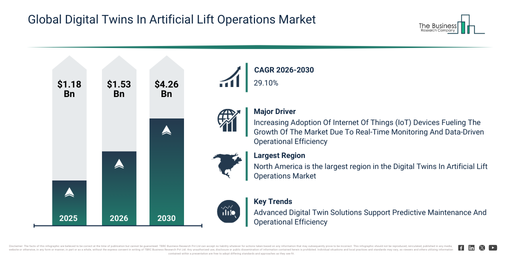
The market size for digital twins in artificial lift operations has expanded significantly in recent years. It is projected to grow from $1.18 billion in 2025 to $1.53 billion in 2026, at a compound annual growth rate (CAGR) of 29.4%. The growth witnessed historically is due to the increasing adoption of digital twin technologies in oil and gas, a rising necessity to reduce operational downtime, a growing emphasis on predictive maintenance, an increasing demand for real-time equipment monitoring, and rising investments in advanced analytics for lift operations.
The market for digital twins in artificial lift operations is anticipated to undergo significant expansion over the coming years. It is projected to achieve a value of $4.26 billion by 2030, exhibiting a compound annual growth rate (CAGR) of 29.1%. This projected growth is driven by factors such as the increasing integration of the internet of things (IoT) and artificial intelligence (AI) within artificial lift systems, a heightened focus on operational efficiency, the rising adoption of cloud-based simulation platforms, the growing necessity for cost optimization, and the expanding use of predictive modeling to assess equipment performance. Significant trends during the forecast period include advancements in artificial intelligence (AI)-driven simulation tools, innovations in real-time monitoring systems, the integration of digital twins with predictive maintenance platforms, enhancements in high-fidelity virtual replicas, and the development of cloud-based digital twin solutions.
Download A Free Sample Report For Comprehensive Market Insights:
Digital Twins In Artificial Lift Operations Market Growth Drivers: What Factors Are Accelerating Expansion?
The rising integration of Internet of Things (IoT) devices is anticipated to fuel the expansion of the digital twins in artificial lift operations market in the future. Internet of Things (IoT) devices represent a linked system of gadgets, including smartphones, sensors, wearables, smart home items, and security cameras, which transmit and share information via the internet autonomously. The demand for Internet of Things (IoT) enabled devices is escalating because of the requirement for instant data, as these devices boost efficiency, facilitate distant surveillance, and aid more informed choices across various sectors. Digital twins in artificial lift operations boost the uptake of Internet of Things (IoT) devices by developing virtual counterparts of machinery for continuous tracking, foresightful upkeep, and improved performance. These twins elevate operational effectiveness by providing data-informed perspectives, minimizing operational interruptions, and backing forward-thinking decisions within oil and gas activities. For example, in September 2024, IoT Analytics, a research company based in Germany specializing in IoT market data, reported that the count of connected IoT devices hit 16.6 billion in 2023, showing a 15% rise from 14.4 billion in 2022. Consequently, the growing integration of Internet of Things (IoT) devices is propelling the expansion of the digital twins in artificial lift operations robot market.
Digital Twins In Artificial Lift Operations Market Segmentation: How Is The Market Structured Across Key Categories?
The digital twins in artificial lift operations market covered in this report is segmented –
1) By Component: Software, Services
2) By System: Rod Lifts, Electric Submersible Pumps, Progressive Cavity Pumps, Gas Lift, Other Systems
3) By Deployment Mode: Cloud-Based, On-Premises
4) By Application: Predictive Maintenance, Performance Optimization, Equipment Monitoring, Operational Efficiency, Other Applications
5) By End User: Oil And Gas Operators, Energy And Utilities, Industrial Manufacturing, Other End-Users
Subsegments:
1) By Software: Simulation And Modeling Software, Predictive Analytics Software, Condition Monitoring Software, Asset Performance Management Software, Visualization And Digital Cockpit Software, Integration And Middleware Software
2) By Services: Consulting And Implementation Services, System Integration Services, Managed Services And Remote Monitoring, Training And Support Services, Data Management And Annotation Services, Maintenance And Calibration Services
Digital Twins In Artificial Lift Operations Market Trends: What Is Shaping Future Industry Growth?
Leading companies in the digital twins in artificial lift operations software market are concentrating on developing technologically advanced solutions, such as integrated lift-and-flow digital-twin solutions, to facilitate real-time monitoring, predictive maintenance, and operational optimization. Integrated lift and flow digital-twin solutions are defined as virtual, real-time models of fluid systems that simulate both lifting operations and flow dynamics, aiming to optimize performance, predict issues, and support operational decisions. For instance, in September 2024, ESSS, a Brazil-based energy-software company, introduced ALFAtwin, a lift-and-flow digital twin solution designed for offshore production and injection wells. This cutting-edge solution, co-developed with Petrobras, features a robust and scalable system for asset management that enhances process automation. Its functionalities include model calibration, performance curve analysis, and cooldown time simulation to prevent hydrate formation, enabling precise optimization of production and injection wells without requiring operator intervention. Additionally, it integrates real-time data and offers scenario simulation, empowering operators to anticipate potential problems and make data-driven choices to improve production efficiency and operational safety for offshore fields.
Digital Twins In Artificial Lift Operations Market Competitive Landscape And Leading Companies
Major companies operating in the digital twins in artificial lift operations market are Exxon Mobil Corporation, Shell plc, Microsoft Corporation, British Petroleum, Siemens AG, International Business Machines Corporation, General Electric Company, Oracle Corporation, Schneider Electric SE, Honeywell International Inc., Systems Applications & Products in data processing Societas Europaea, Schlumberger Limited, Asea Brown Boveri Ltd., Baker Hughes Company, Capgemini SE, Halliburton, Emerson Electric Co., Dassault Systèmes SE, Autodesk Inc., Weatherford International plc, Ansys Inc., Bentley Systems Incorporated
Access The Complete Digital Twins In Artificial Lift Operations Market Report:
Digital Twins In Artificial Lift Operations Market Geographic Landscape: Which Region Dominates Industry Growth?
North America was the largest region in the digital twins in artificial lift operations market in 2025. Asia-Pacific is expected to be the fastest-growing region in the forecast period. The regions covered in the digital twins in artificial lift operations market report are Asia-Pacific, South East Asia, Western Europe, Eastern Europe, North America, South America, Middle East, Africa.
Get in touch with us:
The Business Research Company: https://www.thebusinessresearchcompany.com/
Americas: +1 310-496-7795
Asia: +44 7882 955267 & +91 8897263534
Europe: +44 7882 955267
Email us at: marketing@tbrc.info
Follow us on:
LinkedIn: https://in.linkedin.com/company/the-business-research-company
YouTube: https://www.youtube.com/channel/UC24_fI0rV8cR5DxlCpgmyFQ
Global Market Model: https://www.thebusinessresearchcompany.com/global-market-model

Wasay has over a decade of experience in market research, data modelling, and analytics, with prior experience at GlobalData and Decision Tree Consulting Services. At The Business Research Company , he leads research operations across syndicated studies, customized consulting engagements, and the Global Market Model platform. His professional experience includes supporting organizations such as Boston Consulting Group, KPMG, and Ernst & Young. Wasay holds a degree in Electronics and Communications Engineering, postgraduate management qualifications from International Management Institute Belgium and Indian School of Business and Entrepreneurship, and completed the Integrated Program in Business Analytics from Indian Institute of Management Indore.