
Through market attractiveness analysis, total addressable market evaluation, company benchmarking matrices, interactive Excel dashboards, expanded supply chain intelligence, emerging startup coverage, and detailed product insights, The Business Research Company’s 2026 market reports provide more actionable and strategically valuable research.
Zero Carbon Shipping Market Expansion Outlook: What Revenue Opportunities Lie Ahead?
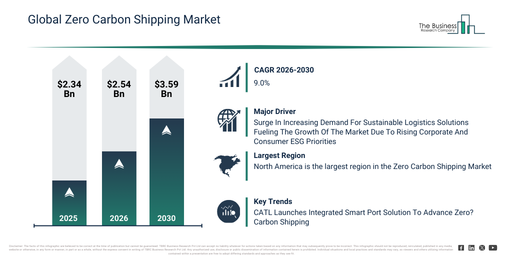
The zero carbon shipping market has experienced robust expansion over recent years. This market is projected to expand from $2.34 billion in 2025 to $2.54 billion by 2026, exhibiting a compound annual growth rate (CAGR) of 8.8%. Historically, this growth was fueled by factors such as the enforcement of maritime emission regulations, an uptick in global trade volumes, increasing environmental awareness, advances in renewable fuel research, and fluctuations in fuel cost.
The zero carbon shipping market is projected to experience significant expansion in the coming years. This market is forecast to reach $3.59 billion by 2030, exhibiting a compound annual growth rate (CAGR) of 9.0%. Factors contributing to this growth during the projection period include more stringent international mandates for decarbonization, an increase in green hydrogen production capacity, the enlargement of electric vessel charging infrastructure, growing public and investor demand for sustainability, and advancements in fuel cell propulsion technology. Key trends anticipated during the forecast timeframe encompass increased funding for alternative marine fuels, a greater uptake of wind and solar-assisted propulsion systems, the broadening of ship retrofit and conversion initiatives, a heightened need for energy-efficient vessel designs, and the incorporation of onboard carbon capture systems.
Download A Free Sample Report For Comprehensive Market Insights:
#Zero Carbon Shipping Market Growth Factors: Which Forces Are Supporting Market Expansion?
The escalating need for sustainable logistics solutions is poised to accelerate the expansion of the zero-carbon shipping market moving forward. These sustainable logistics solutions encompass practices and systems designed to mitigate environmental impacts stemming from freight and supply chains by minimizing emissions, energy consumption, and waste. The heightened demand for such solutions is attributed to a growing number of shippers who prioritize eco-friendly transport options to meet their corporate ESG commitments and comply with regulatory expectations. Zero-carbon shipping contributes to sustainable logistics solutions by supplying vessels and fuels that eliminate carbon emissions from maritime transport, thereby enabling logistics providers to reduce their scope 3 emissions. Illustratively, in June 2025, according to the International council on Clean Tranportation, a US-based, independent non-profit think tank, 1,103 zero-emission heavy-duty trucks were registered in 2024, representing a 34% rise compared to 2023 and nearly four times the figure in 2022. Additionally, these zero-emission heavy-duty trucks comprised 0.40% of the roughly 277,000 heavy-duty trucks registered. Thus, the increasing demand for sustainable logistics solutions is expected to fuel the growth of the zero-carbon shipping market.
Zero Carbon Shipping Market Categorization By Product Type And Application
The zero carbon shipping market covered in this report is segmented –
1) By Ship Type: Cargo Ships, Container Ships, Tankers, Bulk Carriers, Passenger Ships
2) By Fuel Type: Green Hydrogen, Green Ammonia, Bio-Liquefied Natural Gas (LNG), Methanol, Synthetic Fuels
3) By Technology: Fuel Cell Propulsion, Battery-electric Propulsion, Hybrid Propulsion Systems, Wind-Assisted Propulsion, Solar-Assisted Propulsion
4) By Application: Deep-Sea Shipping, Short-Sea Shipping, Inland Water Transport
5) By End-User: Manufacturing, Oil And Gas, Agriculture, Retail, Passenger Transportation, Other Industries
Subsegments:
1) By Cargo Ships: General Cargo Ships, Multi-Purpose Cargo Vessels, Roll-On Or Roll-Off (Ro-Ro) Cargo Ships, Short-Sea Cargo Vessels, Zero-Emission Coastal Cargo Ships
2) By Container Ships: Small Feeder Container Ships, Medium Container Vessels, Large Container Ships, Ultra-large Container Ships (ULCs), Green Container Ships Using Alternative Fuels
3) By Tankers: Crude Oil Tankers, Product Tankers, Liquefied Natural Gas (LNG) Tankers, Chemical Tankers, Zero-emission Fuel Tankers
4) By Bulk Carriers: Handysize Bulk Carriers, Supramax Bulk Carriers, Panamax Bulk Carriers, Capesize Bulk Carriers, Low-Carbon Dry Bulk Carriers
5) By Passenger Ships: Cruise Ships, Ferries, Ro-Pax Vessels, River Passenger Ships, Electric Or Hydrogen-Powered Passenger Ships
Zero Carbon Shipping Market Industry Trends: What Changes Are Reshaping Demand?
Major companies engaged in the zero-carbon shipping market are concentrating on advancements in green fuel production capacity, such as ship-shore-cloud integrated energy and charging networks, to reduce carbon emissions from maritime operations, improve operational efficiency, and comply with stringent environmental regulations. Ship-shore-cloud integrated energy and charging networks combine vessel battery systems, shore-based electrification infrastructure, and cloud-enabled fleet management to facilitate comprehensive decarbonization of maritime activities and efficient energy distribution for zero-carbon fuel use. For example, in December 2025, Contemporary Amperex Electric Vessel Co., Ltd., a China-based battery technology company, launched the world’s first ship-shore-cloud. CATL’s ship-shore-cloud solution provides an end-to-end zero-carbon shipping ecosystem by integrating onboard power and battery systems, shore-side charging and battery-swapping networks, and cloud-based intelligent monitoring and dispatch. It eliminates coordination problems caused by multiple suppliers through a unified, full-chain service model across the vessel’s lifecycle. The solution supports stable long-distance electric ship operations via integrated navigation, energy management, and safety systems. It also reduces cost and range anxiety through the “separation of ship and battery” approach and faster energy replenishment.
Zero Carbon Shipping Market Company Landscape And Strategic Competition
Major companies operating in the zero carbon shipping market are Kongsberg Gruppen ASA, A.P. Moller – Maersk A/S, Wärtsilä Oyj Abp, Norled AS, Amogy Inc., Ocean Infinity Group Limited, Corvus Energy Ltd., Incat Tasmania Pty Ltd., CMA CGM Group, Echandia Marine AB, Artemis Technologies Ltd., Hydrogenious LOHC Technologies GmbH, VEAR AS, NEOLINE S.A.S., Zero Emission Industries, Inc., Yara Clean Ammonia AS, Eco Marine Power Co., Ltd., Synhelion SA, Windship Technology Ltd., and Yara Birkeland.
Access The Complete Zero Carbon Shipping Market Report:
Zero Carbon Shipping Market Geographic Landscape: Which Region Dominates Industry Growth?
North America was the largest region in the zero carbon shipping market in 2025. Asia-Pacific is expected to be the fastest-growing region in the forecast period. The regions covered in the zero carbon shipping market report are Asia-Pacific, South East Asia, Western Europe, Eastern Europe, North America, South America, Middle East, Africa.
Get in touch with us:
The Business Research Company: https://www.thebusinessresearchcompany.com/
Americas: +1 310-496-7795
Asia: +44 7882 955267 & +91 8897263534
Europe: +44 7882 955267
Email us at: marketing@tbrc.info
Follow us on:
LinkedIn: https://in.linkedin.com/company/the-business-research-company
YouTube: https://www.youtube.com/channel/UC24_fI0rV8cR5DxlCpgmyFQ
Global Market Model: https://www.thebusinessresearchcompany.com/global-market-model

Wasay has over a decade of experience in market research, data modelling, and analytics, with prior experience at GlobalData and Decision Tree Consulting Services. At The Business Research Company , he leads research operations across syndicated studies, customized consulting engagements, and the Global Market Model platform. His professional experience includes supporting organizations such as Boston Consulting Group, KPMG, and Ernst & Young. Wasay holds a degree in Electronics and Communications Engineering, postgraduate management qualifications from International Management Institute Belgium and Indian School of Business and Entrepreneurship, and completed the Integrated Program in Business Analytics from Indian Institute of Management Indore.