
Enhanced with market attractiveness analysis, total addressable market evaluation, company benchmarking matrices, interactive Excel dashboards, expanded supply chain intelligence, emerging startup coverage, and detailed product insights, The Business Research Company’s 2026 market reports deliver more actionable and strategically valuable research.
5G mmWave Infrastructure Market Growth Potential: How Will Market Size Change Through 2030?
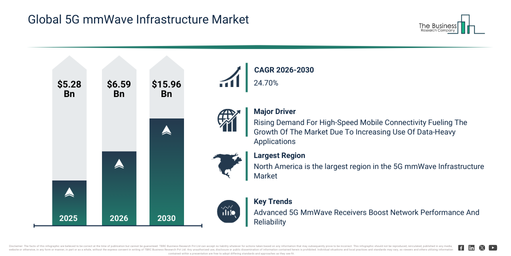
The 5G mmWave infrastructure market size has experienced significant expansion in recent years. This market is forecast to increase from $5.28 billion in 2025 to $6.59 billion in 2026, reflecting a compound annual growth rate (CAGR) of 24.9%. In previous periods, this expansion was driven by factors including increasing consumer mobile data consumption, a rising need for ultra-high capacity mobile backhaul, the ongoing spread of urban densification and smart city developments, growing investments from network operators, and regulatory spectrum auctions and allocations.
The 5G mmWave infrastructure market is projected to experience rapid expansion over the coming years. This market is anticipated to reach $15.96 billion by 2030, exhibiting a compound annual growth rate (CAGR) of 24.7%. Factors driving this growth during the forecast period include higher capital investments from telecom operators, increased spectrum allocation for millimeter-wave bands, expanding public and private collaborations for infrastructure development, a growing need for fixed wireless access in remote regions, and the increasing uptake of private fifth-generation networks by businesses. Key trends expected during this period involve enhancements in fifth-generation millimeter-wave beamforming and massive multiple-input multiple-output techniques, novel integrated access and backhaul solutions, the creation of compact, low-profile phased array antennas, ongoing research and development in sophisticated signal processing algorithms, and the rise of software-defined radio orchestration to enable flexible spectrum utilization.
Download A Free Sample Report For Comprehensive Market Insights:
5G mmWave Infrastructure Market Growth Momentum: Which Factors Are Influencing Demand?
The future expansion of the 5G mmWave infrastructure market is anticipated to be fueled by the rising need for rapid mobile connectivity. This type of connectivity describes quick and dependable wireless data transfer, facilitating seamless streaming, rapid downloads, and effective real-time mobile app usage. The heightened requirement for high-speed mobile connectivity stems from the increasing adoption of data-intensive applications like high-definition streaming and cloud-based services. By delivering ultra-fast, low-latency connections, 5G mmWave infrastructure improves mobile networks, rendering it highly suitable for crowded urban environments and applications that consume a lot of bandwidth. It ensures uninterrupted data flow and dependable performance, thereby enhancing the user experience for activities such as streaming, gaming, and instantaneous communication. For example, in May 2025, data from the Organisation for Economic Co-operation and Development, a France-based intergovernmental organization, indicated that the average monthly mobile broadband data consumption per subscription within OECD countries saw a 65% increase within a single year and more than doubled over two years, rising from 8 GB in June 2022 to 17 GB by June 2024. Consequently, the expanding need for high-speed mobile connectivity is indeed fostering the expansion of the 5G mmWave infrastructure market.
5G mmWave Infrastructure Market Segmentation And Category Breakdown
The 5G mmwave infrastructure market covered in this report is segmented –
1) By Component: Hardware, Software, Services
2) By Spectrum Band: 24 GHz–29 GHz, 30 GHz–39 GHz, 40 GHz–52 GHz, Other Spectrum Bands
3) By Deployment Mode: Indoor, Outdoor
4) By Application: Telecommunications, Automotive, Industrial, Healthcare, Other Applications
5) By End-User: Telecom Operators, Enterprises, Government, Other End-Users
Subsegments:
1) By Hardware: Antenna Systems, Radio Units, Baseband Units, Small Cells, Transceivers, Power Amplifiers, Filters And Duplexers
2) By Software: Radio Resource Management Software, Network Orchestration Platforms, Network Management Systems, Element Management Systems, Deployment Automation Software, Spectrum Management Software
3) By Services: Installation And Integration Services, Network Planning And Design Services, Maintenance And Support Services, Managed Network Services, Consulting And Advisory Services, Site Acquisition And Survey Services, Testing And Optimization Services
5G mmWave Infrastructure Market Trends Reshaping Industry Growth
Major companies in the 5G mmWave Infrastructure market are concentrating on developing advanced products, such as 5G mmWave receivers, to improve network performance, enhance connectivity, and reduce spectrum constraints along with deployment costs. 5G mmWave receivers are advanced radio units that utilize high-frequency spectrum bands to deliver ultra-high-speed, high-capacity wireless broadband connectivity to homes and businesses. For instance, in February 2024, Nokia, a Finland-based telecommunications and network equipment company, launched its FastMile 5G mmWave Receiver. This compact, outdoor unit features patented interference mitigation technology that maintains strong signal integrity, significantly improving reliability in dense urban environments. It includes advanced beamforming and automatic alignment functionality, enabling seamless, high-capacity links over varying distances without manual reconfiguration. Additionally, it incorporates scalable architecture and energy-efficient operation, extending network capacity and reducing the total cost of ownership for service providers.
5G mmWave Infrastructure Market Competitive Analysis Of Major Industry Participants
Major companies operating in the 5G mmwave infrastructure market are Samsung Electronics Co. Ltd., Huawei Technologies Co. Ltd., Qualcomm Technologies Inc., Fujitsu Limited, Telefonaktiebolaget LM Ericsson, NEC Corporation, Nokia Corporation, ZTE Corporation, Keysight Technologies, Rohde & Schwarz GmbH & Co KG, Analog Devices Inc., Skyworks Solutions Inc., Mavenir Systems Inc., Comba Telecom Systems Holdings Ltd., Anritsu Corporation, Qorvo Inc., Casa Systems, Airspan Networks Inc., Anokiwave Inc., Siklu Inc., Filtronic plc
Access The Complete 5G mmWave Infrastructure Market Report:
5G mmWave Infrastructure Market Global Footprint: Which Region Holds Market Leadership?
North America was the largest region in the 5G mmWave infrastructure market in 2025. Asia-Pacific is expected to be the fastest-growing region in the forecast period. The regions covered in the 5G mmwave infrastructure market report are Asia-Pacific, South East Asia, Western Europe, Eastern Europe, North America, South America, Middle East, Africa.
Get in touch with us:
The Business Research Company: https://www.thebusinessresearchcompany.com/
Americas: +1 310-496-7795
Asia: +44 7882 955267 & +91 8897263534
Europe: +44 7882 955267
Email us at: marketing@tbrc.info
Follow us on:
LinkedIn: https://in.linkedin.com/company/the-business-research-company
YouTube: https://www.youtube.com/channel/UC24_fI0rV8cR5DxlCpgmyFQ
Global Market Model: https://www.thebusinessresearchcompany.com/global-market-model

Wasay has over a decade of experience in market research, data modelling, and analytics, with prior experience at GlobalData and Decision Tree Consulting Services. At The Business Research Company , he leads research operations across syndicated studies, customized consulting engagements, and the Global Market Model platform. His professional experience includes supporting organizations such as Boston Consulting Group, KPMG, and Ernst & Young. Wasay holds a degree in Electronics and Communications Engineering, postgraduate management qualifications from International Management Institute Belgium and Indian School of Business and Entrepreneurship, and completed the Integrated Program in Business Analytics from Indian Institute of Management Indore.