
Delivering more actionable and strategically valuable research, The Business Research Company’s 2026 market reports feature market attractiveness analysis, total addressable market evaluation, company benchmarking matrices, interactive Excel dashboards, expanded supply chain intelligence, emerging startup coverage, and detailed product insights.
5G Network Densification Market Expansion Outlook: What Revenue Opportunities Lie Ahead?
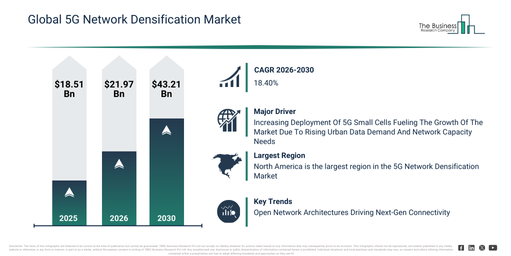
The 5G network densification market size has experienced rapid growth in recent years. It is projected to expand from $18.51 billion in 2025 to $21.97 billion in 2026, at a compound annual growth rate (CAGR) of 18.7%. The expansion witnessed historically can be linked to factors like increasing urban population density, rising smartphone adoption rates, growing mobile data consumption per user, increasing demand for mobile broadband services, and the rising popularity of video streaming services.
The 5G network densification market size is projected to experience substantial expansion over the coming years, with its value anticipated to reach $43.21 billion by 2030, exhibiting a compound annual growth rate (CAGR) of 18.4%. This growth during the predicted timeframe stems from factors such as the surging demand for immersive media experiences, the rising adoption of remote working and virtual collaboration, the growing need for ultra-low latency applications, the increasing requirement for supporting massive device connectivity, and the escalating expectations for seamless indoor and outdoor coverage. Key developments expected in this period encompass advancements in millimetre wave band utilization for high capacity, innovations in small cell form factors and power efficiency, the development of advanced antenna systems like massive multiple input multiple output, dedicated research and development into multi-access edge computing integration, and progress in intelligent self-organizing network automation.
Download A Free Sample Report For Comprehensive Market Insights:
5G Network Densification Market Opportunity Drivers: What Is Creating New Revenue Potential?
The escalating implementation of 5G small cells is anticipated to boost the expansion of the 5G network densification market moving forward. The deployment of 5G small cells involves the installation and activation of low-powered cellular radio access points, such as small cells, microcells, or distributed antenna systems, to improve network coverage, enhance capacity, and increase data speeds. This rise in 5G small cell deployment is attributed to the growing need for high-speed mobile data in urban regions, as dense populations and data-intensive applications place significant strain on existing network infrastructures. 5G network densification supports the rollout of 5G small cells by enhancing network capacity and extending coverage in high-traffic zones, making it perfectly suited for dense urban environments. It leads to better connectivity and faster data speeds, enabling smooth performance for demanding applications and services requiring low latency. For example, in December 2024, according to the Federal Communications Commission, a US-based government agency, CTIA estimated that 156,787 small cells and DAS were operational across the U.S. by the end of 2023, an increase from 142,057 in 2022. Additionally, WIA estimates indicated that 202,100 outdoor small cells were in use by the close of 2023, collectively supporting 466,850 small cell nodes. Thus, the increasing deployment of 5G small cells is a significant driver for the growth of the 5G network densification market.
5G Network Densification Market Segment Analysis And Revenue Opportunities
The 5G network densification market covered in this report is segmented –
1) By Components: Hardware, Software, Services
2) By Spectrum Band: Low-Band (< 1 Ghz), Mid-Band (1–6 Ghz), High-band Or Mmwave (> 24 Ghz)
3) By Network Architecture: Non-Standalone (NSA), Standalone (SA)
4) By Deployment Location: Indoor, Outdoor
5) By Infrastructure: Small Cell, Marco Cell, Radio Access Network
Subsegments:
1) By Hardware: Small Cells, Macro Cells, Antennas, Radio Units, Baseband Units, Fiber Backhaul Equipment, Edge Compute Servers
2) By Software: Network Management Platforms, Orchestration And Automation Software, Network Analytics And Performance Monitoring, Network Slicing Management Software, Self Organizing Network Automation, Security And Firewall Software, Radio Resource Management Software
3) By Services: Network Planning And Design Services, Site Acquisition And Permitting Services, Deployment And Integration Services, Testing And Optimization Services, Maintenance And Support Services, Managed Network Services, Backhaul Provisioning Services, Training And Education Services
5G Network Densification Market Innovation Trends Driving Future Development
Leading entities within the 5G network densification market are concentrating on creating sophisticated network solutions, including open network architectures. Their objective is to elevate performance, improve adaptability, and minimize both vendor dependency and the expenses associated with deployment. Such architectures denote network frameworks constructed upon open and interoperable standards, facilitating the smooth integration and operation of components originating from various suppliers. An illustrative case occurred in October 2024, when Ericsson, a networking and telecommunications firm headquartered in Sweden, collaborated with Masorange S.L., a telecommunications operator situated in Spain, to initiate an open network project. The initiative seeks to accelerate 5G deployment within Spain through the integration of Ericsson’s Cloud RAN (Radio Access Network) technology into Masorange’s infrastructure. It employs Intel’s infrastructure processing units to achieve improved performance and integrates cutting-edge energy-saving software. This undertaking is structured to augment network capacity and adaptability while simultaneously lowering the total cost of ownership for the operator, thereby preparing the ground for subsequent network advancements.
5G Network Densification Market Leading Players Shaping Industry Direction
Major companies operating in the 5G network densification market are Samsung Electronics Co. Ltd., Huawei Technologies Co. Ltd., Qualcomm Technologies Inc., Hewlett Packard Enterprise Company, Fujitsu Network Communications Inc., Telefonaktiebolaget LM Ericsson, NEC Corporation, Nokia Corporation, ZTE Corporation, Prysmian Group, Arista Networks Inc., ADTRAN Inc., VIAVI Solutions Inc., Aviat Networks Inc., Ruckus Networks Inc., Parallel Wireless Inc., Cambium Networks Corporation, Airspan Networks Inc., Dali Wireless Inc., Benetel Limited
Access The Complete 5G Network Densification Market Report:
5G Network Densification Market Geographic Analysis: Where Is Demand Growing The Fastest?
North America was the largest region in the 5G network densification market in 2025. Asia-Pacific is expected to be the fastest-growing region in the forecast period. The regions covered in the 5G network densification market report are Asia-Pacific, South East Asia, Western Europe, Eastern Europe, North America, South America, Middle East, Africa.
Get in touch with us:
The Business Research Company: https://www.thebusinessresearchcompany.com/
Americas: +1 310-496-7795
Asia: +44 7882 955267 & +91 8897263534
Europe: +44 7882 955267
Email us at: marketing@tbrc.info
Follow us on:
LinkedIn: https://in.linkedin.com/company/the-business-research-company
YouTube: https://www.youtube.com/channel/UC24_fI0rV8cR5DxlCpgmyFQ
Global Market Model: https://www.thebusinessresearchcompany.com/global-market-model

Wasay has over a decade of experience in market research, data modelling, and analytics, with prior experience at GlobalData and Decision Tree Consulting Services. At The Business Research Company , he leads research operations across syndicated studies, customized consulting engagements, and the Global Market Model platform. His professional experience includes supporting organizations such as Boston Consulting Group, KPMG, and Ernst & Young. Wasay holds a degree in Electronics and Communications Engineering, postgraduate management qualifications from International Management Institute Belgium and Indian School of Business and Entrepreneurship, and completed the Integrated Program in Business Analytics from Indian Institute of Management Indore.