
Through market attractiveness analysis, total addressable market evaluation, company benchmarking matrices, interactive Excel dashboards, expanded supply chain intelligence, emerging startup coverage, and detailed product insights, The Business Research Company’s 2026 market reports provide more actionable and strategically valuable research.
Ambient Computing Market Growth Potential: How Will Market Size Change Through 2030?
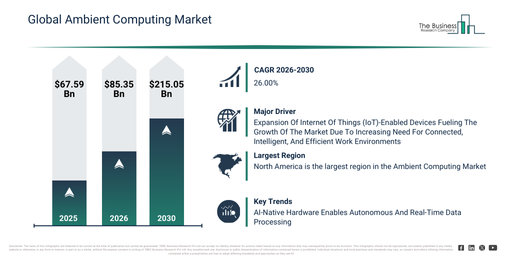
The ambient computing market size has seen significant growth in recent years. It is anticipated to expand from $67.59 billion in 2025 to $85.35 billion in 2026, with a compound annual growth rate (CAGR) of 26.3%. The expansion observed in the historic period stems from the increasing adoption of smart devices, the expanding Internet of Things ecosystem, a rising demand for smart homes and offices, the proliferation of healthcare monitoring applications, and growing enterprise automation initiatives.
The ambient computing market is projected to experience rapid expansion over the coming years. Its valuation is anticipated to reach $215.05 billion by 2030, demonstrating a compound annual growth rate (CAGR) of 26.0%. This expansion during the forecast period is largely driven by factors such as the increasing incorporation of artificial intelligence, the expanding deployment of edge computing, a surge in the embrace of cloud-based ambient computing platforms, the proliferation of smart city and infrastructure initiatives, and a heightened emphasis on energy-efficient and sustainable approaches. Key developments expected within this period encompass technological progress in sensor systems, breakthroughs in predictive artificial intelligence (AI), advancements in real-time edge computing, ongoing research and development in generative AI applications, and the increasing integration of augmented reality.
Download A Free Sample Report For Comprehensive Market Insights:
Ambient Computing Market Growth Factors Supporting Long-Term Expansion
The increasing deployment of Internet of Things (IoT)-enabled devices is projected to fuel the advancement of the ambient computing market in the future. Internet of Things (IoT)-enabled devices are defined as physical items fitted with sensors, software, and network capabilities, facilitating data collection, sharing, and action via the internet, thereby supporting automation, distant monitoring, and improved communication among devices and systems. This growth in IoT-enabled devices stems from an increasing need for intelligent and interconnected settings, where both individuals and companies desire automation, instantaneous monitoring, and effortless device integration. Ambient computing improves ecosystems of Internet of Things (IoT)-enabled devices by fostering smooth interactions and smart automation, which positions them perfectly for smart homes and linked work environments. This technology lessens manual input by enabling devices to predict user requirements and function independently, thus enhancing user convenience, operational efficiency, and prompt decision-making. As an illustration, in July 2025, data from Eurostat, a statistical office situated in Luxembourg, indicated that in 2024, 70% of European Union citizens aged 16 to 74 reported utilizing at least one Internet of Things (IoT) device, beyond their use of computers or smartphones for internet access. This represented a marginal increase of 0.7% from 69.3% in 2023. Consequently, the proliferation of Internet of Things (IoT)-enabled devices is a key factor propelling the expansion of the ambient computing market.
Ambient Computing Market Segment Performance And Strategic Opportunities
The ambient computing market covered in this report is segmented –
1) By Component Or Offering: Smart Devices And Sensors, Software And Platforms, Services
2) By Technology: Internet Of Things (IoT), Artificial Intelligence (AI), Sensor Technology, Edge Computing
3) By Application: Smart Homes, Healthcare, Retail, Automotive, Industrial Automation, Education
4) By End User: Consumer Electronics, Smart Speakers, Smart TVs, Smart Watches, Healthcare Providers, Hospitals, Home Health Monitoring, Medical Equipment Providers, Other End-Users
Subsegments:
1) By Smart Devices: Smart Speakers, Smart Home Hubs, Smart Sensors, Smart Lighting Systems, Smart Wearables, Smart Thermostats, Smart Surveillance Systems
2) By Software And Platforms: Ambient Operating Systems, Context Aware Computing Platforms, Cloud Based Ambient Platforms, Edge Based Ambient Platforms, Voice And Gesture Recognition Software, Predictive Analytics Platforms
3) By Services: Integration And Deployment Services, Consulting Services, Maintenance And Support Services, Managed Ambient Computing Services, Training And Education Services
Ambient Computing Market Industry Trends Shaping Future Revenue Growth
Companies actively engaged in the ambient computing market are prioritizing the development of sophisticated offerings, such as AI-native processors, to improve computational power, boost intelligence on devices, and decrease both latency and reliance on cloud infrastructure. AI-native processors are specialized integrated circuits specifically engineered from inception to efficiently manage artificial intelligence and machine learning workloads at the precise location where data originates. An illustrative example occurred in September 2025, when Ambient Scientific Inc., a US-based semiconductor company, unveiled the GPX10 Pro processor. This particular processor is a low-power, AI-native System-on-Chip (SoC) that incorporates a patented Compute Tile architecture, enabling scalable performance and significantly enhancing efficiency for edge devices. It features dedicated neural processing units (NPUs) and advanced vector processors, allowing for the seamless execution of complex AI models like convolutional neural networks and vision transformers directly on the device, without requiring operator input. Additionally, it integrates robust security features and an energy-efficient core design, thereby extending battery life and lowering operational expenditures for various applications in robotics, industrial automation, and smart vision systems.
Ambient Computing Market Key Players: Which Companies Shape Industry Competition?
Major companies operating in the ambient computing market are Amazon.com Inc., Apple Inc., Alphabet Inc., Microsoft Corporation, Samsung Electronics Co. Ltd., Huawei Technologies Co. Ltd., Robert Bosch GmbH, Sony Group Corporation, Cisco Systems Inc., LG Electronics Inc., Intel Corporation, Schneider Electric SE, Honeywell International Inc., Xiaomi Corporation, Qualcomm Incorporated, ASEA Brown Boveri Ltd., Koninklijke Philips N.V., NXP Semiconductors N.V., Legrand SA, Signify N.V., Garmin Ltd., Generac Holdings Inc., Databricks Inc., Arm Holdings plc, Sonos Inc., Wyze Labs Inc.
Access The Complete Ambient Computing Market Report:
#Ambient Computing Market Largest Region: Which Geography Holds The Highest Market Share?
North America was the largest region in the ambient computing market in 2025. Asia-Pacific is expected to be the fastest-growing region in the forecast period. The regions covered in the ambient computing market report are Asia-Pacific, South East Asia, Western Europe, Eastern Europe, North America, South America, Middle East, Africa.
Get in touch with us:
The Business Research Company: https://www.thebusinessresearchcompany.com/
Americas: +1 310-496-7795
Asia: +44 7882 955267 & +91 8897263534
Europe: +44 7882 955267
Email us at: marketing@tbrc.info
Follow us on:
LinkedIn: https://in.linkedin.com/company/the-business-research-company
YouTube: https://www.youtube.com/channel/UC24_fI0rV8cR5DxlCpgmyFQ
Global Market Model: https://www.thebusinessresearchcompany.com/global-market-model

Wasay has over a decade of experience in market research, data modelling, and analytics, with prior experience at GlobalData and Decision Tree Consulting Services. At The Business Research Company , he leads research operations across syndicated studies, customized consulting engagements, and the Global Market Model platform. His professional experience includes supporting organizations such as Boston Consulting Group, KPMG, and Ernst & Young. Wasay holds a degree in Electronics and Communications Engineering, postgraduate management qualifications from International Management Institute Belgium and Indian School of Business and Entrepreneurship, and completed the Integrated Program in Business Analytics from Indian Institute of Management Indore.