
Through market attractiveness analysis, total addressable market evaluation, company benchmarking matrices, interactive Excel dashboards, expanded supply chain intelligence, emerging startup coverage, and detailed product insights, The Business Research Company’s 2026 market reports provide more actionable and strategically valuable research.
AI Ethics Market Value Analysis: What Growth Is Expected Over The Forecast Period?
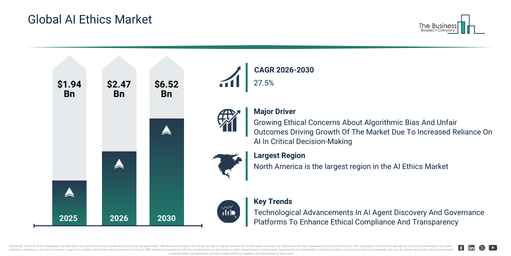
The AI ethics market has experienced substantial growth in recent years. It is forecast to expand from $1.94 billion in 2025 to $2.47 billion in 2026, achieving a compound annual growth rate (CAGR) of 27.2%. This historical growth can be attributed to factors such as increasing enterprise adoption of AI systems, initial occurrences of algorithmic bias, heightened regulatory scrutiny of automated decision systems, the expansion of data-driven business models, and a rising awareness of ethical AI risks.
The AI ethics market size is projected to experience substantial growth in the coming years. It is expected to reach $6.52 billion by 2030, demonstrating a compound annual growth rate (CAGR) of 27.5%. This expansion during the forecast period can be attributed to the increasing enforcement of AI regulations, a rising demand for the adoption of trustworthy AI, the expansion of cross-border data governance requirements, growing investments in responsible AI programs, and the increasing integration of ethics-by-design approaches. Major trends anticipated within this period include a wider embrace of AI ethics auditing services, increasing demand for bias detection and explainable AI tools, more extensive implementation of enterprise AI governance frameworks, the proliferation of ethical AI compliance platforms, and an enhanced focus on transparency and accountability mechanisms.
Download A Free Sample Report For Comprehensive Market Insights:
AI Ethics Market Expansion Drivers: What Is Shaping Future Growth?
Increasing moral apprehensions regarding algorithmic partiality and unjust results are projected to drive the expansion of the AI ethics market in the future. Algorithmic bias manifests when automated systems consistently generate inequitable or prejudiced results, frequently solidifying established social disparities tied to race, gender, economic status, or similar characteristics. Unfair outcomes denote consistently disadvantageous results for members of a specific cohort, despite the absence of any pertinent justification for such detriment. Moral worries concerning algorithmic bias and unfair outcomes are escalating because of the rising dependence on AI technologies in crucial decision-making domains, including recruitment, credit allocation, and policing. AI ethics addresses these expanding ethical concerns about algorithmic bias and unfair outcomes by offering structures and directives to guarantee equity, clarity, and responsibility throughout the creation and implementation of AI systems. As an illustration, in December 2025, the U.S. Equal Employment Opportunity Commission, an independent federal agency based in the US, reported 88,531 fresh discrimination complaints in fiscal year 2024 alone, indicating an increase of over 9% compared to the filings in fiscal year 2023. Consequently, the expanding ethical concerns regarding algorithmic bias and unfair outcomes are propelling the expansion of the AI ethics market.
AI Ethics Market Segment Outlook: Which Categories Are Expanding The Fastest?
The AI ethics market covered in this report is segmented –
1) By Component: Software; Services; Hardware
2) By Deployment: Cloud; On-Premises; Hybrid; Edge
3) By Organization Size: Large Enterprises; Small And Medium Enterprises (SMEs)
4) By Application: Healthcare; Banking Financial Services And Insurance (BFSI); Automotive; Retail; Government; Information Technology (IT) And Telecommunications; Education; Other Applications
5) By End-User: Enterprises; Government; Academia; Other End Users
Subsegments:
1) By Software: Artificial Intelligence (AI) Governance Platforms; Risk And Compliance Tools; Bias Detection Tools; Explainable AI Software; Artificial Intelligence (AI) Guardrails
2) By Services: Artificial Intelligence (AI) Ethics Consulting; Artificial Intelligence (AI) Governance Training; Compliance Auditing Services; Risk Assessment Services; Implementation Support
3) By Hardware: Secure Artificial Intelligence Processing Hardware; Privacy-Preserving Artificial Intelligence Hardware; Trusted Computing Platforms; Secure Data Storage And Processing Devices
AI Ethics Market Strategic Trends: What Is Defining The Next Phase Of Growth?
Leading companies in the AI ethics market are concentrating on developing innovative technologies, such as autonomous AI agent governance frameworks, to ensure clear, responsible, and policy-compliant deployment of AI agents across enterprise environments. These autonomous AI agent governance frameworks are integrated systems designed to enable organizations to identify, oversee, manage, and implement ethical, regulatory, and operational policies for autonomous AI agents throughout their lifecycle, thereby upholding transparency, accountability, and responsible AI utilization. For instance, in January 2026, Arthur AI, a US-based AI ethics company, launched the Agent Discovery & Governance (ADG) Platform to facilitate enterprise-wide discovery, monitoring, and policy enforcement for autonomous AI agents within cloud environments. This platform assists enterprises in identifying, governing, and continuously evaluating agentic AI systems operating within their cloud infrastructures. It provides production-grade controls to observe agent behavior, enforce policies, and mitigate risks such as security issues, operational disruptions, and inconsistent outcomes. The platform supports both third-party and internally developed AI agents, addressing internal as well as customer-facing use cases. By integrating with Google Cloud services including Vertex AI, Gemini models, BigQuery, and Kubernetes, it empowers organizations to scale agentic AI systems responsibly.
AI Ethics Market Key Companies And Competitive Benchmarking
Major companies operating in the AI ethics market are Microsoft Corporation, Accenture plc, International Business Machines Corporation, PricewaterhouseCoopers International Limited, KPMG International Limited, DataRobot Inc., Fractal Analytics Inc., Zest AI Inc., ClarifAI Inc., Fiddler AI Inc., Aporia Technologies Ltd., CalypsoAI Corp., TruEra Inc., Fairly AI Inc., Monitaur Inc., Verta Inc., ML6 BV, Robust Intelligence Inc., Pymetrics Inc., Superwise AI Ltd., AI Ethics Lab Inc.
Access The Complete AI Ethics Market Report:
AI Ethics Market Regional Distribution: Which Areas Drive Market Expansion?
North America was the largest region in AI ethics in 2025. Asia-Pacific is expected to be the fastest-growing region in the forecast period. The regions covered in the AI ethics market report are Asia-Pacific, South East Asia, Western Europe, Eastern Europe, North America, South America, Middle East, Africa.
Get in touch with us:
The Business Research Company: https://www.thebusinessresearchcompany.com/
Americas: +1 310-496-7795
Asia: +44 7882 955267 & +91 8897263534
Europe: +44 7882 955267
Email us at: marketing@tbrc.info
Follow us on:
LinkedIn: https://in.linkedin.com/company/the-business-research-company
YouTube: https://www.youtube.com/channel/UC24_fI0rV8cR5DxlCpgmyFQ
Global Market Model: https://www.thebusinessresearchcompany.com/global-market-model

Wasay has over a decade of experience in market research, data modelling, and analytics, with prior experience at GlobalData and Decision Tree Consulting Services. At The Business Research Company , he leads research operations across syndicated studies, customized consulting engagements, and the Global Market Model platform. His professional experience includes supporting organizations such as Boston Consulting Group, KPMG, and Ernst & Young. Wasay holds a degree in Electronics and Communications Engineering, postgraduate management qualifications from International Management Institute Belgium and Indian School of Business and Entrepreneurship, and completed the Integrated Program in Business Analytics from Indian Institute of Management Indore.