
Enhanced with market attractiveness analysis, total addressable market evaluation, company benchmarking matrices, interactive Excel dashboards, expanded supply chain intelligence, emerging startup coverage, and detailed product insights, The Business Research Company’s 2026 market reports deliver more actionable and strategically valuable research.
Public Transit Optimization Artificial Intelligence (AI) Market Forecast: What Market Value Is Expected By 2030?
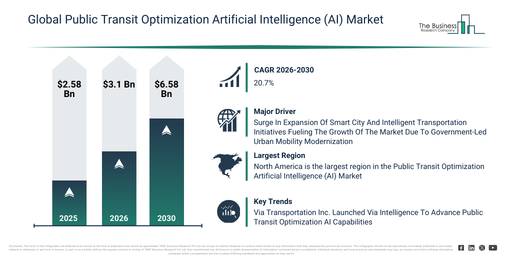
The public transit optimization artificial intelligence (AI) market size has seen substantial expansion in recent years. It is anticipated to increase from $2.58 billion in 2025 to $3.1 billion in 2026, demonstrating a compound annual growth rate (CAGR) of 20.4%. The expansion observed during the historic period can be ascribed to the proliferation of urban transit networks, an uptick in smart city endeavors, the broadening of GPS fleet tracking, the heightened collection of public transport data, and the initial uptake of transit analytics software.
The public transit optimization artificial intelligence (AI) market size is projected to experience significant growth over the next few years, reaching $6.58 billion by 2030 with a compound annual growth rate (CAGR) of 20.7%. This expansion during the forecast period can be attributed to factors such as rising urban congestion, increasing demand for efficient transit services, the broadening of connected transport infrastructure, enhanced government funding for smart mobility, and the expanding adoption of AI scheduling systems. Noteworthy trends for this period include the increased utilization of AI-based route planning tools, the expansion of real-time fleet monitoring systems, a growing embrace of predictive maintenance analytics, the integration of passenger demand forecasting models, and an increase in SaaS transit optimization platforms.
Download A Free Sample Report For Comprehensive Market Insights:
Public Transit Optimization Artificial Intelligence (AI) Market Expansion Supported By Key Demand Factors
The public transit optimization AI market is expected to expand going forward, propelled by the increasing development of smart city and intelligent transportation initiatives. These initiatives are government-led endeavors focused on implementing digital technologies and data analytics to improve urban services and mobility efficiency for citizens. Their emergence is primarily driven by governments prioritizing real-time, data-driven infrastructure to manage expanding urban populations and rising transportation demand. Public transit optimization AI aids smart city and intelligent transportation initiatives by enabling real-time transit scheduling, predictive route optimization, and dynamic resource allocation, which in turn enhance service reliability, improve operational efficiency, and alleviate congestion. For instance, in 2024, the Smart Nation 2.0 report, a Singapore-based government-led digital transformation program, indicated that public transport systems in Singapore manage approximately 7.5 million trips daily as of 2025. This volume requires the deployment of digital monitoring systems and AI-driven tools to optimize operations and maintain system efficiency. Therefore, the growth of the public transit optimization AI market is being driven by the expansion of smart city and intelligent transportation initiatives.
Public Transit Optimization Artificial Intelligence (AI) Market Segmentation: How Is The Market Structured Across Key Categories?
The public transit optimization artificial intelligence (AI) market covered in this report is segmented –
1) By Component: Software; Hardware; Services
2) By Transit Mode: Bus; Rail; Metro; Tram; Other Transit Modes
3) By Deployment Mode: Cloud; On Premises
4) By Application: Route Planning; Scheduling; Demand Forecasting; Real Time Monitoring; Passenger Information Systems; Other Applications
5) By End User: Public Transit Agencies; Private Operators; Municipalities; Other End Users
Subsegments:
1) By Software: Predictive Analytics Software; Route Planning And Scheduling Software; Demand Forecasting Software; Real Time Monitoring And Visualization Software; Fare Optimization Software
2) By Hardware: Onboard Sensors; Global Positioning System Devices; Edge Computing Units; Traffic Signal Controllers; Passenger Counting Devices
3) By Services: Consulting And Strategy Services; System Integration Services; Deployment And Implementation Services; Maintenance And Support Services; Training And Education Services
Public Transit Optimization Artificial Intelligence (AI) Market Growth Trends Influencing Competitive Dynamics
Key entities within the public transit optimization AI market are emphasizing technological progress, particularly vertical AI platforms for public transit, to achieve a competitive edge via faster deployment, domain-specific optimization, and enhanced operational effectiveness. A vertical AI platform tailored for public transit is a bespoke artificial intelligence system crafted for transit agencies, which incorporates real-time data, predictive analytics, and machine learning models to optimize route planning, fleet utilization, scheduling, and the overall service performance of public transportation networks. For instance, in 2024, Via, a US-based transit technology company, unveiled Via Intelligence, a vertical AI platform custom-built for public transit agencies to enhance planning, operations, and service outcomes. Via Intelligence translates intricate transit data into actionable insights, enabling cities to design, test, and optimize transit networks with greater efficiency. Among its features are a scheduling engine that adapts routes and timetables in real time to minimize delays and enhance reliability, along with predictive runtime functionalities that estimate bus travel durations more precisely, thereby supporting improved route planning and budgeting.
Public Transit Optimization Artificial Intelligence (AI) Market Competitive Landscape And Leading Companies
Major companies operating in the public transit optimization artificial intelligence (AI) market are International Business Machines Corporation (IBM), Thales Group, Siemens Mobility GmbH, Hitachi Rail Ltd., T-Systems International GmbH, Cubic Transportation Systems Inc, Remix, PTV Group, INIT Innovation in Traffic Systems SE, Trapeze Software Inc., Optibus Ltd., Moovit Inc., Swiftly Inc., Alstom SA, Bridj Pty Ltd., ioki GmbH, Esperanto Technologies Inc., Spedsta, TransitIQ, Smart Transit Systems
Access The Complete Public Transit Optimization Artificial Intelligence (AI) Market Report:
Public Transit Optimization Artificial Intelligence (AI) Market Largest Region By Revenue And Market Share
North America was the largest region in the public transit optimization artificial intelligence (AI) market in 2025. Asia-Pacific is expected to be the fastest-growing region in the forecast period. The regions covered in the public transit optimization artificial intelligence (AI) market report are Asia-Pacific, South East Asia, Western Europe, Eastern Europe, North America, South America, Middle East, Africa.
Get in touch with us:
The Business Research Company: https://www.thebusinessresearchcompany.com/
Americas: +1 310-496-7795
Asia: +44 7882 955267 & +91 8897263534
Europe: +44 7882 955267
Email us at: marketing@tbrc.info
Follow us on:
LinkedIn: https://in.linkedin.com/company/the-business-research-company
YouTube: https://www.youtube.com/channel/UC24_fI0rV8cR5DxlCpgmyFQ
Global Market Model: https://www.thebusinessresearchcompany.com/global-market-model

Wasay has over a decade of experience in market research, data modelling, and analytics, with prior experience at GlobalData and Decision Tree Consulting Services. At The Business Research Company , he leads research operations across syndicated studies, customized consulting engagements, and the Global Market Model platform. His professional experience includes supporting organizations such as Boston Consulting Group, KPMG, and Ernst & Young. Wasay holds a degree in Electronics and Communications Engineering, postgraduate management qualifications from International Management Institute Belgium and Indian School of Business and Entrepreneurship, and completed the Integrated Program in Business Analytics from Indian Institute of Management Indore.