
Delivering more actionable and strategically valuable research, The Business Research Company’s 2026 market reports feature market attractiveness analysis, total addressable market evaluation, company benchmarking matrices, interactive Excel dashboards, expanded supply chain intelligence, emerging startup coverage, and detailed product insights.
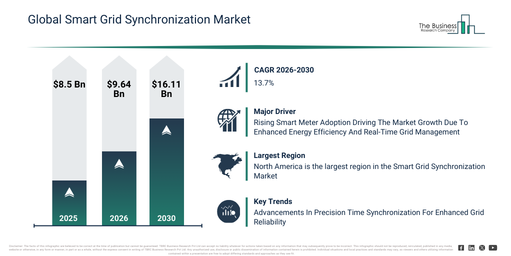
Smart Grid Synchronization Market Expected To Reach $16.11 Billion By 2030 At 13.7% CAGR
The smart grid synchronization market size has experienced rapid growth in recent years. It is forecast to grow from $8.5 billion in 2025 to $9.64 billion in 2026, achieving a compound annual growth rate (CAGR) of 13.4%. The market’s expansion in earlier periods stemmed from the adoption of phasor measurement units, the implementation of wide area monitoring systems, various grid stability programs, advancements in transmission modernization, and initiatives designed for blackout prevention.
The smart grid synchronization market is projected for swift expansion in the coming years. By 2030, this market is anticipated to reach $16.11 billion, demonstrating a compound annual growth rate (CAGR) of 13.7%. The growth during the forecast period is primarily driven by renewable variability management, increasing microgrid synchronization demand, high distributed energy resources (DER) penetration, the necessity for real-time grid control, and advancements in grid analytics. Key trends expected in this timeframe include synchrophasor-based grid coordination, the adoption of high precision time synchronization devices, dense PMU deployment networks, real-time phase angle monitoring, and automated grid frequency alignment.
Download A Free Sample Report For Comprehensive Market Insights:
Smart Grid Synchronization Market Development Factors: Which Trends Are Supporting Demand?
The increasing integration of smart meters is anticipated to boost the expansion of the smart grid synchronization market in the future. These electronic instruments are designed to automatically record and relay real-time consumption data for electricity, gas, or water directly to utility providers, facilitating precise billing and effective energy governance. The proliferation of smart meters is driven by efforts toward energy efficiency, given their ability to supply immediate usage information that empowers consumers to decrease consumption and allows utilities to streamline grid operations, thereby cutting expenses and mitigating environmental effects. Smart Grid Synchronization plays a crucial role for Smart Meters by facilitating uninterrupted data exchange between them and the grid, thereby supporting automated energy regulation, minimizing service interruptions, and enhancing the distribution of power. A notable example is observed in November 2025, when Gov.uk, a government organization based in the UK, reported that during Q3 2025, primary energy providers throughout Great Britain deployed a combined total of 680,000 smart and advanced meters. Consequently, the growing uptake of smart meters is a key catalyst for the expansion of the smart grid synchronization market.
Smart Grid Synchronization Market Segment Landscape: Which Areas Lead Market Development?
The smart grid synchronization market covered in this report is segmented –
1) By Component: Hardware; Software; Services
2) By Deployment: On-Premises; Cloud; Hybrid
3) By Technology: Phasor Measurement Units; Synchrophasors; Digital Fault Recorders; Smart Meters; Other Technologies
4) By Application: Transmission; Distribution; Generation; Other Applications
5) By End-User: Utilities; Industrial; Commercial; Residential; Other End-Users
Subsegments:
1) By Hardware: Smart Meters; Sensors; Controllers; Communication Devices; Energy Storage Systems
2) By Software: Grid Management Software; Data Analytics Platforms; Monitoring and Control Software; Predictive Maintenance Software; Energy Optimization Software
3) By Services: Installation Services; Integration Services; Consulting Services; Maintenance Services; Training and Support Services
Smart Grid Synchronization Market Transformation Trends: Which Innovations Are Driving Change?
Major companies operating in the smart grid synchronization market are focusing on developing innovative solutions, such as precision time synchronization technologies, to meet the rising demand for enhanced grid reliability, interoperability, and resilient digital power infrastructure. Precision Time Synchronization technologies are methods that align clocks across devices or systems with microsecond or nanosecond accuracy to enable coordinated operations in networks, industrial systems, and critical applications. For instance, in December 2025, Siemens AG, a Germany-based industrial automation and power systems technology company, introduced the siprotec 5 precision time protocol (PTP) grandmaster clock (GMC), designed to fortify digital substations and critical grid infrastructure. The Siprotec 5 PTP GMC integrates Precision Time Protocol (IEEE 1588v2) grandmaster capabilities with enhanced cybersecurity features, including strict separation of process bus and station bus networks and patent-pending seamless grandmaster changeover technology to maintain continuous synchronization without disruptive time jumps during clock transitions. This innovation supports resilient, fail-safe time coordination essential for modern smart grids, improves protection functions against disturbances, and strengthens overall grid reliability.
Smart Grid Synchronization Market Industry Leaders And Market Competition
Major companies operating in the smart grid synchronization market are Siemens AG., Hitachi Energy Ltd., Cisco Systems Inc., Oracle Corporation, Schneider Electric SE, Honeywell International Inc., ABB Ltd., Eaton Corporation plc., Quanta Technology LLC, Prysmian Group, Emerson Electric Co., Fluence Energy Inc., Itron Inc., Schweitzer Engineering Laboratories Inc., Landis+Gyr Group AG., Bentley Systems Incorporated, Crompton Greaves, S&C Electric Company, Kamstrup A/S, ETAP, Toshiba Corporation, and General Electric Company.
Access The Complete Smart Grid Synchronization Market Report:
Smart Grid Synchronization Market Regional Analysis And Leading Geography
North America was the largest region in the smart grid synchronization market in 2025. Asia-Pacific is expected to be the fastest-growing region in the forecast period. The regions covered in the smart grid synchronization market report are Asia-Pacific, South East Asia, Western Europe, Eastern Europe, North America, South America, Middle East, Africa.
Get in touch with us:
The Business Research Company: https://www.thebusinessresearchcompany.com/
Americas: +1 310-496-7795
Asia: +44 7882 955267 & +91 8897263534
Europe: +44 7882 955267
Email us at: marketing@tbrc.info
Follow us on:
LinkedIn: https://in.linkedin.com/company/the-business-research-company
YouTube: https://www.youtube.com/channel/UC24_fI0rV8cR5DxlCpgmyFQ
Global Market Model: https://www.thebusinessresearchcompany.com/global-market-model

Wasay has over a decade of experience in market research, data modelling, and analytics, with prior experience at GlobalData and Decision Tree Consulting Services. At The Business Research Company , he leads research operations across syndicated studies, customized consulting engagements, and the Global Market Model platform. His professional experience includes supporting organizations such as Boston Consulting Group, KPMG, and Ernst & Young. Wasay holds a degree in Electronics and Communications Engineering, postgraduate management qualifications from International Management Institute Belgium and Indian School of Business and Entrepreneurship, and completed the Integrated Program in Business Analytics from Indian Institute of Management Indore.