
Delivering more actionable and strategically valuable research, The Business Research Company’s 2026 market reports feature market attractiveness analysis, total addressable market evaluation, company benchmarking matrices, interactive Excel dashboards, expanded supply chain intelligence, emerging startup coverage, and detailed product insights.
Token-Aware Load Balancing for Large Language Models (LLMs) Market Expansion From $2.06 Billion In 2026 To $4.85 Billion In 2030
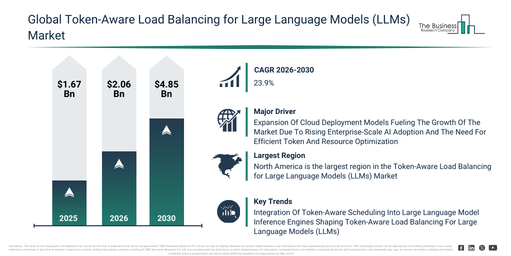
The market size for token-aware load balancing for large language models (llms) has seen considerable expansion over recent years. It is forecast to grow from $1.67 billion in 2025 to $2.06 billion in 2026, exhibiting a compound annual growth rate (CAGR) of 23.6%. This historical progression is largely due to factors such as increased llm deployment, a rise in AI inference workloads, the expansion of cloud AI platforms, the need for low latency AI responses, and an increase in multi model serving.
The market for token-aware load balancing in large language models (LLMs) is projected to experience rapid expansion over the coming years. By 2030, this market is anticipated to reach a valuation of $4.85 billion, exhibiting a compound annual growth rate (CAGR) of 23.9%. Factors driving this growth during the forecast period include the increasing adoption of LLMs by enterprises, the proliferation of real-time AI applications, a greater demand for cost-efficient inference, the rise of distributed AI serving infrastructures, and the implementation of multi-cluster AI routing solutions. Key trends anticipated for the forecast period encompass token-based request routing engines, LLM inference traffic shaping, dynamic token cost scheduling, autoscaling capabilities for LLM workloads, and real-time token usage analytics.
Download A Free Sample Report For Comprehensive Market Insights:
Token-Aware Load Balancing for Large Language Models (LLMs) Market Demand Drivers: What Is Fueling Industry Growth?
The increasing integration of cloud deployment is anticipated to boost the expansion of the token-aware load balancing for large language models (LLMs) market moving ahead. Cloud deployment involves utilizing cloud infrastructure and platforms to host, manage, and scale AI workloads, providing businesses with access to flexible computing resources, efficient AI service integration, and lower initial infrastructure expenditures. This growth in cloud deployment models is fueled by rising corporate demand for AI, as companies transition from preliminary trials to extensive, production-grade deployments necessitating enhanced tokenization and resource administration for large language models. Within cloud-deployed LLMs, token-aware load balancing improves resource use by distributing requests according to token length and processing needs, thereby decreasing latency and avoiding system saturation. It guarantees effective scaling and stable performance through the dynamic matching of workloads to available processing power. As an illustration, AAG reported that in June 2024, public cloud platform-as-a-service (PaaS) revenue hit $111 billion, and the overall cloud market is forecast to expand to $376.36 billion by 2029, with an estimated 200 zettabytes (2 billion terabytes) anticipated to be stored in the cloud by 2025. Consequently, the increased adoption of cloud deployment is a key factor propelling the expansion of the token-aware load balancing for large language models (LLMs) market.
Token-Aware Load Balancing for Large Language Models (LLMs) Market Segmentation Trends And Revenue Drivers
The token-aware load balancing for large language models (llms) market covered in this report is segmented –
1) By Component: Software; Hardware; Services
2) By Deployment Mode: On-Premises; Cloud
3) By Application: Model Training; Inference; Data Processing; Real-Time Analytics; Other Applications
4) By End-User: Banking, Financial Services, And Insurance (BFSI); Healthcare; Information Technology (IT) And Telecommunications; Retail And E-commerce; Media And Entertainment; Manufacturing; Other End-Users
Subsegments:
1) By Software: Load Balancing Software; Traffic Management Software; Performance Monitoring Software; Token Routing Software; Analytics And Reporting Software
2) By Hardware: High Performance Servers; Network Switches; Storage Systems; Accelerator Cards; Edge Computing Devices
3) By Services: Consulting Services; Implementation And Integration Services; Monitoring And Optimization Services; Maintenance And Support Services; Training And Advisory Services
Token-Aware Load Balancing for Large Language Models (LLMs) Market Innovation Trends: Which Developments Are Transforming The Industry?
Major companies within the token-aware load balancing market for large language models (LLMs) are concentrating on integrating token-aware scheduling into LLM inference engines, such as zero-overhead batch schedulers, which enable CPU-side request scheduling to overlap with graphics processing unit (GPU) computation. A zero-overhead batch scheduler is a mechanism that manages inference batches concurrently with ongoing GPU computations, ensuring the GPU remains fully utilized and avoids idleness due to CPU-side batching delays. For instance, in December 2024, the US-based research organization Laboratory for Machine Systems (LMSYS), focused on large language model inference systems, introduced a cache-aware load balancer. This cache-aware load balancer facilitates intelligent request routing by directing LLM inference requests to workers with the highest probability of prefix key-value (KV) cache reuse, thereby reducing redundant token computation. It enhances throughput and lowers response latency by maximizing cache hit rates during real-time inference. By avoiding simple round-robin routing, it ensures better utilization of computational resources across distributed workers. This approach scales efficiently across multi-node environments while maintaining token locality.
#Token-Aware Load Balancing for Large Language Models (LLMs) Market Industry Leaders: Which Organizations Are Driving Competition?
Major companies operating in the token-aware load balancing for large language models (llms) market are International Business Machines Corporation, NVIDIA Corporation, SAP SE, AkamAI Technologies Inc., Snowflake Inc., Databricks Inc., Datadog Inc., Dynatrace LLC, Cloudflare Inc., Elastic N.V., Fastly Inc., Kong Inc., Redis Ltd., Vercel Inc., Cohere Inc., Together AI Inc., Mistral AI SAS, Solo.io Inc., Fireworks AI Inc., HAProxy Technologies LLC, Fly.io Inc., and Envoy Proxy.
Access The Complete Token-Aware Load Balancing for Large Language Models (LLMs) Market Report:
Token-Aware Load Balancing for Large Language Models (LLMs) Market Geographic Analysis: Where Is Demand Growing The Fastest?
North America was the largest region in the token-aware load balancing for large language models (LLMs) market in 2025. Asia-Pacific is expected to be the fastest-growing region in the forecast period. The regions covered in the token-aware load balancing for large language models (llms) market report are Asia-Pacific, South East Asia, Western Europe, Eastern Europe, North America, South America, Middle East, Africa.
Get in touch with us:
The Business Research Company: https://www.thebusinessresearchcompany.com/
Americas: +1 310-496-7795
Asia: +44 7882 955267 & +91 8897263534
Europe: +44 7882 955267
Email us at: marketing@tbrc.info
Follow us on:
LinkedIn: https://in.linkedin.com/company/the-business-research-company
YouTube: https://www.youtube.com/channel/UC24_fI0rV8cR5DxlCpgmyFQ
Global Market Model: https://www.thebusinessresearchcompany.com/global-market-model

Wasay has over a decade of experience in market research, data modelling, and analytics, with prior experience at GlobalData and Decision Tree Consulting Services. At The Business Research Company , he leads research operations across syndicated studies, customized consulting engagements, and the Global Market Model platform. His professional experience includes supporting organizations such as Boston Consulting Group, KPMG, and Ernst & Young. Wasay holds a degree in Electronics and Communications Engineering, postgraduate management qualifications from International Management Institute Belgium and Indian School of Business and Entrepreneurship, and completed the Integrated Program in Business Analytics from Indian Institute of Management Indore.