
Enhanced with market attractiveness analysis, total addressable market evaluation, company benchmarking matrices, interactive Excel dashboards, expanded supply chain intelligence, emerging startup coverage, and detailed product insights, The Business Research Company’s 2026 market reports deliver more actionable and strategically valuable research.
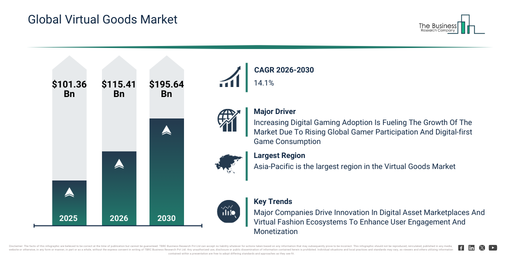
Virtual Goods Market Growth From $115.41 Billion In 2026 To $195.64 Billion By 2030 At A CAGR Of 14.1%
The virtual goods market has experienced swift expansion recently. It is projected to grow from $101.36 billion in 2025 to $115.41 billion in 2026, achieving a compound annual growth rate (CAGR) of 13.9%. The growth witnessed in earlier periods can be ascribed to factors such as the increase in online gaming, the development of social platforms, the broadening of app stores, a rise in digital payments, and the introduction of early microtransaction models.
The virtual goods market is projected to experience swift expansion over the coming years. By 2030, this market is forecasted to reach $195.64 billion, demonstrating a compound annual growth rate (CAGR) of 14.1%. This anticipated growth during the forecast period stems from factors such as the increasing adoption of the metaverse, the expanding creator economy, the proliferation of virtual events, increased digital spending by youth, and the development of cross-platform virtual assets. Key trends for this period encompass a surging demand for avatar customization items, the growing popularity of digital collectibles, an increase in in-app virtual purchases, the wider utilization of platform-based virtual currencies, and enhanced monetization strategies involving virtual event assets.
Download A Free Sample Report For Comprehensive Market Insights:
Virtual Goods Market Growth Drivers: What Factors Are Accelerating Expansion?
The virtual goods market is projected to expand due to the increasing embrace of digital gaming. Digital gaming itself refers to the experience of playing video games delivered through electronic devices and software platforms, relying on digital content rather than physical media. The rise in digital gaming adoption is largely attributed to improved internet connectivity and more accessible smart devices, which broaden participation in digital entertainment. Virtual goods contribute to this digital gaming adoption by offering various in-game items, digital currencies, and customization features, thereby enhancing user engagement and monetization within gaming ecosystems. As an illustration, in August 2024, data from the International Trade Administration (ITA), a US-based government agency, indicated that the global gaming population surpassed 3.2 billion players, with digital game purchases constituting approximately 95% of all game sales compared to physical formats, marking a continuous increase from 2023 levels. Consequently, the expanding adoption of digital gaming is a primary driver for growth in the virtual goods market.
Virtual Goods Market Segment Performance And Strategic Opportunities
The virtual goods market covered in this report is segmented –
1) By Type: In-Game Items; Digital Collectibles; Virtual Currency; Other Types
2) By Platform: Gaming Consoles; Personal Computers; Mobile Devices; Other Platforms
3) By Payment Mode: Credit or Debit Cards; Digital Wallets; Other Payment Modes
4) By Distribution Channel: Direct Purchase; Subscription Based Services; In App Purchases; Online Marketplaces
5) By End-User: Gamers; Social Media Users; Other End-Users
Subsegments:
1) By In-Game Items: Weapon Skins; Character Skins; Power-Ups; Virtual Pets; Accessories
2) By Digital Collectibles: Non-Fungible Tokens; Trading Cards; Digital Art; Virtual Memorabilia
3) By Virtual Currency: Game Coins; Premium Tokens; Reward Points; Cryptocurrency
4) By Other Types: Virtual Fashion; Digital Assets for Content Creation; Virtual Real Estate; Phygital Goods
Virtual Goods Market Trends: What Is Shaping Future Industry Growth?
Leading companies in the virtual goods market are concentrating on developing innovative solutions, such as consolidated digital asset marketplaces and advancements within digital fashion ecosystems, to satisfy the growing demand for improved user engagement, enhanced monetization prospects, and seamless cross-platform operability. Unified digital asset marketplaces are platforms designed to integrate digital assets from multiple sources into a single ecosystem, empowering creators and users to efficiently buy, sell, trade, and manage virtual items while reducing supply fragmentation and distribution complexity compared to traditional standalone marketplaces. For instance, in July 2025, DRESSX, a US-based digital fashion and artificial intelligence (AI) styling company, launched DRESSGO, a fashion-focused game on Roblox that transforms avatar styling into an interactive gameplay experience. Designed to attract Gen Z and Gen Alpha users, the game enables players to collect rare virtual fashion items through Boutique Boxes, complete Daily Quests to earn in-game currency, and participate in brand collaborations with companies like PUMA, supporting deeper community interaction and sustained virtual goods consumption.
Virtual Goods Market Key Players: Which Companies Shape Industry Competition?
Major companies operating in the virtual goods market are G2A.COM S.A., OpenSea Inc., SuperRare Labs Inc., Magic Eden Inc., Decentraland Marketplace, PlayerAuctions Inc., Zepeto Marketplace, Axie Marketplace, Solanart Inc., Exclusible Inc., Enjin Marketplace, Rarible Ltd., Mintable Inc., Foundation Inc., LooksRare Inc., AtomicHub Inc., DRESSX Inc., The Sandbox Marketplace, Larva Labs Marketplace, and SuperWorld Marketplace.
Access The Complete Virtual Goods Market Report:
Virtual Goods Market Geographic Analysis: Where Is Demand Growing The Fastest?
Asia-Pacific was the largest region in the virtual goods market in 2025. North America is expected to be the fastest-growing region in the forecast period. The regions covered in the virtual goods market report are Asia-Pacific, South East Asia, Western Europe, Eastern Europe, North America, South America, Middle East, Africa.
Get in touch with us:
The Business Research Company: https://www.thebusinessresearchcompany.com/
Americas: +1 310-496-7795
Asia: +44 7882 955267 & +91 8897263534
Europe: +44 7882 955267
Email us at: marketing@tbrc.info
Follow us on:
LinkedIn: https://in.linkedin.com/company/the-business-research-company
YouTube: https://www.youtube.com/channel/UC24_fI0rV8cR5DxlCpgmyFQ
Global Market Model: https://www.thebusinessresearchcompany.com/global-market-model

Wasay has over a decade of experience in market research, data modelling, and analytics, with prior experience at GlobalData and Decision Tree Consulting Services. At The Business Research Company , he leads research operations across syndicated studies, customized consulting engagements, and the Global Market Model platform. His professional experience includes supporting organizations such as Boston Consulting Group, KPMG, and Ernst & Young. Wasay holds a degree in Electronics and Communications Engineering, postgraduate management qualifications from International Management Institute Belgium and Indian School of Business and Entrepreneurship, and completed the Integrated Program in Business Analytics from Indian Institute of Management Indore.